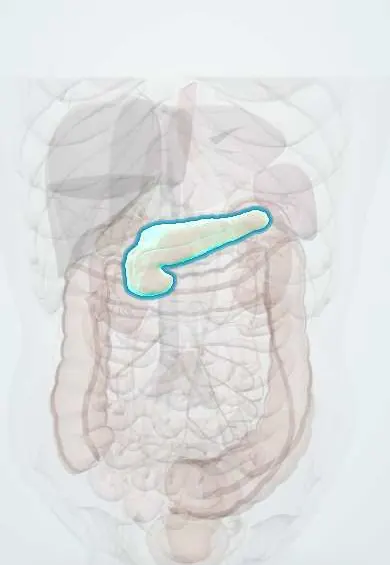
Pancreatic cancer !
Pancreatic cancer is a malignant tumour of the pancreas that is often found late; tumours in its head typically cause jaundice without pain.
Updated 2026-10-30
Structures involved
Tap one to see what it is and open it in 3D.
- Pancreas
- Pancreatic duct
- Common bile duct
- Ampulla of Vater
- Duodenum
- Gallbladder
- Superior mesenteric artery
- Portal vein
- Celiac trunk
In biochemistry
- Alkaline phosphatase (ALP) as a lab test
- Lipase as a lab test
- Tumour markers: principles of use
- Carcinoembryonic antigen (CEA)
- Receptor tyrosine kinases
- Thymidylate synthase
- Oncogenes and tumour suppressor genes
In histology
In the clinical exam
In physiology
Why it happens
- Oncogenes: RAS, MYC, HER2, BCR-ABL and the table to know
- Tumour suppressor genes: RB, TP53, APC, BRCA and the two-hit hypothesis
- Local effects of tumours and cancer cachexia
- The cell cycle in cancer: cyclins, CDKs and checkpoints
- Tumour markers: serum and tissue, and what each one is for
- Tobacco: how smoking injures tissue
Show 2 more
What it is
Malignant tumour of the pancreas, almost always a ductal adenocarcinoma. It is often found late, and tumours in the head typically present with painless jaundice.
Who gets it
Mainly affects older adults, peaking after 60. It is one of the deadliest cancers worldwide and in Latin America, because most cases are found when advanced. Global Burden of Disease estimates for 1990–2019 show incidence rising in 20 of 23 Latin American and Caribbean countries, but falling slightly in Colombia (−0.5% a year).
Causes
- Pancreatic ductal adenocarcinoma (most cases)
- Precursor lesions: pancreatic intraepithelial neoplasia, intraductal papillary mucinous neoplasm, mucinous cystic neoplasm
- Common driver mutations: KRAS, CDKN2A, TP53, SMAD4
- Inherited syndromes: BRCA2 and other hereditary cancer genes, Lynch syndrome, Peutz-Jeghers, hereditary pancreatitis
Risk factors
- Smoking (the main modifiable risk factor)
- Older age
- Family history and inherited cancer syndromes
- Chronic pancreatitis
- Obesity and long-standing diabetes; new-onset diabetes in an older adult may be an early sign
- Heavy alcohol use (through pancreatitis)
Pathophysiology
Precursor lesions gather mutations and become invasive cancer surrounded by a dense fibrous stroma. A tumour in the head blocks the common bile duct and pancreatic duct, causing jaundice and malabsorption. The cancer invades nearby vessels and nerves early and spreads to the liver and peritoneum.
Classification
- Location: head (most common), body, tail
- Resectability on imaging: resectable, borderline resectable, locally advanced, metastatic
- TNM staging
Symptoms and signs
- Painless obstructive jaundice with dark urine, pale stools and itching (tumours of the head)
- Vague epigastric pain radiating to the back (body and tail tumours)
- Weight loss, loss of appetite, fatigue
- Steatorrhoea and new-onset diabetes
- Courvoisier sign: palpable, non-tender gallbladder with jaundice
- Migratory superficial thrombophlebitis (Trousseau sign) or venous thrombosis
Diagnosis
- Clinical
- Jaundice, weight loss and back pain; a palpable gallbladder points to a malignant rather than a stone obstruction.
- Tests
- Liver tests with a cholestatic pattern. CA 19-9 supports the diagnosis and helps follow treatment, but it is not used for screening: it rises in benign bile obstruction and is absent in some people. Tissue by endoscopic ultrasound-guided biopsy; germline genetic testing.
- Imaging
- Multiphase pancreas-protocol CT shows the mass and its relation to the superior mesenteric vessels, portal vein and celiac trunk. Endoscopic ultrasound, MRI with MRCP; CT of the chest for staging.
Differential diagnosis
- Choledocholithiasis
- Chronic pancreatitis (including autoimmune pancreatitis)
- Ampullary or distal bile duct cancer
- Pancreatic neuroendocrine tumour
- Gallbladder cancer
Goal of treatment
Cure the minority with resectable disease by complete resection plus chemotherapy; otherwise extend life and control jaundice, pain, obstruction and malnutrition.
Treatment
- Surgical
- Surgical resection: pancreaticoduodenectomy (Whipple operation) for tumours of the head; distal pancreatectomy with splenectomy for body and tail.
- Medical
- Multi-agent chemotherapy, given after surgery or before it (neoadjuvant) in borderline cases; sometimes with radiotherapy.
- Medical
- Systemic therapy for advanced disease; targeted options for tumours with specific mutations (for example BRCA-related).
- Procedure
- Biliary stenting by ERCP to relieve jaundice; duodenal stent or bypass for gastric outlet obstruction.
- Medical
- Pain control with analgesics and celiac plexus neurolysis; enzyme replacement and nutritional support.
- Conservative
- Early palliative care alongside treatment.
Drugs for this condition
Complications
- Biliary obstruction and cholangitis
- Gastric outlet obstruction
- Liver and peritoneal metastases, ascites
- Venous thromboembolism
- Cachexia
- After Whipple: pancreatic fistula, delayed gastric emptying
Prognosis
Poor overall; most patients are diagnosed when surgery is no longer possible. Survival is best after complete resection followed by chemotherapy, yet recurrence is common.
Prevention
- Not smoking; healthy weight
- Surveillance programmes for selected high-risk inherited cases
Test yourself
Think of the answer, then tap the question to see it.
What is the classic presentation of a carcinoma of the head of the pancreas?
Painless obstructive jaundice with weight loss, dark urine, pale stools and itching.
What is the Courvoisier sign?
A palpable, non-tender gallbladder in a jaundiced patient, suggesting malignant obstruction rather than gallstones.
Why is CA 19-9 not used to screen for pancreatic cancer?
It lacks accuracy: it rises in benign biliary obstruction and some people cannot produce it. It helps monitor response and recurrence.
What operation is used for resectable cancer of the pancreatic head?
Pancreaticoduodenectomy (Whipple operation), usually combined with chemotherapy.
What is the main modifiable risk factor for pancreatic cancer?
Smoking.
Related conditions
Educational information, not medical advice. For any symptom, see a health professional.
Sources: Pancreatic Cancer (StatPearls (NCBI Bookshelf), 2024); The burden of pancreatic cancer in Latin America and the Caribbean: trends in incidence, mortality and DALYs from 1990 to 2019 (Ecancermedicalscience, 2025) · adapted, CC BY 4.0.
Spotted a mistake?We are always improving for the community. Tell us what is wrong and our team will review it.Report a mistake
Representative model, for educational purposes only.