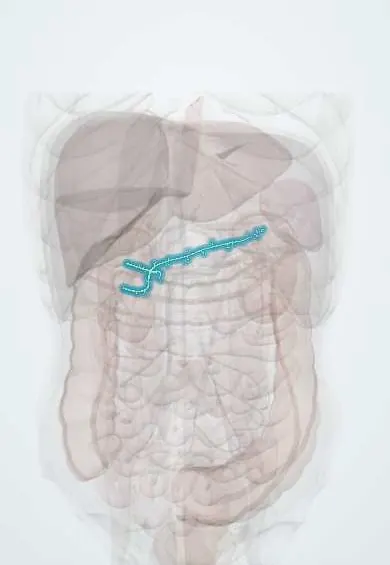
Pancreatic duct !
The pancreatic duct runs through the length of the pancreas and carries its digestive juice to the duodenum, joining the bile duct at the ampulla.
Opens in the Durgical app, no sign-up needed.
What it is
The main duct running the length of the pancreas, joining the bile duct at the ampulla (and a smaller accessory duct).
What it does
Carries digestive enzymes to the duodenum.
Key facts
- Where
- Main duct (Wirsung) runs tail to head; accessory duct (Santorini) in upper head
- Function
- Carries pancreatic juice to the duodenum
- Drains
- Exocrine pancreas
- Into
- Main: with common bile duct at major papilla; accessory: minor papilla about 2 cm higher (varies: pancreas divisum)
Relations
- Course
- Starts in the tail near the splenic hilum, runs through the body and neck collecting side branches in a herringbone pattern, then turns down and back in the head to meet the common bile duct
- Above
- Accessory pancreatic duct (Santorini) in the upper head, opening at the minor duodenal papilla and usually still connected to the main duct
- Behind
- Splenic vein behind the body and tail; in the head, the common bile duct approaches it from the right and behind
How to find it
Reached at ERCP through the major duodenal papilla on the medial wall of the second part of the duodenum; the accessory duct opens on the smaller minor papilla a little higher up. In surgery it is seen in the cut surface of the pancreatic neck, and intraoperative ultrasound helps to find a narrow duct.
On imaging
MRCP shows the duct and its branches without injection; with secretin it shows pancreas divisum and outflow better. ERCP fills it directly when treatment is needed (stones, strictures, leaks). On contrast CT, a dilated duct with an abrupt cut-off points to a mass.
Common problems
- Acute pancreatitis, most often from gallstones or alcohol: severe upper abdominal pain spreading to the back.
- Pancreatic cancer.
- Diabetes (islet cells).
How it is diagnosed
Blood tests (lipase), CT, MRI, endoscopic ultrasound.
Treatment
- Hospital care for pancreatitis; remove gallstones; surgery for some tumours.
Clinical notes
- A torn duct after pancreatitis or trauma leaks pancreatic juice: pseudocyst, pancreatic ascites or fistula; a stent placed at ERCP can bridge the leak
- In chronic pancreatitis, duct stones and strictures can cause pain from high pressure in the duct; they are treated endoscopically or by drainage surgery (lateral pancreaticojejunostomy)
- After a Whipple procedure the duct of the remaining pancreas is joined to the jejunum or stomach; leak from this join (pancreatic fistula) is the main complication
Anatomical variants
- Pancreas divisum: the ventral and dorsal ducts do not fuse, so most juice drains through the accessory duct and the minor papilla; usually silent, possibly linked to recurrent pancreatitis
- The accessory duct may be absent or end blindly before reaching the duodenum
Development
The main duct is formed by the duct of the ventral bud plus the distal part of the dorsal duct; the accessory duct is what remains of the proximal dorsal duct. Pancreas divisum is the failure of this union.
Related conditions
Test yourself
Think of the answer, then tap the question to see it.
Where do the main and the accessory pancreatic ducts open into the duodenum?
The main duct (Wirsung) joins the common bile duct at the major duodenal papilla; the accessory duct (Santorini) opens at the minor papilla, about 2 cm higher.
What is the double duct sign?
Dilatation of both the common bile duct and the main pancreatic duct, classically from a tumour of the pancreatic head or the ampulla blocking them downstream.
What is pancreas divisum?
Failure of the ventral and dorsal pancreatic ducts to fuse, so most pancreatic juice drains through the accessory duct and minor papilla; usually silent, possibly linked to recurrent pancreatitis.
How does the main pancreatic duct look on imaging in chronic pancreatitis?
Irregular and dilated, with clubbed side branches (a «chain of lakes») and calcified stones; stones and strictures can cause pain from high pressure in the duct.
Educational information, not medical advice. For any symptom, see a health professional.
Its names
- Official Latin (TA2)
- ductus pancreaticus; ductus pancreaticus accessorius TA2 3129
- Official Spanish (DeCS)
- Conductos pancreáticos DeCS D010183
- English (TA2)
- Pancreatic duct
- Also called
- pancreatic ducts · ductus pancreaticus major · ductus Wirsungi · duct of Wirsung
Related
Sources: Terminologia Anatomica (TA2); DeCS; Anatomy, Abdomen and Pelvis: Biliary Ducts; 23.6 Accessory Organs in Digestion: The Liver, Pancreas, and Gallbladder (OpenStax (Rice University), 2022) · adapted, CC BY 4.0.
Spotted a mistake?We are always improving for the community. Tell us what is wrong and our team will review it.Report a mistake
Representative model, for educational purposes only.