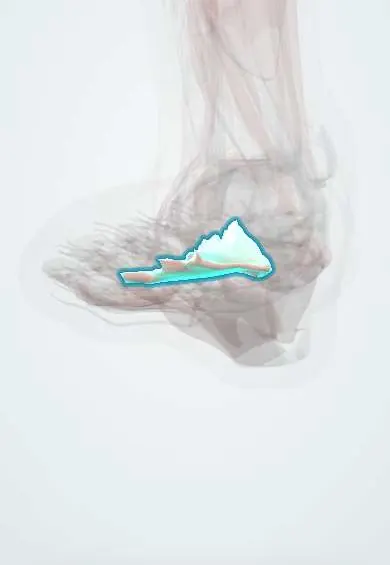
Adductor hallucis !
The adductor hallucis is a deep sole muscle with two heads; it pulls the big toe toward the other toes.
Opens in the Durgical app, no sign-up needed.
What it is
A deep muscle of the sole with two heads: one runs at an angle, the other across the ball of the foot.
What it does
Pulls the big toe toward the other toes and helps support the cross arch.
Key facts
- Origin
- Oblique head: bases of metatarsals 2–4; transverse head: plantar ligaments of MTP joints 3–5
- Insertion
- Lateral base of proximal phalanx of big toe (via lateral sesamoid)
- Action
- Adducts big toe; helps maintain transverse arch
- Nerve
- Lateral plantar nerve, deep branch (S2–S3)
- Blood supply
- Lateral plantar artery; plantar arch and plantar metatarsal arteries
Relations
- Superficial
- Long flexor tendons, lumbricals and flexor digitorum brevis
- Deep
- Interossei and metatarsals; the deep plantar arch and the deep branch of the lateral plantar nerve run between it and the interossei
- Medial
- Lateral head of flexor hallucis brevis and the lateral sesamoid
How to find it
It cannot be felt. In dissection it appears after the first two layers of the sole are removed; in surgery its insertion is reached through the first web space or from inside the big-toe joint.
On imaging
Not seen as such on radiographs, but its pull shows in hallux valgus. On weight-bearing dorsoplantar views the hallux valgus and intermetatarsal angles are measured and the sesamoids are seen drifting lateral to the first metatarsal head. MRI shows its oblique and transverse heads deep in the sole when a plantar mass or injury is assessed.
Common problems
- Like the other small muscles of the foot, it can weaken with age, nerve problems or tight shoes, which can let the arch drop or the toes change shape.
Clinical notes
- Lateral soft-tissue release of its tendon frees the sesamoids during hallux valgus correction
- Lateral plantar nerve lesions weaken it along with most other small muscles of the sole, contributing to clawing
Memory aid
The foot mirrors the hand: like adductor pollicis, it has oblique and transverse heads and is supplied by the deep branch of the foot's ulnar-like nerve, the lateral plantar.
Related conditions
Test yourself
Think of the answer, then tap the question to see it.
What are the two heads of the adductor hallucis, and which nerve supplies it?
Oblique (bases of metatarsals 2–4) and transverse (plantar ligaments of MTP joints 3–5); deep branch of the lateral plantar nerve.
What role does the adductor hallucis play in hallux valgus?
It is a main deforming force; releasing it from the lateral sesamoid and proximal phalanx is part of many bunion operations.
Which hand muscle does the adductor hallucis mirror?
The adductor pollicis: both have oblique and transverse heads and are supplied by the deep branch of the ulnar-like nerve (here, the lateral plantar).
Educational information, not medical advice. For any symptom, see a health professional.
Its names
- Official Latin (TA2)
- adductor hallucis TA2 2676
- Official Spanish (DeCS)
- Músculo aductor del dedo gordo
- English (TA2)
- Adductor hallucis
- Also called
- adductor hallucis muscle
Related
- Flexor hallucis brevis
- Lateral plantar nerve
- Plantar arteries
- Cuboid
- Lateral cuneiform
- First metatarsal
- Second metatarsal
- Third metatarsal
Sources: Terminologia Anatomica (TA2); Anatomy, Bony Pelvis and Lower Limb, Foot Muscles.
Spotted a mistake?We are always improving for the community. Tell us what is wrong and our team will review it.Report a mistake
Representative model, for educational purposes only.