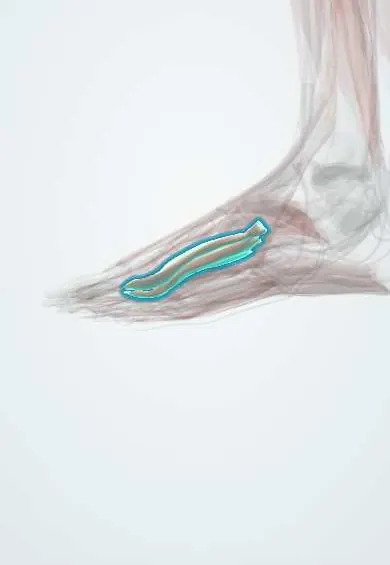
Flexor hallucis brevis !
The flexor hallucis brevis is a short sole muscle that bends the big toe; the two sesamoid bones sit inside its tendons.
Opens in the Durgical app, no sign-up needed.
What it is
A short muscle under the first metatarsal, with two heads. The two sesamoid bones sit in its tendons.
What it does
Bends the big toe at its base and helps push off.
Key facts
- Origin
- Plantar surfaces of cuboid and lateral cuneiform
- Insertion
- Both sides of base of proximal phalanx of big toe, via the two sesamoids
- Action
- Flexes big toe at MTP joint
- Nerve
- Medial plantar nerve (S1–S2) (some texts: S2–S3); lateral head sometimes from the lateral plantar nerve
- Blood supply
- Medial plantar artery; first plantar metatarsal artery
Relations
- Superficial
- Flexor hallucis longus tendon and the plantar fascia
- Deep
- Plantar surface of the first metatarsal
- Medial
- Abductor hallucis
- Lateral
- Oblique head of adductor hallucis, which joins its lateral tendon
How to find it
It lies under the shaft of the first metatarsal. Its two sesamoids are felt as small firm nodules under the first metatarsal head, moving with the tendon when the big toe is flexed and extended.
Examination
- Sesamoid compression with passive dorsiflexion of the big toe: pain under the first metatarsal head that moves with the sesamoid suggests sesamoiditis, a sesamoid fracture or a plantar plate injury
On imaging
Forefoot views, including an axial (sesamoid) view, show the sesamoids. A bipartite sesamoid has smooth, rounded edges, while a fracture has sharp, irregular lines. In hallux valgus the sesamoids appear displaced laterally relative to the metatarsal head.
Common problems
- Like the other small muscles of the foot, it can weaken with age, nerve problems or tight shoes, which can let the arch drop or the toes change shape.
Clinical notes
- Hallux valgus: the sesamoids stay tethered by adductor hallucis while the first metatarsal head drifts medially
- Turf toe: forced hyperextension of the big toe injures the plantar plate and sesamoid complex
- Removing a sesamoid can unbalance the big toe: loss of the medial one favours hallux valgus, loss of the lateral one hallux varus
Anatomical variants
- A bipartite sesamoid, most often the medial one and often on both sides, is a common normal variant
Development
Its two sesamoids start as cartilage in the tendons and ossify in later childhood; when one ossifies from two or more centres that never join, the result is a bipartite sesamoid, which has smooth, rounded edges unlike a fracture.
Test yourself
Think of the answer, then tap the question to see it.
What is held within the two tendons of the flexor hallucis brevis, and what runs between them?
The two sesamoids of the big toe; the flexor hallucis longus tendon runs in the groove between them.
What are the action and nerve supply of the flexor hallucis brevis?
It flexes the big toe at the MTP joint; medial plantar nerve.
On imaging, how is a bipartite sesamoid told apart from a fracture?
A bipartite sesamoid has smooth, rounded edges; a fracture has sharp, irregular lines.
Educational information, not medical advice. For any symptom, see a health professional.
Its names
- Official Latin (TA2)
- flexor brevis hallucis TA2 2673
- Official Spanish (DeCS)
- Músculo flexor corto del dedo gordo
- English (TA2)
- Flexor hallucis brevis
- Also called
- flexor hallucis brevis muscle
Related
- Sesamoids
- Adductor hallucis
- Abductor hallucis
- Medial plantar nerve
- Plantar arteries
- Medial cuneiform
- First metatarsal
- Big toe
Sources: Terminologia Anatomica (TA2); Anatomy, Bony Pelvis and Lower Limb, Foot Muscles.
Spotted a mistake?We are always improving for the community. Tell us what is wrong and our team will review it.Report a mistake
Representative model, for educational purposes only.