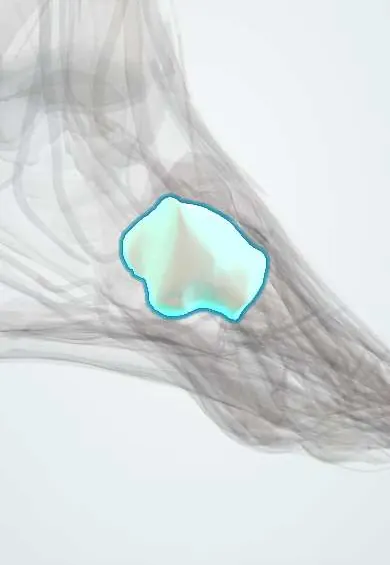
Cuboid !
The cuboid is a cube-shaped bone on the outer side of the midfoot, in front of the heel bone.
Official name: Cuboid bone
Opens in the Durgical app, no sign-up needed.
What it is
A cube-shaped bone on the outer side of the midfoot, between the heel bone and the fourth and fifth metatarsals.
What it does
Supports the outer arch. The fibularis longus tendon runs in a groove under it.
Key facts
- Joints with
- Calcaneus; metatarsals 4–5; lateral cuneiform; sometimes navicular
- Landmarks
- Plantar groove for fibularis longus tendon; cuboid tuberosity; key bone of lateral column
Relations
- Behind
- Calcaneus at the calcaneocuboid joint, the lateral half of the transverse tarsal (Chopart) joint
- In front
- Bases of the fourth and fifth metatarsals
- Medial
- Lateral cuneiform and sometimes the navicular
- Below
- Fibularis longus tendon in its groove; long and short plantar ligaments
- Lateral
- Fibularis brevis tendon on its way to the fifth metatarsal tuberosity; the sural nerve along the outer foot
- Above
- Extensor digitorum brevis, arising from the calcaneus, covers its dorsum
How to find it
Felt on the lateral side of the foot in the hollow just behind the prominent base of the fifth metatarsal, with the calcaneocuboid joint a little further back. The fibularis longus tendon can be traced down to the groove under it.
On imaging
Often missed on routine views; the oblique foot view shows it and its joints best, and the medial border of the fourth metatarsal should line up with the medial border of the cuboid. CT for nutcracker fractures and lateral column length. A displaced or split os peroneum suggests a fibularis longus tear.
Common problems
- Fractures, sometimes from the forefoot being forced outward; 'cuboid syndrome', a painful slight shift of the bone after sprains.
Clinical notes
- Injuries of the transverse tarsal (Chopart) joint are easily missed and later cause midfoot pain and deformity
- Painful os peroneum syndrome: pain at the lateral cuboid from the ossicle in the fibularis longus tendon
Anatomical variants
- Os peroneum, an ossicle in the fibularis longus tendon beside the cuboid; its frequency varies between populations
Development
Ossifies around birth, so it is usually visible on newborn X-rays.
Related conditions
Test yourself
Think of the answer, then tap the question to see it.
Which tendon runs in the groove on the plantar surface of the cuboid?
The fibularis longus tendon, turned medially across the sole to the medial cuneiform and first metatarsal base.
What is a nutcracker fracture of the cuboid?
A crush of the cuboid between the calcaneus and the bases of the fourth and fifth metatarsals when the forefoot is forced outwards.
Which bones articulate with the cuboid?
The calcaneus, the fourth and fifth metatarsals, the lateral cuneiform and sometimes the navicular.
Educational information, not medical advice. For any symptom, see a health professional.
Its names
- Official Latin (TA2)
- os cuboideum TA2 1489
- Official Spanish (DeCS)
- Hueso cuboides DeCS D013639
- English (TA2)
- Cuboid bone
- Also called
- os cuboides
Related
- Calcaneus
- Lateral cuneiform
- Fourth metatarsal
- Fifth metatarsal
- Bifurcate ligament
- Adductor hallucis
- Extensor digitorum brevis
- Extensor hallucis brevis
Sources: Terminologia Anatomica (TA2); DeCS; Anatomy, Bony Pelvis and Lower Limb: Foot and Ankle.
Spotted a mistake?We are always improving for the community. Tell us what is wrong and our team will review it.Report a mistake
Representative model, for educational purposes only.