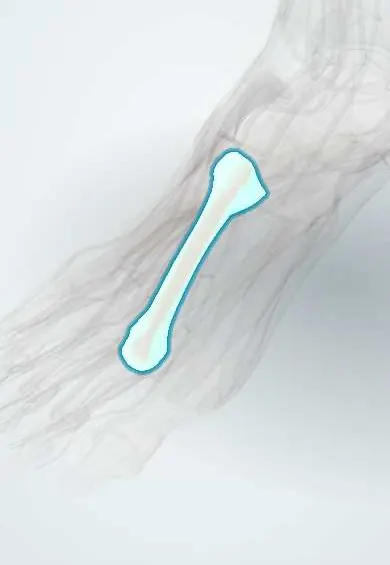
Second metatarsal !
The second metatarsal is the longest foot bone behind the second toe; its base locks into the midfoot like a keystone.
Official name: Second
Opens in the Durgical app, no sign-up needed.
What it is
The longest metatarsal, behind the second toe. Its base locks into a notch among the cuneiforms like a keystone.
What it does
The metatarsals spread weight across the ball of the foot and act as levers when you push off.
Key facts
- Joints with
- All three cuneiforms; third metatarsal; proximal phalanx of second toe
- Landmarks
- Longest metatarsal; base keyed into cuneiform recess (keystone of tarsometatarsal joint); Lisfranc ligament; common stress (march) fracture site
Relations
- Behind
- Base locked between the medial, intermediate and lateral cuneiforms; Lisfranc ligament to the medial cuneiform
- In front
- Head with the plantar plate and the proximal phalanx of the second toe
- Medial
- First intermetatarsal space with the first dorsal interosseous and the deep plantar artery
- Lateral
- Third metatarsal and the second dorsal interosseous
- Below
- Oblique head of adductor hallucis from the bases of metatarsals 2–4; plantar interossei of the neighbouring rays
- Above
- Extensor digitorum longus tendon to the second toe; the dorsalis pedis artery near its base
How to find it
Followed on the dorsum from its base, just in front of the intermediate cuneiform, to the head. Under the ball of the foot its head is often the most prominent. Localised dorsal tenderness and swelling over the shaft suggest a stress fracture.
Examination
- Vertical stress (drawer) test of the second toe: lifting the toe straight up on the steadied metatarsal head; pain and extra upward glide suggest a plantar plate tear
On imaging
Stress fractures often show only after 2–3 weeks, as periosteal new bone; MRI or bone scan shows them earlier. Standing AP view for its alignment with the intermediate cuneiform. In Freiberg disease the head is flattened and sclerotic.
Common problems
- Stress fractures, common in runners and military recruits ('march fracture').
- Pain under its head (metatarsalgia).
Clinical notes
- Weil osteotomy shortens a long second metatarsal to unload its head
- Second metatarsal base fractures in a twisting or crushing midfoot injury warrant a search for Lisfranc instability
Anatomical variants
- The second metatarsal is usually the longest; a markedly long one, often with a second toe longer than the big toe (Morton or Greek foot), is a common variant
Development
Its secondary centre is at the head, as in metatarsals 3–5.
Related conditions
Test yourself
Think of the answer, then tap the question to see it.
Which metatarsal is the commonest site of march fracture?
The second metatarsal, usually at the neck or distal shaft.
What is Freiberg disease?
Osteonecrosis of a metatarsal head, most often the second, typically in adolescent girls.
Why does a fracture at the base of the second metatarsal raise concern for a Lisfranc injury?
The base is the keystone locked among the cuneiforms; fracture or displacement there is the hallmark of a Lisfranc injury.
Why can a long second metatarsal cause problems at its head?
It overloads the head: metatarsalgia, plantar plate tears and a crossover second toe.
Educational information, not medical advice. For any symptom, see a health professional.
Its names
- Official Latin (TA2)
- os metatarsi II TA2 1496
- Official Spanish (DeCS)
- Segundo metatarsiano DeCS D008682
- English (TA2)
- Second
Related
- Intermediate cuneiform
- Second toe
- Lisfranc ligaments
- Adductor hallucis
- Dorsal interossei
- Toe extensor tendons
- Extensor digitorum brevis
- Extensor hallucis brevis
Sources: Terminologia Anatomica (TA2); DeCS; Anatomy, Bony Pelvis and Lower Limb: Metatarsal Bones.
Spotted a mistake?We are always improving for the community. Tell us what is wrong and our team will review it.Report a mistake
Representative model, for educational purposes only.