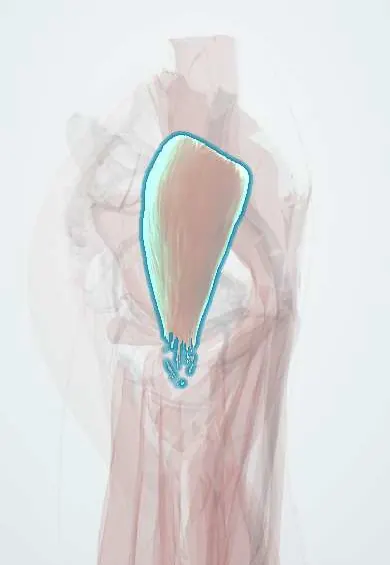
Gluteus minimus !
The gluteus minimus is the smallest and deepest buttock muscle, on the outer hip bone; it helps keep the pelvis level when walking.
Official name: Gluteus minimus muscle
Opens in the Durgical app, no sign-up needed.
What it is
The smallest and deepest gluteal muscle, under the gluteus medius. It runs from the outer pelvis to the front of the greater trochanter.
What it does
Helps the gluteus medius keep the pelvis level, moves the leg out to the side and helps turn the thigh inward.
Key facts
- Origin
- External ilium between anterior and inferior gluteal lines
- Insertion
- Anterior surface of greater trochanter
- Action
- Abducts and medially rotates hip; keeps pelvis level in single-leg stance
- Nerve
- Superior gluteal nerve (L4–S1)
- Blood supply
- Superior gluteal artery (deep branch)
Relations
- Superficial
- Gluteus medius, with the superior gluteal nerve and the deep branch of the superior gluteal artery between them
- Deep
- Outer surface of the ilium, the reflected head of the rectus femoris and the upper hip joint capsule
- Below
- Piriformis and superior gemellus
- In front
- Tensor fasciae latae
How to find it
Not palpable on its own: it lies under the gluteus medius. It is identified in hip approaches as the deepest layer on the ilium, or on ultrasound and MRI by its tendon on the front of the greater trochanter.
Examination
- Trendelenburg test: in single-leg stance the pelvis should stay level or lift slightly on the raised side; a drop on that side means the gluteus medius and minimus of the standing leg, or their superior gluteal nerve, are failing
On imaging
Ultrasound of the lateral hip uses the bony facets of the greater trochanter as landmarks: the gluteus minimus tendon lies on the anterior facet, the gluteus medius tendon on the lateral and superoposterior facets; a thickened, dark (hypoechoic) tendon suggests tendinopathy.
Common problems
- Gluteal tendinopathy: wear and pain of its tendon at the outer hip, common in women over 40 and in runners. It is the main cause of greater trochanteric pain syndrome.
- Tendon tears, sometimes called a 'rotator cuff tear of the hip'.
- Weakness causes a limp where the pelvis drops on the other side (Trendelenburg gait).
How it is diagnosed
Physical exam: tenderness over the outer hip, pain when standing on one leg, and strength testing. Ultrasound or MRI shows tendon damage or tears.
Treatment
- Physical therapy with progressive loading exercises; avoiding crossing the legs and lying on the sore side.
- Injections or shock wave therapy for pain that does not settle.
- Surgical repair of the tendon (open or endoscopic) for significant tears.
Clinical notes
- Anterior and lateral hip approaches, and screws placed in the outer ilium, can damage the muscle or its nerve
- After hip arthroplasty, damage to the abductors (gluteus medius and minimus) can cause a limp and contribute to instability
Anatomical variants
- It may be divided into front and back parts, and may send fibres to the piriformis or the superior gemellus
Development
Develops with the gluteus medius and the tensor fasciae latae from the dorsal muscle mass of the limb bud; the three keep one nerve, the superior gluteal.
Related conditions
Test yourself
Think of the answer, then tap the question to see it.
Where does the gluteus minimus insert, compared with the gluteus medius?
On the anterior facet of the greater trochanter; the gluteus medius uses the lateral and superoposterior facets.
Which nerve supplies the gluteus minimus, and where does it run?
The superior gluteal nerve (L4–S1), running between the gluteus medius and gluteus minimus.
What are the actions of the gluteus minimus?
It abducts and medially rotates the hip and helps keep the pelvis level in single-leg stance.
Educational information, not medical advice. For any symptom, see a health professional.
Its names
- Official Latin (TA2)
- musculus gluteus minimus TA2 2600
- Official Spanish (DeCS)
- Músculo glúteo menor
- English (TA2)
- Gluteus minimus muscle
- Also called
- musculus glutaeus minimus
Related
Sources: Terminologia Anatomica (TA2); Anatomy, Bony Pelvis and Lower Limb, Gluteus Minimus Muscle.
Spotted a mistake?We are always improving for the community. Tell us what is wrong and our team will review it.Report a mistake
Representative model, for educational purposes only.