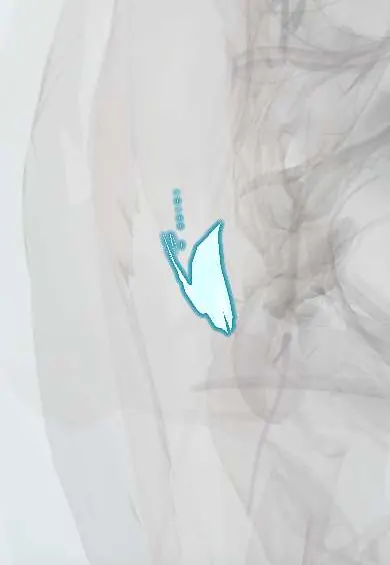
Gluteus medius tendon !
The gluteus medius tendon attaches to the bony point of the outer hip (greater trochanter); it is a common source of side-hip pain.
Official name: Tendon of gluteus medius
Opens in the Durgical app, no sign-up needed.
What it is
The tendon of the gluteus medius, attaching to the greater trochanter on the outer hip. This is where gluteal tendinopathy and tears happen.
What it does
Carries the pull of the gluteus medius to the femur to keep the pelvis level.
Key facts
- Attaches
- Lateral and superoposterior facets of the greater trochanter
- Function
- Abducts the hip and keeps the pelvis level in single-leg stance; its tendinopathy or tear (the 'rotator cuff of the hip') is a main cause of greater trochanteric pain syndrome
- Tight in
- Hip adduction (crossing the legs)
Relations
- Superficial
- IT band, gluteus maximus and tensor fasciae latae, with the trochanteric bursae between
- Deep
- Gluteus minimus tendon, with a small bursa between them
- In front
- Tensor fasciae latae and the gluteus minimus insertion on the anterior facet
- Behind
- Piriformis tendon
How to find it
Lying on the side, the tip and outer surface of the greater trochanter are felt; tenderness just above and behind the tip, with pain on resisted abduction, points to the tendon.
Examination
- Trendelenburg test: standing on the affected leg, the opposite side of the pelvis drops if the abductors are weak
- Single-leg stance for 30 seconds: lateral hip pain within that time suggests gluteal tendinopathy
- Resisted external derotation test: lateral hip pain when the bent, outwardly rotated hip is brought back to neutral against resistance suggests gluteal tendinopathy
On imaging
Ultrasound shows a thickened, hypoechoic tendon, calcification, tears and bursal fluid; MRI shows tendon signal change, tears, fatty change of the muscle and oedema over the trochanter.
Common problems
- Gluteal tendinopathy: wear and pain of its tendon at the outer hip, common in women over 40 and in runners. It is the main cause of greater trochanteric pain syndrome.
- Tendon tears, sometimes called a 'rotator cuff tear of the hip'.
- Weakness causes a limp where the pelvis drops on the other side (Trendelenburg gait).
How it is diagnosed
Physical exam: tenderness over the outer hip, pain when standing on one leg, and strength testing. Ultrasound or MRI shows tendon damage or tears.
Treatment
- Physical therapy with progressive loading exercises; avoiding crossing the legs and lying on the sore side.
- Injections or shock wave therapy for pain that does not settle.
- Surgical repair of the tendon (open or endoscopic) for significant tears.
Clinical notes
- Tears can be repaired endoscopically or through an open approach; chronic tears with fatty muscle may need a muscle transfer
- After hip replacement through a lateral approach, failed healing of the abductors is a cause of limp and lateral hip pain
Development
Its insertion, the greater trochanter, ossifies from a separate centre that appears around the fourth year and fuses with the shaft in adolescence; until then a violent abductor pull can, rarely, avulse the trochanteric apophysis.
Related conditions
Test yourself
Think of the answer, then tap the question to see it.
Where does the gluteus medius tendon insert?
On the lateral and superoposterior facets of the greater trochanter.
What is the commonest cause of pain over the greater trochanter?
Gluteal tendinopathy, rather than pure bursitis; the trochanteric bursae are often involved secondarily.
What does a positive Trendelenburg test show?
Weak hip abductors: standing on the affected leg, the opposite side of the pelvis drops.
Which nerve is endangered if the gluteus medius is split too high in a lateral hip approach?
The superior gluteal nerve, running between the gluteus medius and minimus about 5 cm above the trochanter tip.
Educational information, not medical advice. For any symptom, see a health professional.
Its names
- Official Latin (TA2)
- musculus gluteus medius TA2 2599
- Official Spanish (DeCS)
- Tendón del glúteo medio DeCS D013710
- English (TA2)
- Tendon of gluteus medius
- Also called
- musculus glutaeus medius
Related
Sources: Terminologia Anatomica (TA2); DeCS; Anatomy, Bony Pelvis and Lower Limb, Gluteus Medius Muscle; 8.5 Development of the Appendicular Skeleton (OpenStax (Rice University), 2022) · adapted, CC BY 4.0.
Spotted a mistake?We are always improving for the community. Tell us what is wrong and our team will review it.Report a mistake
Representative model, for educational purposes only.