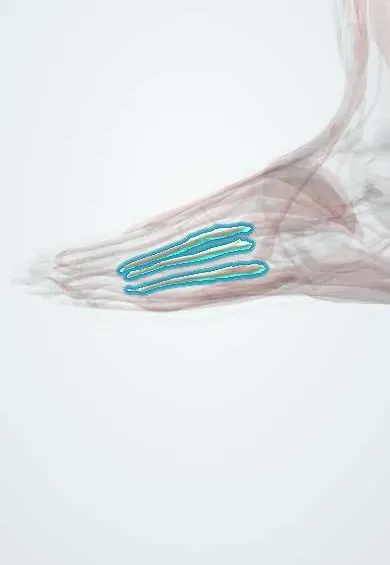
Plantar interossei !
The plantar interossei are three muscles under the outer metatarsals that bring the toes together.
Official name: Plantar interossei muscles
Opens in the Durgical app, no sign-up needed.
What it is
Three muscles under the third, fourth and fifth metatarsals.
What it does
Bring the toes together and help bend the toes at the base.
Key facts
- Origin
- Three unipennate muscles from bases and medial sides of metatarsals 3–5
- Insertion
- Medial sides of bases of proximal phalanges of toes 3–5
- Action
- Adduct toes 3–5 toward second toe (PAD); flex MTP joints
- Nerve
- Lateral plantar nerve (S2–S3)
- Blood supply
- Plantar metatarsal arteries (plantar arch)
Relations
- Above
- Dorsal interossei and metatarsals 3–5
- Below
- Adductor hallucis, the deep plantar arch with the deep branch of the lateral plantar nerve, and the long flexor tendons
- Course
- Their tendons pass forward, dorsal to the deep transverse metatarsal ligament, to the medial side of the proximal phalanges
How to find it
They cannot be felt. In dissection they appear in the fourth layer once the long flexor tendons and adductor hallucis are removed; on coronal MRI they lie on the plantar side of the lateral metatarsals.
On imaging
Not seen on radiographs. On MRI they lie in the deepest layer of the sole along the plantar side of metatarsals 3 to 5; short-axis images separate them from the dorsal interossei. Fatty atrophy of the interossei and other intrinsic foot muscles suggests a lateral plantar nerve lesion or a peripheral neuropathy such as diabetic neuropathy.
Common problems
- Like the other small muscles of the foot, it can weaken with age, nerve problems or tight shoes, which can let the arch drop or the toes change shape.
Clinical notes
- Ischaemic contracture after foot compartment syndrome involving the interosseous compartments can leave claw toes
- Lateral plantar nerve lesions weaken them with the other interossei, leading to clawing
Memory aid
"PAD": Plantar ADduct. The big toe and second toe have none: the big toe has adductor hallucis and the second toe is the axis.
Test yourself
Think of the answer, then tap the question to see it.
What are the origin and action of the plantar interossei?
Three unipennate muscles from metatarsals 3–5; they adduct toes 3–5 toward the second toe («PAD») and flex the MTP joints.
Which nerve supplies the plantar interossei?
The lateral plantar nerve.
Why do the big toe and second toe have no plantar interosseous?
The big toe has the adductor hallucis, and the second toe is the axis of movement.
Educational information, not medical advice. For any symptom, see a health professional.
Its names
- Official Latin (TA2)
- musculi interossei plantares TA2 2687
- Official Spanish (DeCS)
- Músculos interóseos plantares
- English (TA2)
- Plantar interossei muscles
- Also called
- plantar interossei muscles 1-3
Related
- Dorsal interossei
- Lateral plantar nerve
- Plantar arteries
- Third metatarsal
- Fourth metatarsal
- Fifth metatarsal
- Third toe
- Fourth toe
Sources: Terminologia Anatomica (TA2); Anatomy, Bony Pelvis and Lower Limb, Foot Muscles.
Spotted a mistake?We are always improving for the community. Tell us what is wrong and our team will review it.Report a mistake
Representative model, for educational purposes only.