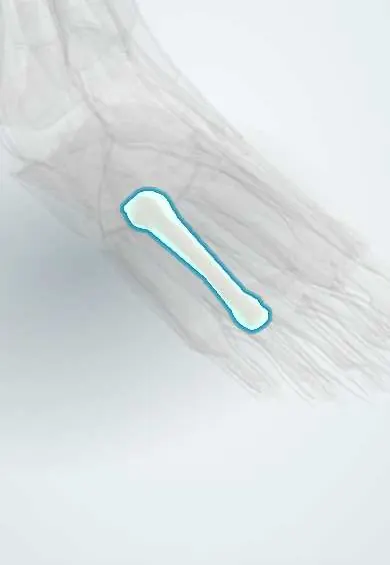
Fourth metatarsal !
The fourth metatarsal is one of the five long bones of the forefoot, behind the fourth toe; it forms the mobile outer side with the fifth.
Official name: Fourth
Opens in the Durgical app, no sign-up needed.
What it is
One of the five long bones of the forefoot, behind the fourth toe.
What it does
The metatarsals spread weight across the ball of the foot and act as levers when you push off.
Key facts
- Joints with
- Cuboid and lateral cuneiform; metatarsals 3 and 5; proximal phalanx of fourth toe
- Landmarks
- Base, shaft and head; dorsal and plantar interossei attach
Relations
- Behind
- Cuboid and the side of the lateral cuneiform
- In front
- Proximal phalanx of the fourth toe
- Medial
- Third metatarsal with the third dorsal interosseous; the third web space with the common plantar digital nerve
- Lateral
- Fifth metatarsal with the fourth dorsal interosseous
- Below
- Origin of the second plantar interosseous; oblique head of adductor hallucis near the base
How to find it
Followed from its base, just in front of the cuboid, to its head behind the fourth toe; the shaft is felt on the dorsum between the extensor digitorum longus tendons to the fourth and fifth toes.
On imaging
Oblique foot view for alignment with the cuboid in suspected Lisfranc injuries. In brachymetatarsia, standing views show the short metatarsal and its head lying behind the curve of the other heads.
Common problems
- Stress fractures, common in runners and military recruits ('march fracture').
- Pain under its head (metatarsalgia).
Clinical notes
- Fourth metatarsal base fractures can be part of a Lisfranc injury and are checked against the cuboid line
- In brachymetatarsia the fourth toe sits short and often riding up; the bone can be lengthened surgically
Anatomical variants
- Brachymetatarsia, more frequent in women and often in both feet; it can occur alone or with conditions such as Turner syndrome or pseudohypoparathyroidism
Development
Its secondary centre is at the head; early closure of this growth plate produces brachymetatarsia.
Related conditions
Test yourself
Think of the answer, then tap the question to see it.
Why is the joint between the fourth metatarsal and the cuboid spared in midfoot fusions?
The lateral column (fourth and fifth metatarsals) is mobile, and this motion is needed for a comfortable gait.
Which metatarsal is most often affected by brachymetatarsia?
The fourth metatarsal; the fourth toe sits short and often rides up.
On the oblique foot view, which alignment is checked for the fourth metatarsal?
The medial border of its base lines up with the medial border of the cuboid.
Educational information, not medical advice. For any symptom, see a health professional.
Its names
- Official Latin (TA2)
- os metatarsi IV TA2 1496
- Official Spanish (DeCS)
- Cuarto metatarsiano DeCS D008682
- English (TA2)
- Fourth
Related
- Cuboid
- Fourth toe
- Adductor hallucis
- Dorsal interossei
- Toe extensor tendons
- Extensor digitorum brevis
- Toe flexor tendon
- Long plantar ligament
Sources: Terminologia Anatomica (TA2); DeCS; Anatomy, Bony Pelvis and Lower Limb: Metatarsal Bones.
Spotted a mistake?We are always improving for the community. Tell us what is wrong and our team will review it.Report a mistake
Representative model, for educational purposes only.