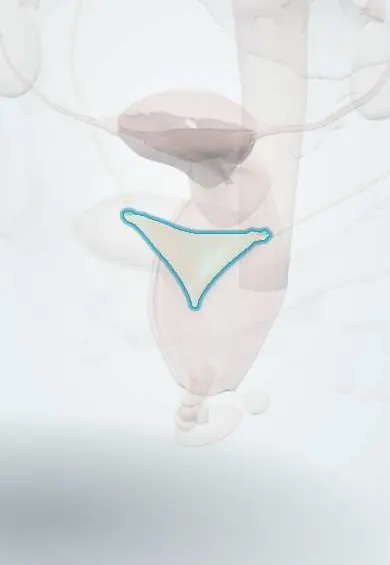
Trigone of bladder !
The trigone is the smooth triangle at the base of the bladder, between the openings of the two ureters and the urethra; it lies on the front wall of the vagina.
Opens in the Durgical app, no sign-up needed.
What it is
The smooth triangle at the base of the bladder between the two ureter openings and the urethra.
What it does
Funnels urine into the urethra; it lies on the front wall of the vagina.
Key facts
- Where
- Smooth triangle on the bladder base between the two ureteric orifices and the internal urethral orifice; rests on the anterior vaginal wall
- Function
- Smooth muscle continuous with the ureters; funnels urine to the urethra; sensitive to stretch
Relations
- Behind
- Female: the anterior vaginal wall and, above it, the cervix. Male: the seminal glands and the ends of the ductus deferens, with the rectum behind them
- Below
- The bladder neck and internal urethral orifice, leading into the urethra; in the male the base of the prostate lies directly below
- Lateral
- The ureters, entering obliquely at its upper corners
- Deep
- Trigonal smooth muscle, continuous with the ureteric muscle, over the detrusor
How to find it
It cannot be felt. At cystoscopy the scope enters through the internal urethral orifice and is angled back and to each side to find the ureteric orifices at the ends of the interureteric ridge; watching a jet of urine from each one confirms which opening is which.
On imaging
At cystoscopy it is the pale, smooth triangle at the bladder base; the interureteric ridge leads to the ureteric orifices, which can be seen squirting urine. On colour Doppler ultrasound the ureteric jets appear at its upper corners.
Common problems
- Bladder infections (cystitis), much more common in women.
- Overactive bladder and incontinence.
- Cystocele: the bladder bulges into the front wall of the vagina.
- Injury risk in a caesarean section or hysterectomy, so it is moved away and emptied with a catheter.
How it is diagnosed
Urine test and culture; bladder diary; ultrasound; cystoscopy in some cases.
Treatment
- Antibiotics for infections; bladder training and medicines for overactive bladder.
- Anterior repair for a cystocele.
Clinical notes
- Main landmark at cystoscopy for passing catheters or stents up the ureters (retrograde pyelography)
- Male: an enlarged middle lobe of the prostate lifts the area just behind the internal urethral orifice and can block outflow
- Female: cystocele repair and anterior vaginal wall surgery work just beneath the trigone and the ureteric orifices
Anatomical variants
- Ectopic ureteric orifice, usually from the upper-pole ureter of a duplex kidney, opening below and medial to the normal site (Weigert–Meyer rule); in girls it can open into the urethra or vestibule and cause constant dribbling despite normal voiding
Development
Classically taught to form where the ends of the mesonephric ducts are absorbed into the back of the urogenital sinus, which explains its distinct smooth surface (some texts describe a mainly sinus origin).
Related conditions
Test yourself
Think of the answer, then tap the question to see it.
What are the three corners of the trigone of the bladder?
The two ureteric orifices above and to the sides and the internal urethral orifice below; the interureteric ridge joins the ureteric orifices.
Why does the trigone of the bladder stay smooth whether the bladder is full or empty?
Its lining is bound tightly to the muscle beneath; the rest of the bladder lining folds into rugae when empty.
What predisposes to vesicoureteral reflux at the trigone?
A short intramural ureteric segment; normally the oblique path through the bladder wall acts as a valve.
According to the Weigert–Meyer rule, where does the upper-pole ureter of a duplex kidney open?
Below and medial to the normal site; in girls it can open into the urethra or vestibule, causing constant dribbling despite normal voiding.
Educational information, not medical advice. For any symptom, see a health professional.
Its names
- Official Latin (TA2)
- trigonum vesicae TA2 3421
- Official Spanish (DeCS)
- Trígono vesical
- English (TA2)
- Trigone of bladder
- Also called
- trigonum Lieutaudi · Lieutaud's trigone
Sources: Terminologia Anatomica (TA2); Anatomy, Abdomen and Pelvis: Bladder; 25.2 Gross Anatomy of Urine Transport (OpenStax (Rice University), 2022) · adapted, CC BY 4.0.
Spotted a mistake?We are always improving for the community. Tell us what is wrong and our team will review it.Report a mistake
Representative model, for educational purposes only.