Conditions · Metabolism: amino acids and the urea cycle
Cystinuria !
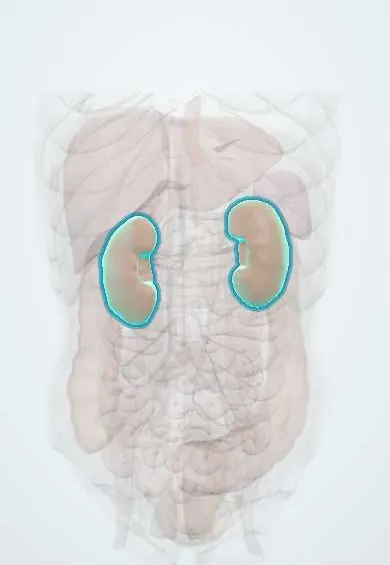
In cystinuria the kidney does not reabsorb cystine, which is poorly soluble and forms repeated urinary stones from a young age.
Updated 2026-11-01
Structures involved
Tap one to see what it is and open it in 3D.
In biochemistry
- Membrane structure
- Membrane transport
- Urinalysis
- Amino acids: structure, charge and pKa
- Protein structure and folding
In physiology
What it is
An inherited disorder of amino acid transport in the renal proximal tubule and the gut. Cystine, ornithine, lysine and arginine are lost in urine.
Who gets it
It affects about 1 in 10,000 people and causes a small share of kidney stones, but a larger share in children.
Causes
- Variants in SLC3A1 or SLC7A9, the two subunits of the dibasic amino acid and cystine transporter
Risk factors
- Family history
- Low water intake
- Acidic urine
- Diet high in sodium and animal protein
Pathophysiology
The brush-border transporter does not recover cystine or the dibasic amino acids (ornithine, lysine, arginine; mnemonic COLA). Cystine is poorly soluble in acidic urine and crystallises as hexagons that form stones. The other amino acids are lost without clinical effect.
Symptoms and signs
- Recurrent renal colic
- Haematuria
- Urinary infections
- Stones from childhood or youth
Diagnosis
- Clinical
- Recurrent stones in a young person or with a family history.
- Tests
- Hexagonal crystals in urine sediment; positive cyanide–nitroprusside test; high 24-hour urinary cystine; stone analysis; genetic testing.
- Imaging
- Non-contrast CT or ultrasound to locate the stones; they are faintly radio-opaque on plain X-ray.
Treatment
- Lifestyle
- Plenty of water day and night, less salt and less animal protein
- Medical
- Alkalinising urine with potassium citrate so cystine dissolves better
- Medical
- Thiol drugs (tiopronin, D-penicillamine) that form a soluble compound with cysteine
- Procedure
- Ureteroscopy or percutaneous nephrolithotomy for stones that do not pass
Complications
- Urinary obstruction
- Pyelonephritis
- Chronic kidney disease from stones and repeated procedures
Prognosis
A lifelong disease with frequent recurrences; well-kept hydration and alkalinisation reduce stones.
Test yourself
Think of the answer, then tap the question to see it.
Which amino acids are lost in urine in cystinuria?
Cystine, ornithine, lysine and arginine (COLA), from failure of one proximal tubule transporter.
What shape are cystine crystals?
Flat hexagons in urine sediment.
Why is urine alkalinised in cystinuria?
Cystine is much more soluble in alkaline urine, so it crystallises less.
Related conditions
Educational information, not medical advice. For any symptom, see a health professional.
Sources: Cystinuria: MedlinePlus Genetics (MedlinePlus, US National Library of Medicine, 2026); SLC3A1 gene: MedlinePlus Genetics (MedlinePlus, US National Library of Medicine, 2026); Amino acid transport across the plasma membrane (Reactome, 2026).
Spotted a mistake?We are always improving for the community. Tell us what is wrong and our team will review it.Report a mistake
Representative model, for educational purposes only.