Conditions · Gastroenterology and hepatology
Eosinophilic oesophagitis !
A chronic allergic inflammation of the oesophagus that causes trouble swallowing and food getting stuck, often in young people with allergies.
Updated 2026-11-01
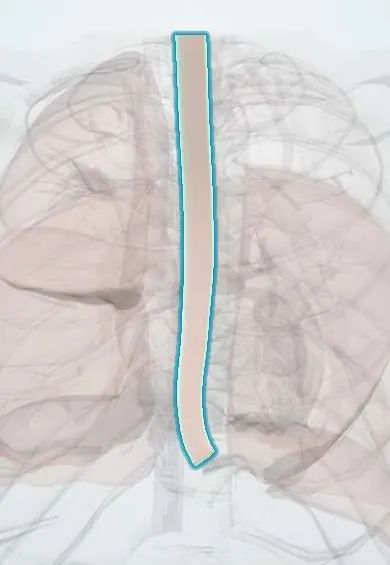
Structures involved
Tap one to see what it is and open it in 3D.
Why it happens
- Chronic inflammation: causes, cells and features
- Fibrosis in organs: TGF-β and the myofibroblast
- Innate and adaptive immunity: overview
- Esophagus and the Barrett change
What it is
A chronic, immune- or antigen-mediated disease of the oesophagus defined by symptoms of oesophageal dysfunction and dense eosinophilic infiltration of the mucosa (at least 15 eosinophils per high-power field), after other causes are excluded.
Who gets it
Recognised increasingly worldwide over the last three decades; it is a leading cause of food impaction in young adults. It predominates in males and in people with atopy. Data from Colombia and Latin America are fewer but show the same pattern, with diagnoses rising as endoscopy and biopsy practice spread.
Causes
- Type 2 (allergic) immune response to food antigens, most often milk, wheat, egg, soy, nuts and seafood
- Aeroallergens may contribute, with seasonal flares in some patients
- Genetic susceptibility affecting the epithelial barrier and the type 2 immune pathway
Risk factors
- Male sex
- Personal or family history of atopy: asthma, allergic rhinitis, atopic dermatitis, food allergy
- Family history of eosinophilic oesophagitis
- Childhood or young adulthood
Pathophysiology
Food antigens cross a weakened oesophageal epithelium and trigger a type 2 inflammatory response driven by cytokines such as interleukin 4, 5 and 13. Eosinophils and mast cells infiltrate the mucosa and release mediators that cause oedema, dysmotility and, over time, subepithelial fibrosis. Untreated inflammation remodels the oesophagus into a narrow, rigid tube, which explains food impaction.
Classification
- Inflammatory phenotype (oedema, furrows, exudates)
- Fibrostenotic phenotype (rings, strictures, narrow-calibre oesophagus)
Symptoms and signs
- Dysphagia to solid foods in adolescents and adults
- Food impaction (food bolus getting stuck)
- Chest pain or heartburn that does not respond to acid suppression
- Coping habits: eating slowly, chewing a lot, drinking water with each bite, avoiding meat and bread
- In infants and children: feeding difficulty, vomiting, abdominal pain and poor weight gain
Diagnosis
- Clinical
- Suspected in a young person, often atopic, with solid-food dysphagia or food impaction, or with reflux-like symptoms that do not respond to acid suppression.
- Tests
- Upper endoscopy with at least six biopsies from the proximal and distal oesophagus; the diagnosis requires at least 15 eosinophils per high-power field and exclusion of other causes. Endoscopy may show rings (trachealisation), longitudinal furrows, white exudates, oedema and strictures, but it can look normal.
- Imaging
- Barium oesophagram can show a narrow-calibre oesophagus or strictures and helps plan dilation.
Differential diagnosis
- Gastro-oesophageal reflux disease
- Infectious oesophagitis (Candida, herpes simplex, cytomegalovirus)
- Achalasia and other motility disorders
- Pill-induced oesophagitis
- Eosinophilic gastrointestinal disease beyond the oesophagus, hypereosinophilic syndrome
Goal of treatment
Control the eosinophilic inflammation to relieve dysphagia, prevent fibrosis and strictures, and treat food impaction safely.
Treatment
- Medical
- Proton pump inhibitors, which induce remission in a proportion of patients.
- Medical
- Swallowed topical corticosteroids (budesonide or fluticasone formulations made to coat the oesophagus); biologic therapy (dupilumab) for selected patients.
- Lifestyle
- Dietary elimination of trigger foods (empiric elimination starting with milk, or broader elimination diets), guided by a dietitian, with repeat biopsies to confirm response.
- Procedure
- Endoscopic dilation of strictures for persistent dysphagia; urgent endoscopy to remove an impacted food bolus.
- Follow-up
- Repeat endoscopy with biopsies to confirm histological remission; nutritional follow-up and growth monitoring in children.
Complications
- Food impaction
- Oesophageal stricture and narrow-calibre oesophagus
- Oesophageal perforation (spontaneous or after dilation or impaction)
- Malnutrition and growth failure in children
Prognosis
A chronic relapsing disease: symptoms and inflammation usually return when treatment stops. With maintenance treatment most patients control symptoms and avoid progression to fibrostenotic disease. It does not raise the risk of oesophageal cancer.
Test yourself
Think of the answer, then tap the question to see it.
What is the classic presentation of eosinophilic oesophagitis?
A young atopic man with solid-food dysphagia and episodes of food impaction.
What histological threshold confirms the diagnosis?
At least 15 eosinophils per high-power field in oesophageal biopsies, with other causes excluded.
What are the typical endoscopic findings?
Concentric rings (trachealisation), longitudinal furrows, white exudates, oedema and strictures.
What are the three main first-line treatment options?
Proton pump inhibitors, swallowed topical corticosteroids and dietary elimination.
Related conditions
- Gastro-oesophageal reflux disease (GERD)
- Achalasia
- Infectious and pill-induced oesophagitis (Candida, HSV, CMV)
- Asthma
- Allergic rhinitis
- Atopic dermatitis
- Oesophageal perforation (Boerhaave syndrome)
Educational information, not medical advice. For any symptom, see a health professional.
Sources: Eosinophilic Esophagitis - American College of Gastroenterology (American College of Gastroenterology, 2024).
Spotted a mistake?We are always improving for the community. Tell us what is wrong and our team will review it.Report a mistake
Representative model, for educational purposes only.