Asthma !
Asthma is a long-term inflammation of the airways that makes them narrow in episodes, causing wheezing, breathlessness, chest tightness and cough.
Updated 2026-10-30
Structures involved
Tap one to see what it is and open it in 3D.
In biochemistry
- Prostaglandin and thromboxane synthesis: Step 3 · Peroxidase activity of COX-1/COX-2
- Eicosanoids: prostaglandins, thromboxanes and leukotrienes
- IP₃, DAG and calcium pathway
- Cyclic AMP (cAMP)
- Arachidonic acid
In immunology
- Eosinophil
- Mast cell and basophil
- Type I hypersensitivity (immediate, IgE)
- Latex and drug allergy
- Th1, Th2, Th17, Tfh and Treg
- Antibody structure and isotypes (IgG, IgA, IgM, IgE, IgD)
- Cytokines: the table to know
- IL-4, IL-5 and IL-13 (the Th2 cytokines)
In histology
- Simple, stratified, pseudostratified and transitional epithelium
- Smooth muscle
- The airway: from nose to bronchioles
In the clinical exam
- Chest inspection: shape, expansion, accessory muscles and retractions
- Lung auscultation: normal breath sounds
- Adventitious sounds: crackles, wheezes, rhonchi, stridor and pleural rub
- Respiratory symptoms: cough, sputum, hemoptysis and dyspnea
- The pleuropulmonary syndromes: the comparison table to know
- Bronchial obstruction syndrome
- Respiratory distress and respiratory failure: the signs
- Pulmonary hyperinflation syndrome (emphysema)
In physiology
- Smooth muscle contraction
- Sympathetic and parasympathetic effects on each organ
- Respiratory acidosis and alkalosis
- Lung volumes, capacities and spirometry
- Obstructive and restrictive patterns, and flow–volume loops
- Airway resistance
- The work of breathing
Why it happens
- Mediators of inflammation: the table to know
- Arachidonic acid metabolites in inflammation, and the drugs that block them
- Histamine, serotonin, bradykinin and the plasma protein cascades
- Multifactorial (complex) disorders
- Air pollution and occupational exposures
- Health effects of climate change
What it is
Chronic inflammatory disease of the airways with variable, largely reversible airflow obstruction and hyperresponsiveness, causing recurrent wheeze, breathlessness, chest tightness and cough.
Who gets it
One of the most common chronic diseases in children and young adults; in Colombia and Latin America it is often under-diagnosed or under-treated, causing avoidable emergency visits. In ISAAC phase 3 (2002–2003), 11.8% of adolescents in three Colombian centres had current asthma, and a national study found 6.3% of Colombian adults with a medical diagnosis.
Causes
- Allergic (atopic) airway inflammation, often type 2
- Triggers: dust mites, animal dander, pollen, moulds
- Viral respiratory infections
- Exercise and cold air
- Smoke, air pollution and occupational exposures
- Aspirin or NSAID sensitivity in some patients
Risk factors
- Personal or family history of atopy (eczema, allergic rhinitis)
- Exposure to tobacco smoke, including in pregnancy
- Obesity
- Indoor and outdoor air pollution
- Early-life viral infections
- Occupational sensitisers
Pathophysiology
Airway inflammation with eosinophils, mast cells and Th2 cytokines makes bronchi hyperresponsive. Triggers cause smooth-muscle contraction, mucosal oedema and mucus plugging, which narrow the airway reversibly. Chronic disease can lead to airway remodelling with partly fixed obstruction.
Classification
- By control: well controlled, partly controlled, uncontrolled
- By severity: defined by the treatment step needed for control
- Phenotypes: allergic, non-allergic, eosinophilic, exercise-induced, occupational
Symptoms and signs
- Episodic wheeze
- Shortness of breath
- Chest tightness
- Cough, often at night or early morning
- Symptoms triggered by exercise, allergens, cold air or infections
- Expiratory wheeze and prolonged expiration on examination
Diagnosis
- Clinical
- Typical variable symptoms with triggers; a history of atopy supports it. Examination may be normal between attacks.
- Tests
- Spirometry shows obstruction (reduced FEV1/FVC) with a significant bronchodilator response; peak-flow variability, bronchial challenge tests or FeNO help when spirometry is normal. Blood eosinophils and IgE for phenotype.
- Imaging
- Chest X-ray is usually normal; it is used to exclude other causes or complications such as pneumothorax.
Differential diagnosis
- COPD
- Vocal cord dysfunction
- Heart failure (cardiac asthma)
- Foreign body or airway tumour
- Bronchiectasis
- GERD-related cough
Goal of treatment
Achieve good symptom control, prevent exacerbations and loss of lung function, and minimise medication side effects with the lowest effective treatment step.
Treatment
- Medical
- Controller therapy: inhaled corticosteroids as the basis, with long-acting beta-2 agonists added at higher steps; leukotriene receptor antagonists as alternatives.
- Medical
- Reliever therapy: short-acting beta-2 agonists or a low-dose inhaled corticosteroid–formoterol combination as needed, per current guidelines; biologics for severe eosinophilic or allergic asthma.
- Acute
- Severe exacerbation: oxygen, repeated inhaled bronchodilators (beta-2 agonists plus antimuscarinics), systemic corticosteroids and, in selected cases, intravenous magnesium.
- Lifestyle
- Trigger avoidance, smoke-free environment, inhaler technique education and a written action plan.
- Follow-up
- Regular review of control, exacerbations and lung function to step treatment up or down.
Drugs for this condition
- Ketamine
- Methacholine
- Dexamethasone
- Prednisone
- Prednisolone
- Methylprednisolone
- Salbutamol
- Tiotropium bromide
- Budesonide
- Budesonide + formoterol
- Beclometasone
- Fluticasone
- Montelukast
- Formoterol
- Salmeterol
- Terbutaline
Complications
- Life-threatening exacerbation and respiratory failure
- Pneumothorax or pneumomediastinum
- Airway remodelling with fixed obstruction
- Side effects of repeated systemic corticosteroids
Prognosis
Most patients achieve good control with regular controller therapy and good inhaler technique. Childhood asthma often improves in adolescence; poor adherence and previous near-fatal attacks predict worse outcomes.
Prevention
- Avoidance of tobacco smoke and known triggers
- Influenza vaccination
- Adherence to controller therapy to prevent exacerbations
Test yourself
Think of the answer, then tap the question to see it.
What spirometry finding supports a diagnosis of asthma?
Airflow obstruction (low FEV1/FVC) with a significant improvement in FEV1 after a bronchodilator, showing reversibility.
What is the cornerstone controller medication class in persistent asthma?
Inhaled corticosteroids, which reduce airway inflammation and the risk of exacerbations.
Why is a silent chest an ominous sign in an asthma attack?
It means airflow is so reduced that no wheeze is heard: a sign of life-threatening obstruction and impending respiratory failure.
How does asthma differ from COPD in its airflow obstruction?
In asthma obstruction is variable and largely reversible; in COPD it is persistent and not fully reversible after a bronchodilator.
Related conditions
- Chronic obstructive pulmonary disease (COPD)
- Gastro-oesophageal reflux disease (GERD)
- Obesity
- Heart failure
- Bronchiectasis
- Acute rhinosinusitis
- Allergic rhinitis
Educational information, not medical advice. For any symptom, see a health professional.
Sources: Asthma (StatPearls (NCBI Bookshelf), 2024); Asthma: epidemiology of disease control in Latin America - short review (Asthma research and practice, 2017) · adapted, CC BY 4.0.
Spotted a mistake?We are always improving for the community. Tell us what is wrong and our team will review it.Report a mistake
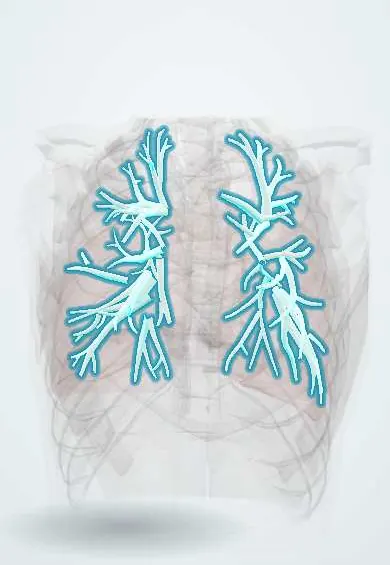
Representative model, for educational purposes only.