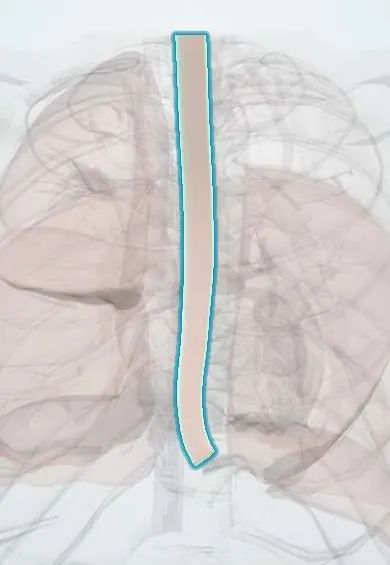
Achalasia !
Achalasia is a disorder in which the muscle at the bottom of the esophagus does not relax, making it gradually harder to swallow solids and liquids.
Updated 2026-10-29
Structures involved
Tap one to see what it is and open it in 3D.
In histology
- The GI tract wall: mucosa, submucosa, muscularis, serosa; enteric plexuses
- Esophagus and the Barrett change
In physiology
What it is
A primary motility disorder in which the lower oesophageal sphincter fails to relax on swallowing and peristalsis in the oesophageal body is lost. It causes progressive difficulty swallowing both solids and liquids.
Who gets it
Uncommon; it can appear at any age, most often in middle adulthood. In Colombia and other Latin American countries, Chagas disease causes a similar picture (Chagas megaoesophagus) in people from endemic areas.
Causes
- Primary (idiopathic): loss of inhibitory neurons in the myenteric plexus, possibly autoimmune after a viral trigger
- Secondary: Chagas disease, in which Trypanosoma cruzi destroys enteric neurons
- Pseudoachalasia: a tumour at the gastro-oesophageal junction that mimics achalasia
Risk factors
- Middle age
- Living in, or coming from, a Chagas-endemic area
- Autoimmune predisposition
- Rare familial syndromes (such as triple A syndrome)
Pathophysiology
Loss of inhibitory neurons that release nitric oxide and vasoactive intestinal peptide in the myenteric (Auerbach) plexus leaves the sphincter contracted and stops peristalsis. Food and fluid stay in the oesophagus, which slowly dilates and can become tortuous. Chronic stasis irritates the lining and raises the risk of squamous cell cancer.
Classification
- By high-resolution manometry (Chicago classification): type I, classic, with little pressurisation
- Type II: pan-oesophageal pressurisation; usually the best response to treatment
- Type III: spastic contractions in the distal oesophagus
Symptoms and signs
- Difficulty swallowing both solids and liquids from the start, slowly getting worse
- Regurgitation of undigested food, especially lying down
- Chest pain or heartburn-like discomfort
- Weight loss
- Night-time cough and aspiration
- Eating slowly and drinking water to push food down
Diagnosis
- Clinical
- Progressive dysphagia to solids and liquids, regurgitation and weight loss; ask whether the person comes from a Chagas-endemic area.
- Tests
- High-resolution oesophageal manometry is the reference test: incomplete sphincter relaxation and absent peristalsis. Upper endoscopy with biopsies excludes cancer. Chagas serology when the history suggests it.
- Imaging
- Barium swallow: a dilated oesophagus with smooth «bird's-beak» tapering at the gastro-oesophageal junction; a timed barium study measures emptying. CT if a tumour is suspected.
Differential diagnosis
- Pseudoachalasia (cancer of the cardia)
- Chagas megaoesophagus
- Peptic stricture from reflux
- Eosinophilic oesophagitis
- Distal oesophageal spasm
- Oesophageal cancer
Goal of treatment
Relieve the obstruction at the sphincter to improve emptying, symptoms and nutrition; no treatment restores normal peristalsis.
Treatment
- Procedure
- Endoscopic pneumatic balloon dilation of the sphincter; it may need to be repeated.
- Procedure
- Peroral endoscopic myotomy (POEM): the muscle is cut from inside the oesophagus.
- Surgical
- Laparoscopic Heller myotomy, usually with a partial fundoplication to limit reflux.
- Medical
- For people unfit for the above: endoscopic botulinum toxin injection, or calcium channel blockers or nitrates before meals, with short-lived benefit.
- Lifestyle
- Eating slowly in small bites, drinking with meals and staying upright after eating.
- Follow-up
- Follow-up for reflux after myotomy and for late complications; criteria for endoscopic cancer surveillance vary.
Complications
- Aspiration pneumonia
- Malnutrition and weight loss
- Megaoesophagus (sigmoid oesophagus)
- Higher risk of squamous cell oesophageal cancer
- Reflux oesophagitis after treatment
- Perforation during dilation
Prognosis
A chronic condition that cannot be cured, but treatment gives good relief in most people. Some need repeated treatment over the years.
Test yourself
Think of the answer, then tap the question to see it.
What are the two manometry findings of achalasia?
Incomplete relaxation of the lower oesophageal sphincter and absent peristalsis in the oesophageal body.
What is the classic barium swallow sign of achalasia?
A dilated oesophagus with smooth bird's-beak tapering at the gastro-oesophageal junction.
Which infection causes an achalasia-like megaoesophagus in Latin America?
Chagas disease (Trypanosoma cruzi), which destroys the enteric neurons.
How does the dysphagia of achalasia differ from that of a mechanical stricture?
Achalasia affects solids and liquids from the start; a stricture or tumour starts with solids.
What is pseudoachalasia?
An achalasia-like picture caused by a tumour at the gastro-oesophageal junction; suspected with older age, short history and rapid weight loss.
Related conditions
- Chagas disease
- Oesophageal cancer
- Gastro-oesophageal reflux disease (GERD)
- Community-acquired pneumonia
- Chagas cardiomyopathy
Educational information, not medical advice. For any symptom, see a health professional.
Sources: Achalasia (StatPearls (NCBI Bookshelf), 2026).
Spotted a mistake?We are always improving for the community. Tell us what is wrong and our team will review it.Report a mistake
Representative model, for educational purposes only.