Conditions · Gastroenterology and hepatology
Infectious and pill-induced oesophagitis (Candida, HSV, CMV) !
Inflammation of the food pipe from infection, mostly in people with weak immunity, or from a tablet stuck in it. It makes swallowing painful.
Updated 2026-11-01
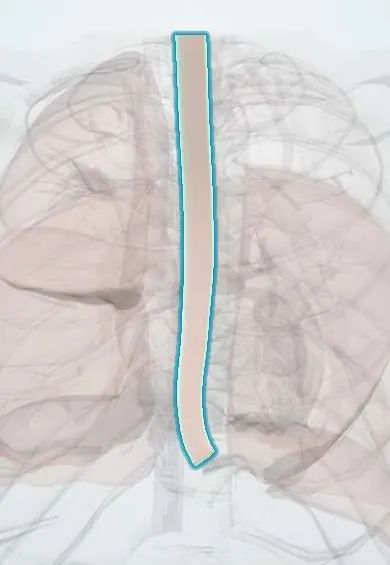
Structures involved
Tap one to see what it is and open it in 3D.
Why it happens
- Patterns of acute inflammation: serous, fibrinous, purulent, abscess, ulcer
- Innate and adaptive immunity: overview
- Esophagus and the Barrett change
What it is
Inflammation and ulceration of the oesophageal lining caused by an infection, mainly Candida, herpes simplex virus or cytomegalovirus, usually in immunocompromised people, or by direct injury from a tablet that lodges in the oesophagus (pill oesophagitis).
Who gets it
Candida oesophagitis is the most common infectious form and is an AIDS-defining illness; it remains frequent in Colombia and Latin America among people with advanced HIV who are diagnosed late or not on treatment. CMV and HSV oesophagitis occur mainly in HIV, transplant and chemotherapy patients. Pill oesophagitis is underrecognised and is common in older adults.
Causes
- Candida albicans (fungal), the most common cause
- Herpes simplex virus type 1
- Cytomegalovirus
- Rarely HIV itself (idiopathic aphthous ulcers), tuberculosis or other organisms
- Pills: doxycycline and tetracyclines, NSAIDs, bisphosphonates, potassium chloride, iron, quinidine and some antiretrovirals
Risk factors
- HIV infection with a low CD4 count
- Solid organ or bone marrow transplantation, chemotherapy and neutropenia
- Corticosteroids, including inhaled corticosteroids, and other immunosuppressants
- Diabetes, broad-spectrum antibiotics, proton pump inhibitors and old age (Candida)
- For pill injury: taking tablets with little water, lying down right after, large tablets, oesophageal narrowing or reduced motility
Pathophysiology
When local or systemic immunity is weak, Candida adheres to and invades the squamous epithelium, forming white plaques. HSV infects squamous cells and causes small vesicles that break into shallow, punched-out ulcers, while CMV infects endothelial and stromal cells in the ulcer base and causes large, deep, linear ulcers. In pill oesophagitis, a tablet sticks at a natural narrowing, often near the aortic arch or the left atrium, and releases acidic or caustic material directly onto the mucosa, producing a local ulcer.
Classification
- Fungal: Candida
- Viral: herpes simplex virus, cytomegalovirus
- Pill-induced (drug-induced) oesophagitis
- Other: idiopathic HIV ulcers, mycobacterial and bacterial infections
Symptoms and signs
- Painful swallowing (odynophagia), the hallmark symptom
- Difficulty swallowing (dysphagia)
- Retrosternal chest pain or burning
- Oral thrush in many people with Candida oesophagitis
- Oral or lip ulcers with HSV; fever and other organ involvement with CMV
- Sudden pain on swallowing after taking a tablet (pill oesophagitis)
Diagnosis
- Clinical
- Suspected from odynophagia in an immunocompromised person or after taking a tablet. In a person with HIV and oral thrush, typical symptoms are often treated empirically for Candida first, with endoscopy if there is no response.
- Tests
- Upper endoscopy with biopsy and brushings is the key test. Candida: white plaques that do not wipe off easily, with yeast and pseudohyphae on biopsy. HSV: small, shallow, well-defined ulcers with multinucleated giant cells and intranuclear inclusions at the ulcer edge. CMV: large, deep, linear ulcers with enlarged cells and inclusions in the ulcer base. CD4 count and HIV testing when the status is unknown.
- Imaging
- Barium swallow may show plaques or ulcers but is rarely needed; CT is used if perforation or another complication is suspected.
Differential diagnosis
- Reflux oesophagitis (GERD)
- Eosinophilic oesophagitis
- Caustic injury
- Oesophageal cancer or lymphoma
- Radiation oesophagitis
- Cardiac chest pain
Goal of treatment
Treat the specific cause, relieve pain so the person can eat and drink, and correct the underlying immune problem when possible.
Treatment
- Medical
- Candida: systemic azole antifungals (fluconazole first line), with echinocandins or amphotericin B for refractory cases. HSV: acyclovir or related antivirals. CMV: ganciclovir or foscarnet. Antiretroviral therapy for HIV and reduction of immunosuppression when possible.
- Conservative
- Pill oesophagitis: stopping or changing the culprit drug or its formulation; acid suppression and topical protective agents may ease healing.
- Lifestyle
- To prevent pill injury: taking tablets with a full glass of water and staying upright for at least 30 minutes afterwards.
- Follow-up
- Nursing focus: pain control before meals, soft or liquid diet, hydration and weight, oral care for thrush, monitoring for bleeding, and adherence to antimicrobial and antiretroviral treatment.
Drugs for this condition
Complications
- Bleeding from ulcers
- Strictures and narrowing
- Perforation and mediastinitis (rare)
- Dehydration and malnutrition
- Spread of infection (disseminated candidiasis or CMV disease)
Prognosis
Usually heals completely with the right antimicrobial treatment and removal of the cause; pill oesophagitis typically heals within days to weeks. Recurrence is common while immunosuppression persists.
Prevention
- Early HIV diagnosis and antiretroviral therapy
- Antimicrobial prophylaxis in selected transplant and chemotherapy patients
- Correct technique for taking tablets, especially in older or bedridden people
- Rinsing the mouth after inhaled corticosteroids
Test yourself
Think of the answer, then tap the question to see it.
What is the most common cause of infectious oesophagitis?
Candida albicans, typically with white plaques on endoscopy.
How do the endoscopic ulcers of HSV and CMV oesophagitis differ?
HSV gives small, shallow, punched-out ulcers; CMV gives large, deep, linear ulcers.
What is the hallmark symptom of infectious oesophagitis?
Odynophagia (painful swallowing).
Which drugs classically cause pill oesophagitis?
Doxycycline and tetracyclines, NSAIDs, bisphosphonates, potassium chloride and iron.
What is the usual first step for a person with HIV, oral thrush and odynophagia?
Empirical systemic azole antifungal treatment, with endoscopy if symptoms do not improve.
Related conditions
- HIV infection and AIDS
- Genital herpes (herpes simplex infection)
- Cytomegalovirus infection
- Candidiasis: oral, oesophageal and invasive
- Gastro-oesophageal reflux disease (GERD)
- Eosinophilic oesophagitis
- Oesophageal perforation (Boerhaave syndrome)
- Febrile neutropenia
- Upper gastrointestinal bleeding
Educational information, not medical advice. For any symptom, see a health professional.
Sources: Infectious Esophageal Disorders - Gastroenterology - MSD Manual Professional Edition (MSD Manual Professional Edition, 2025); Esophagitis: MedlinePlus Medical Encyclopedia (MedlinePlus (U.S. National Library of Medicine), 2025).
Spotted a mistake?We are always improving for the community. Tell us what is wrong and our team will review it.Report a mistake
Representative model, for educational purposes only.