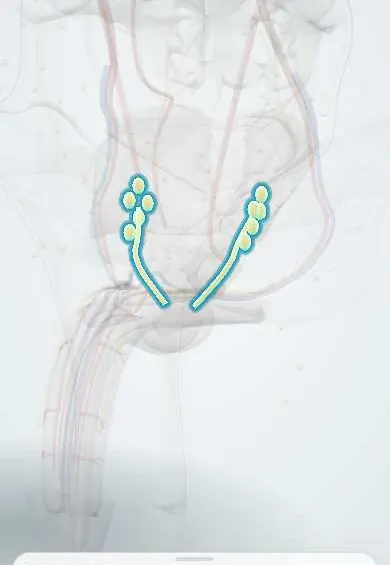
Pelvic plexus and cavernous nerves !
The pelvic plexus is a nerve network beside the prostate and rectum; its cavernous nerves control erection, and it also controls the bladder and ejaculation.
Official name: Inferior hypogastric plexus
Opens in the Durgical app, no sign-up needed.
What it is
The inferior hypogastric (pelvic) plexus: a network of autonomic nerves on each side of the rectum, bladder base and prostate. Its lower part, the prostatic plexus, gives the cavernous nerves, which run in the neurovascular bundles along the back and sides of the prostate to the penis.
What it does
Controls the bladder and rectum, ejaculation and the blood flow of erection (the cavernous nerves open the penile arteries).
Key facts
- Roots
- Hypogastric nerves and sacral splanchnic nerves (sympathetic, T10–L2); pelvic splanchnic nerves (parasympathetic, S2–S4)
- Moves
- Parasympathetic: erection via the cavernous nerves, bladder emptying; sympathetic: emission and bladder neck closure at ejaculation; rectal, vesical, prostatic subplexuses
- Feeling from
- Visceral afferents from bladder, prostate and rectum (S2–S4); cavernous nerves run in the posterolateral neurovascular bundles, spared in nerve-sparing prostatectomy
Relations
- Course
- Fed by the hypogastric nerves and the pelvic splanchnic nerves (S2–S4); its fibres spread forward over the rectum and seminal vesicles into the vesical and prostatic plexuses; the cavernous nerves run along the posterolateral prostate, pass beside the membranous urethra and pierce the perineal membrane to the corpora cavernosa
- Medial
- Rectum with the mesorectal fascia, seminal vesicles, prostate and bladder base
- Lateral
- Branches of the internal iliac artery and veins and the pelvic side wall
- Behind
- Sacrum, where the pelvic splanchnic nerves emerge from the sacral foramina
How to find it
Not palpable. At surgery the cavernous nerves are found in the fascia along the posterolateral border of the prostate, marked by the small capsular vessels that run with them.
On imaging
Not seen on imaging. The inferior hypogastric plexus lies on the side wall of the rectum, beside the seminal vesicles and prostate, so these organs are the landmarks on MRI and transrectal ultrasound. Its relevance is indirect: MRI staging of rectal and prostate cancer shows how close a tumor is to the neurovascular bundles and the mesorectal fascia, which guides nerve-sparing surgery.
Common problems
- Can be injured in radical prostatectomy and in bladder or rectal cancer surgery, causing erectile dysfunction and bladder problems.
Treatment
- Nerve-sparing prostatectomy keeps the neurovascular bundles when the cancer allows it.
- Medicines and penile rehabilitation after surgery help recovery of erections.
Clinical notes
- Erection recovery after nerve-sparing surgery can take months, as the stretched nerves recover
- Abdominoperineal resection and pelvic exenteration carry a high risk of bladder and sexual dysfunction from injury to the plexus
Memory aid
'Point and shoot': Parasympathetic for erection (point), Sympathetic for emission (shoot).
Related conditions
Test yourself
Think of the answer, then tap the question to see it.
What does the mnemonic «point and shoot» describe?
Parasympathetic (pelvic splanchnic, S2–S4) for erection; sympathetic (T10–L2) for emission.
Where do the cavernous nerves run, and how does nerve-sparing prostatectomy use this?
In the neurovascular bundles on the posterolateral prostate; keeping them improves recovery of erection when cancer does not reach them.
What does injury to the pelvic plexus cause?
Erectile dysfunction, ejaculation problems and poor bladder emptying.
Which cancer operations put the pelvic plexus at risk besides prostatectomy?
Low rectal cancer surgery (total mesorectal excision), abdominoperineal resection, pelvic exenteration and bladder cancer surgery.
Educational information, not medical advice. For any symptom, see a health professional.
Its names
- Official Latin (TA2)
- plexus hypogastricus inferior; plexus prostaticus; nervi cavernosi penis TA2 6715
- Official Spanish (DeCS)
- Plexo hipogástrico inferior; plexo prostático; nervios cavernosos del pene DeCS D007001
- English (TA2)
- Inferior hypogastric plexus
- Also called
- pelvic plexus · plexus pelvinus
Related
Sources: Terminologia Anatomica (TA2); DeCS; Anatomy, Abdomen and Pelvis: Inferior Hypogastric Plexus.
Spotted a mistake?We are always improving for the community. Tell us what is wrong and our team will review it.Report a mistake
Representative model, for educational purposes only.