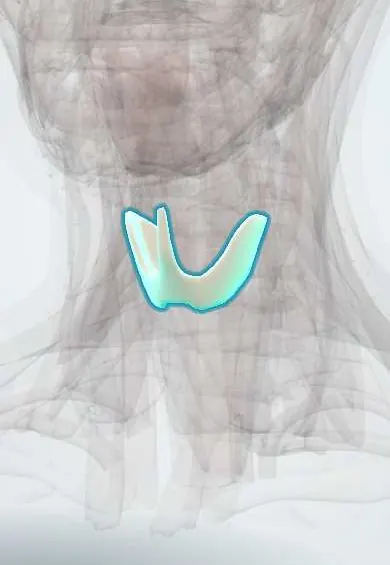
Thyroiditis (subacute, painless and postpartum) !
Inflammation of the thyroid that leaks stored hormone, causing a short overactive phase, often followed by an underactive phase before recovery.
Updated 2026-11-01
Structures involved
Tap one to see what it is and open it in 3D.
In embryology
In the clinical exam
Why it happens
- Granulomatous inflammation: caseating vs non-caseating, the causes to know
- The thyroid axis: reading TSH and free T4
- Thyroid hormone synthesis
- Thyroid follicles, C cells and parathyroid
What it is
A group of inflammatory thyroid disorders in which damaged follicles release stored hormone, causing transient thyrotoxicosis that may be followed by hypothyroidism. The main destructive forms are subacute granulomatous (painful, de Quervain), painless (silent) and postpartum thyroiditis. Hashimoto thyroiditis is the chronic autoimmune form and is covered under hypothyroidism.
Who gets it
Subacute thyroiditis is most common in women aged 30 to 50 and often follows a viral upper respiratory infection. Postpartum thyroiditis affects a notable minority of women in the year after delivery and is more frequent in those with thyroid antibodies or type 1 diabetes.
Causes
- Subacute granulomatous: probably post-viral (after upper respiratory infections, mumps and other viruses)
- Painless and postpartum: autoimmune, related to thyroid peroxidase antibodies
- Drug-induced: amiodarone, lithium, interferon-alpha and immune checkpoint inhibitors
- Others: radiation, palpation or trauma, and acute suppurative (bacterial) thyroiditis
Risk factors
- Female sex
- Recent viral infection (subacute form)
- Positive thyroid peroxidase antibodies, type 1 diabetes or a previous episode (postpartum form)
- Treatment with amiodarone, lithium or immunotherapy
Pathophysiology
Inflammation destroys follicles and releases preformed T4 and T3, producing thyrotoxicosis while new hormone synthesis and iodine uptake are low. When stores are exhausted a hypothyroid phase may follow, and most glands then recover. This is why radioactive iodine uptake is low, unlike Graves disease, where synthesis is increased.
Classification
- Subacute granulomatous (painful) thyroiditis
- Painless (silent) lymphocytic thyroiditis
- Postpartum thyroiditis (within 12 months of delivery)
- Drug-induced, acute suppurative and radiation thyroiditis
- Chronic autoimmune (Hashimoto) thyroiditis
Symptoms and signs
- Subacute: anterior neck pain radiating to the jaw or ear, tender firm gland, fever and malaise
- Thyrotoxic phase: palpitations, tremor, heat intolerance, anxiety and weight loss
- Hypothyroid phase: fatigue, cold intolerance, weight gain and low mood
- Painless and postpartum forms: small non-tender goitre or no goitre
- No eye disease or pretibial myxoedema (these point to Graves disease)
Diagnosis
- Clinical
- Neck pain and tenderness, timing after a viral illness or delivery, and drug history. The absence of ophthalmopathy helps separate it from Graves disease.
- Tests
- TSH low with high free T4 and T3 in the thyrotoxic phase; high ESR and CRP in subacute thyroiditis; thyroid peroxidase antibodies in painless and postpartum forms; TSH receptor antibodies are negative.
- Imaging
- Low radioactive iodine (or technetium) uptake confirms a destructive cause. Ultrasound shows hypoechoic areas with low blood flow on Doppler, unlike the high flow of Graves disease.
Differential diagnosis
- Graves disease (high uptake, TSH receptor antibodies, eye signs)
- Toxic nodular goitre
- Exogenous thyroid hormone intake (low uptake, low thyroglobulin)
- Haemorrhage into a thyroid nodule or cyst
- Anaplastic thyroid cancer or acute suppurative thyroiditis when pain and a mass coexist
Goal of treatment
Control pain and thyrotoxic symptoms during the inflammatory phase and treat any hypothyroidism, knowing that most cases resolve on their own.
Treatment
- Medical
- Beta-blockers for palpitations and tremor; antithyroid drugs are not useful because hormone synthesis is not increased.
- Medical
- Subacute thyroiditis: non-steroidal anti-inflammatory drugs for pain, and glucocorticoids when pain is severe or does not respond.
- Medical
- Levothyroxine for symptomatic or persistent hypothyroidism.
- Follow-up
- TSH and free T4 every few weeks until recovery, then periodically, because permanent hypothyroidism can develop (especially after postpartum thyroiditis).
Complications
- Permanent hypothyroidism
- Recurrence in later pregnancies (postpartum form)
- Atrial fibrillation in older patients during the thyrotoxic phase
Prognosis
Most patients recover normal thyroid function within 12 to 18 months. A minority, particularly those with high antibody levels, develop permanent hypothyroidism and need lifelong replacement.
Test yourself
Think of the answer, then tap the question to see it.
How does radioactive iodine uptake help separate thyroiditis from Graves disease?
Uptake is low in destructive thyroiditis and high in Graves disease.
What is the typical presentation of subacute granulomatous thyroiditis?
Painful tender thyroid with fever and transient thyrotoxicosis a few weeks after a viral infection, with raised ESR.
Why are antithyroid drugs ineffective in thyroiditis?
The excess hormone comes from release of stored hormone, not from increased synthesis.
What is the classic course of thyroid function in postpartum thyroiditis?
Thyrotoxicosis a few months after delivery, then hypothyroidism, then usually recovery within a year.
Related conditions
- Graves disease (hyperthyroidism)
- Hypothyroidism
- Thyroid storm
- Thyroid nodule
- Thyroid cancer (papillary)
- Euthyroid sick syndrome (non-thyroidal illness)
Educational information, not medical advice. For any symptom, see a health professional.
Sources: Thyroiditis (American Thyroid Association, 2025); Subacute thyroiditis (MedlinePlus Medical Encyclopedia (U.S. National Library of Medicine), 2025).
Spotted a mistake?We are always improving for the community. Tell us what is wrong and our team will review it.Report a mistake
Representative model, for educational purposes only.