Euthyroid sick syndrome (non-thyroidal illness) !
Abnormal thyroid blood tests, mainly low T3, caused by a serious illness rather than thyroid disease. It settles as the person recovers.
Updated 2026-11-01
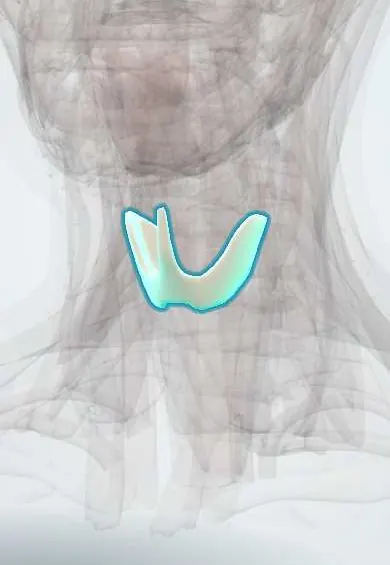
Structures involved
Tap one to see what it is and open it in 3D.
Why it happens
- Thyroid hormone transport and deiodinases
- The thyroid axis: reading TSH and free T4
- Iodothyronine deiodinases (DIO1, DIO2, DIO3)
What it is
A pattern of abnormal thyroid function tests in patients with acute or chronic non-thyroidal illness, starvation or major stress, without intrinsic thyroid or pituitary disease. The classic finding is low T3 with raised reverse T3; T4 falls in more severe illness and TSH is usually normal or low.
Who gets it
Very common in intensive care, where most critically ill patients show low T3, and frequent in sepsis, heart failure, kidney and liver disease and malnutrition. A low T4 in a critically ill patient is linked to higher mortality.
Causes
- Sepsis, major surgery, trauma and burns
- Myocardial infarction and heart failure
- Chronic kidney disease, cirrhosis and diabetic ketoacidosis
- Fasting, starvation and anorexia nervosa
- Drugs that alter thyroid tests (glucocorticoids, dopamine, amiodarone, beta-blockers)
Risk factors
- Critical illness and prolonged ICU stay
- Severe malnutrition or prolonged fasting
- Advanced chronic organ failure
Pathophysiology
Illness and cytokines reduce type 1 deiodinase activity, so less T4 is converted to active T3; inactive reverse T3 rises mainly because it is cleared more slowly. In very sick patients, type 3 deiodinase in poorly perfused tissues also speeds the breakdown of T4 and T3. Hypothalamic TRH and pituitary TSH output fall, binding proteins decrease and binding inhibitors circulate. Many authors view this as an adaptive response that lowers energy use during severe illness.
Classification
- Low T3 syndrome (mild illness)
- Low T3 and low T4 syndrome (severe or prolonged illness, worse prognosis)
- Recovery phase: transient rise in TSH as the axis restarts
Symptoms and signs
- No specific thyroid symptoms; the clinical picture is that of the underlying illness
- Abnormal thyroid tests found during hospital admission or in the ICU
Diagnosis
- Clinical
- A diagnosis of exclusion in a severely ill patient without a history, goitre or signs of thyroid disease; drug history is reviewed. Thyroid tests are best not ordered in critical illness unless thyroid disease is clinically suspected.
- Tests
- Low total and free T3, high reverse T3, normal or low T4 and normal or low TSH; TSH may rise transiently during recovery. Cortisol is often raised, which helps separate it from central hypothyroidism. Repeating tests after recovery confirms the diagnosis.
- Imaging
- No imaging is required; thyroid imaging is only for a separate clinical finding.
Differential diagnosis
- Primary hypothyroidism
- Central (secondary) hypothyroidism from pituitary or hypothalamic disease
- Recovery phase of thyroiditis
- Drug effects on thyroid tests (glucocorticoids, dopamine, amiodarone, heparin)
Goal of treatment
Treat the underlying illness and avoid unnecessary thyroid hormone, while not missing true hypothyroidism or pituitary failure.
Treatment
- Medical
- Treatment of the cause (sepsis, heart failure, nutrition). Thyroid hormone replacement is not recommended, as trials have not shown benefit.
- Follow-up
- Repeat thyroid function tests several weeks after recovery; investigate further if TSH stays clearly high or T4 stays low.
Complications
- Misdiagnosis as hypothyroidism leading to unnecessary treatment
- Missed central hypothyroidism or adrenal insufficiency
- Low T4 is a marker of severe illness and higher mortality
Prognosis
The tests normalise as the underlying illness resolves. The degree of hormone change reflects illness severity, and a markedly low T4 predicts higher mortality.
Test yourself
Think of the answer, then tap the question to see it.
What is the most typical thyroid test pattern in euthyroid sick syndrome?
Low T3 with raised reverse T3, with normal or low TSH; T4 falls in more severe illness.
Which enzyme change explains the low T3?
Reduced peripheral 5'-deiodinase (type 1) activity, so less T4 is converted to T3 and reverse T3 is cleared more slowly, so it rises.
Should a critically ill patient with this pattern receive levothyroxine?
No; management is treatment of the underlying illness and repeating thyroid tests after recovery.
Which finding suggests true primary hypothyroidism instead?
A clearly elevated TSH (above about 10 mIU/L) that persists after recovery, often with goitre or a history of thyroid disease; a brief TSH rise can occur during recovery.
Related conditions
- Hypothyroidism
- Myxoedema coma
- Hypopituitarism (incl. Sheehan syndrome and pituitary apoplexy)
- Thyroiditis (subacute, painless and postpartum)
- Sepsis and septic shock
- Myocardial Infarction (Heart Attack)
- Diabetic ketoacidosis
- Chronic kidney disease
- Cirrhosis
- Heart failure
- Anorexia nervosa
- Burns (thermal, chemical, electrical; inhalation injury)
Educational information, not medical advice. For any symptom, see a health professional.
Sources: Euthyroid Sick Syndrome - Endocrinology - MSD Manual Professional Edition (MSD Manual Professional Edition, 2025).
Spotted a mistake?We are always improving for the community. Tell us what is wrong and our team will review it.Report a mistake
Representative model, for educational purposes only.