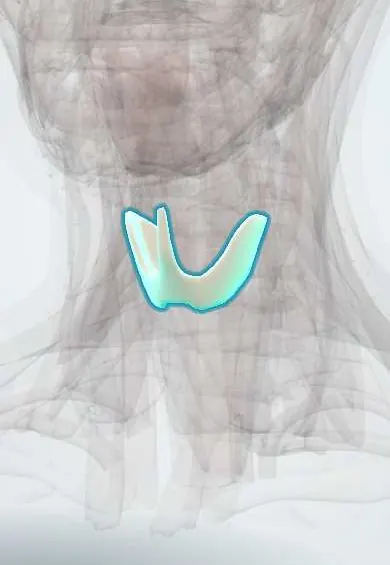
Thyroid cancer (papillary) !
Thyroid cancer is a malignant tumour of the thyroid; the papillary type is by far the most common and usually has an excellent outlook.
Updated 2026-10-29
Structures involved
Tap one to see what it is and open it in 3D.
- Thyroid gland
- Neck lymph nodes
- Recurrent laryngeal nerves
- Parathyroid glands
- Trachea
- Superior laryngeal nerve
- Vocal folds
In biochemistry
In histology
- From biopsy to slide: fixation, sectioning, frozen section
- Thyroid follicles, C cells and parathyroid
In embryology
- Pharyngeal pouches: tonsil, thymus, parathyroids and C cells
- Thyroid gland: from the foramen cecum to the neck
- Thyroglossal duct cyst and ectopic thyroid
In the clinical exam
Why it happens
- Oncogenes: RAS, MYC, HER2, BCR-ABL and the table to know
- Translocations, amplifications and epigenetic changes in cancer
- Frozen section: the intraoperative consultation
- Ionizing radiation injury
- Differentiation and anaplasia: how a tumour cell looks under the microscope
- Cytology: the Pap test, fine-needle aspiration and body fluids
Show 2 more
What it is
A malignant tumour of the thyroid. Papillary carcinoma is by far the most common type and usually has an excellent outlook; follicular, medullary and anaplastic carcinomas are less frequent.
Who gets it
The most common endocrine cancer, more frequent in women. Detected cases have risen with widespread ultrasound use, largely from small papillary cancers.
Causes
- Papillary carcinoma: BRAF mutations and RET/PTC rearrangements
- Follicular carcinoma: RAS mutations
- Medullary carcinoma: from parafollicular C cells; RET mutations in familial forms (MEN 2)
- Anaplastic carcinoma: undifferentiated, often from long-standing differentiated cancer
Risk factors
- Ionising radiation to the neck in childhood
- Female sex
- Family history and inherited syndromes
- Iodine deficiency (follicular type)
Pathophysiology
Papillary carcinoma grows as papillae lined by cells with characteristic nuclear features (optically clear nuclei, grooves, pseudoinclusions) and psammoma bodies. It spreads mostly through lymphatics to the central and lateral neck nodes. Follicular carcinoma spreads more through the blood to lung and bone.
Classification
- Differentiated: papillary (most common), follicular, oncocytic
- Medullary carcinoma
- Anaplastic carcinoma
- TNM staging, in which age at diagnosis matters for differentiated cancer
Symptoms and signs
- Painless thyroid nodule, often found by chance
- Enlarged neck lymph nodes
- Hoarseness, dysphagia or breathing difficulty in advanced disease
Diagnosis
- Clinical
- Examination of the thyroid, neck nodes and vocal folds (laryngoscopy before surgery).
- Tests
- TSH; ultrasound-guided fine-needle aspiration (Bethesda); after thyroidectomy, thyroglobulin is a tumour marker; calcitonin and CEA in medullary carcinoma.
- Imaging
- Neck ultrasound of thyroid and lymph nodes; CT for extensive disease; radioiodine scanning after treatment.
Differential diagnosis
- Benign thyroid nodule or adenoma
- Multinodular goitre
- Thyroid lymphoma
- Metastasis to the thyroid
Goal of treatment
Remove the cancer, reduce recurrence and death, and limit treatment harm in the many low-risk cases.
Treatment
- Surgical
- Lobectomy or total thyroidectomy depending on size and risk; central or lateral neck dissection for nodal disease.
- Medical
- Radioactive iodine ablation in selected intermediate and high-risk cases; thyroid hormone replacement, with TSH suppression in higher-risk patients.
- Follow-up
- Active surveillance for some very small low-risk papillary cancers; long-term follow-up with ultrasound and thyroglobulin.
- Medical
- Targeted therapies such as kinase inhibitors for advanced, radioiodine-refractory disease.
Drugs for this condition
Complications
- Recurrent laryngeal nerve injury and hoarseness after surgery
- Hypoparathyroidism and hypocalcaemia
- Local or nodal recurrence
- Distant metastases (lung, bone)
Prognosis
Papillary carcinoma has one of the best outlooks of any cancer, with long-term survival in most patients. Anaplastic carcinoma is aggressive and has a poor prognosis.
Test yourself
Think of the answer, then tap the question to see it.
What is the most common type of thyroid cancer?
Papillary thyroid carcinoma.
Which histological findings are typical of papillary carcinoma?
Optically clear (Orphan Annie eye) nuclei, nuclear grooves, pseudoinclusions and psammoma bodies.
How does papillary carcinoma usually spread?
Through the lymphatics to neck lymph nodes.
From which cells does medullary carcinoma arise, and what is its marker?
From parafollicular C cells; calcitonin (and CEA) are its markers.
Which tumour marker is used after total thyroidectomy for differentiated cancer?
Serum thyroglobulin, with thyroglobulin antibodies.
Related conditions
Educational information, not medical advice. For any symptom, see a health professional.
Sources: Papillary Thyroid Carcinoma (StatPearls (NCBI Bookshelf), 2024).
Spotted a mistake?We are always improving for the community. Tell us what is wrong and our team will review it.Report a mistake
Representative model, for educational purposes only.