Cardiovascular system · Head and neck
Inferior thyroid artery !
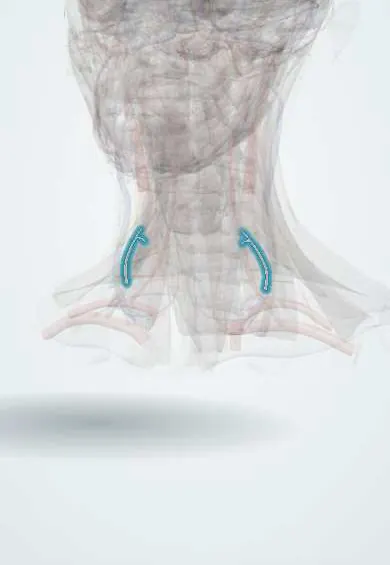
The inferior thyroid artery feeds the lower thyroid and the parathyroid glands; the nerve to the voice box crosses it, so surgeons find it with care.
Opens in the Durgical app, no sign-up needed.
What it is
A branch from the thyrocervical trunk that loops behind the carotid to the lower thyroid.
What it does
Feeds the thyroid and parathyroids; the recurrent laryngeal nerve crosses it.
Key facts
- Origin
- Thyrocervical trunk (subclavian artery)
- Branches
- Inferior laryngeal, ascending cervical, pharyngeal, oesophageal, tracheal branches
- Supplies
- Lower thyroid, parathyroids; crossed by the recurrent laryngeal nerve
Relations
- Course
- Up along the inner edge of the anterior scalene, then turns inward near the C6 vertebra, behind the carotid sheath, and drops to the back of the lower thyroid lobe
- In front
- Carotid sheath: common carotid artery, internal jugular vein and vagus nerve
- Behind
- Vertebral artery and vein; the sympathetic trunk and middle cervical ganglion lie close to its arch
- Medial
- Recurrent laryngeal nerve in the tracheo-oesophageal groove, near the lower pole and the parathyroid glands
How to find it
Not palpable. In surgery it is found by turning the thyroid lobe forward and inward: it enters the back of the lobe from the side, with the recurrent laryngeal nerve sought in the groove near it. Doppler ultrasound follows it behind the common carotid artery.
On imaging
Colour Doppler follows it from behind the common carotid into the back of the thyroid lobe; its peak velocity is high in Graves disease and low in destructive thyroiditis, which helps tell them apart. CT angiography shows it arising from the thyrocervical trunk. With a parathyroid adenoma, a feeding branch entering the nodule from outside the thyroid (polar vessel sign) supports it.
Clinical notes
- Doppler flow in this artery is high in Graves disease and low in destructive thyroiditis, which helps tell them apart
- Injury during thyroid surgery can bleed into the neck and compress the airway
- A thyroid ima artery (a variant from the brachiocephalic trunk or aortic arch, more likely when an inferior thyroid artery is missing) runs up in front of the trachea and can bleed in a low tracheostomy
Anatomical variants
- May arise directly from the subclavian or vertebral artery instead of the thyrocervical trunk
- Absent on one side in a small minority, with the superior thyroid artery or a thyroid ima artery taking over
- Its relation to the recurrent laryngeal nerve differs between people and between the two sides of the neck
Related conditions
Test yourself
Think of the answer, then tap the question to see it.
From which trunk does the inferior thyroid artery arise?
The thyrocervical trunk of the subclavian artery.
Which nerve crosses the inferior thyroid artery near the thyroid, and what is done before its branches are tied?
The recurrent laryngeal nerve, which may pass in front, behind or between the branches; it is identified first.
Why are the branches of the inferior thyroid artery tied close to the thyroid capsule?
It is the main blood supply of the parathyroid glands, which are kept alive this way.
Educational information, not medical advice. For any symptom, see a health professional.
Its names
- Official Latin (TA2)
- arteria thyreoidea inferior TA2 4591
- Official Spanish (DeCS)
- Arteria tiroidea inferior
- English (TA2)
- Inferior thyroid artery
- Also called
- arteria thyreoidea caudalis
Related
Sources: Terminologia Anatomica (TA2); Anatomy, Head and Neck, Thyroid Arteries; Tratado de anatomía humana (9.ª ed.), tomo II, Libro IV Angiología, arterias subclavia, axilar, humeral, radial y cubital, arcos palmares y vías anastomóticas del miembro superior.
Spotted a mistake?We are always improving for the community. Tell us what is wrong and our team will review it.Report a mistake
Representative model, for educational purposes only.