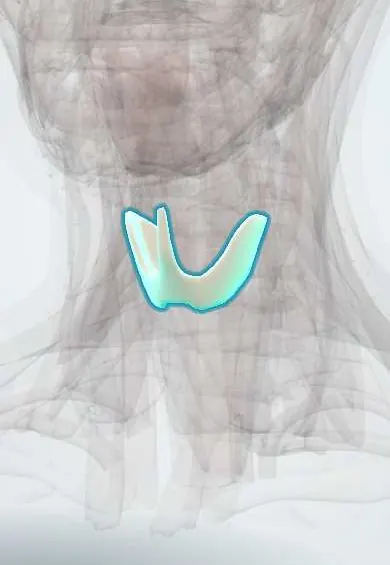
Hypothyroidism !
Hypothyroidism means the thyroid gland makes too little hormone, slowing the body: tiredness, feeling cold, weight gain and dry skin.
Updated 2026-10-29
Structures involved
Tap one to see what it is and open it in 3D.
In biochemistry
- Thyroid hormone synthesis: Step 1 · Sodium–iodide symporter (NIS)
- Thyroid hormone synthesis: Step 3 · Thyroid peroxidase (oxidation)
- Thyroid hormone synthesis: Step 7 · Deiodinases DIO1 and DIO2
- Tyrosine
- LDL receptor
- Creatine kinase (CK) and CK-MB as lab tests
- Newborn screening
- Energy requirements and basal metabolic rate (BMR)
- Radioisotopes and radioimmunoassay (RIA)
- Fredrickson classification of hyperlipoproteinaemias
- Nuclear receptors
- Hormone classes and mechanisms
- Thyroid peroxidase (TPO)
- Iodothyronine deiodinases (DIO1, DIO2, DIO3)
- Thyroxine (T4)
- Triiodothyronine (T3)
- Iodine
- Selenium
In immunology
In histology
In embryology
- Thyroid gland: from the foramen cecum to the neck
- Thyroglossal duct cyst and ectopic thyroid
- Lithium and Ebstein anomaly
In the clinical exam
- Arterial pulse: rate, rhythm and amplitude
- Diagnostic facies
- Thyroid examination
- Hyperthyroidism and hypothyroidism: the signs
In physiology
- The hypothalamic–pituitary system: overview
- Actions of thyroid hormones
- The thyroid axis: reading TSH and free T4
- Prolactin and its control by dopamine
- Thyroid hormone transport and deiodinases
- Body temperature regulation
- Energy metabolism and basal metabolic rate
- Hypothermia and cold injury
- Maternal physiological changes in pregnancy
- Puberty
- Newborn physiology and fetal maturation
Why it happens
What it is
Deficiency of thyroid hormone that slows the body's metabolism. It is usually primary, from failure of the thyroid gland itself, and most often due to autoimmune (Hashimoto) thyroiditis.
Who gets it
Common, and much more frequent in women and older adults. Iodine deficiency once caused endemic goitre and cretinism in Andean regions of Latin America; salt iodisation has largely controlled it. Congenital hypothyroidism is sought by newborn screening.
Causes
- Chronic autoimmune (Hashimoto) thyroiditis: commonest where iodine intake is adequate
- Iodine deficiency: the commonest cause worldwide
- After radioactive iodine, thyroid surgery or neck radiotherapy
- Drugs: lithium, amiodarone, immune checkpoint inhibitors
- Thyroiditis (postpartum, subacute) with a transient phase
- Central: pituitary or hypothalamic disease; congenital: thyroid dysgenesis or dyshormonogenesis
Risk factors
- Female sex and older age
- Family history of thyroid disease
- Other autoimmune diseases (type 1 diabetes, vitiligo, celiac disease)
- Down and Turner syndromes
- Pregnancy and the year after delivery
- Previous thyroid surgery, radioiodine or neck irradiation
Pathophysiology
Low thyroid hormone slows metabolism in almost every tissue, reducing heat production, heart rate and gut motility. In primary disease, loss of negative feedback raises TSH, which may enlarge the gland. Glycosaminoglycans build up in the skin and tissues (myxoedema). In the fetus and infant, lack of hormone harms brain development.
Classification
- Primary (thyroid), central (pituitary or hypothalamic)
- Overt: high TSH, low free T4
- Subclinical: high TSH, normal free T4
- Congenital or acquired
Symptoms and signs
- Tiredness, slowness, cold intolerance
- Weight gain despite poor appetite
- Constipation
- Dry skin, hair loss, puffy face and eyelids, hoarse voice
- Menstrual changes, low mood, poor memory
- Bradycardia, slow-relaxing tendon reflexes, goitre in some
- Newborn: prolonged jaundice, poor feeding, large tongue, umbilical hernia (often no signs at birth)
Diagnosis
- Clinical
- Symptoms are nonspecific and develop slowly, so diagnosis rests on blood tests. A goitre, bradycardia and delayed reflex relaxation support it.
- Tests
- TSH is the screening test; free T4 confirms and grades it. Thyroid peroxidase (TPO) antibodies support Hashimoto. Low or normal TSH with low free T4 points to central disease. Raised cholesterol, CK and hyponatraemia may be found. Newborn TSH screening.
- Imaging
- Not routine. Thyroid ultrasound if there is a nodule or asymmetric goitre; pituitary MRI in central hypothyroidism.
Differential diagnosis
- Depression
- Non-thyroidal illness (sick euthyroid syndrome)
- Anaemia
- Chronic kidney disease
- Adrenal insufficiency
- Obstructive sleep apnoea
Goal of treatment
Replace thyroid hormone to restore normal metabolism and, in primary disease, bring TSH into the reference range; in newborns, protect brain development by starting treatment early.
Treatment
- Medical
- Lifelong oral replacement with synthetic thyroxine (T4), taken on an empty stomach; the dose is adjusted to the TSH and to age and heart disease.
- Follow-up
- TSH rechecked some weeks after each dose change, then periodically; free T4 is used instead in central disease. Requirements rise in pregnancy.
- Acute
- Myxoedema coma: intensive care, intravenous thyroid hormone, corticosteroids until adrenal insufficiency is excluded, warming and support of breathing and circulation.
- Medical
- Congenital hypothyroidism: replacement started as soon as screening is confirmed, with close follow-up of growth and development.
Drugs for this condition
Complications
- Myxoedema coma
- Dyslipidaemia and atherosclerotic heart disease
- Heart failure, pericardial effusion
- Infertility and pregnancy complications
- Intellectual disability if congenital disease goes untreated
- Over-replacement: atrial fibrillation and bone loss
Prognosis
With correct replacement most people return to normal health and life expectancy. Congenital hypothyroidism treated early allows normal development. Myxoedema coma still carries a high mortality.
Prevention
- Adequate dietary iodine (iodised salt)
- Universal newborn screening
- Periodic thyroid tests after radioiodine, thyroid surgery or neck radiotherapy, and in people on lithium or amiodarone
Test yourself
Think of the answer, then tap the question to see it.
What is the most common cause of hypothyroidism where iodine intake is adequate?
Chronic autoimmune (Hashimoto) thyroiditis.
Which laboratory pattern defines overt primary hypothyroidism?
High TSH with low free T4.
Which pattern suggests central (secondary) hypothyroidism?
Low free T4 with a low or inappropriately normal TSH.
Why are newborns screened for congenital hypothyroidism?
Most have no signs at birth, and early treatment prevents intellectual disability.
In myxoedema coma, why are corticosteroids given before or with thyroid hormone?
Coexisting adrenal insufficiency may be present, and thyroid hormone can precipitate an adrenal crisis.
Related conditions
- Graves disease (hyperthyroidism)
- Atherosclerosis and dyslipidaemia
- Heart failure
- Obesity
- Chronic kidney disease
- Adrenal insufficiency
- Obstructive sleep apnoea
- Alzheimer disease
Educational information, not medical advice. For any symptom, see a health professional.
Sources: Hypothyroidism (StatPearls (NCBI Bookshelf), 2024).
Spotted a mistake?We are always improving for the community. Tell us what is wrong and our team will review it.Report a mistake
Representative model, for educational purposes only.