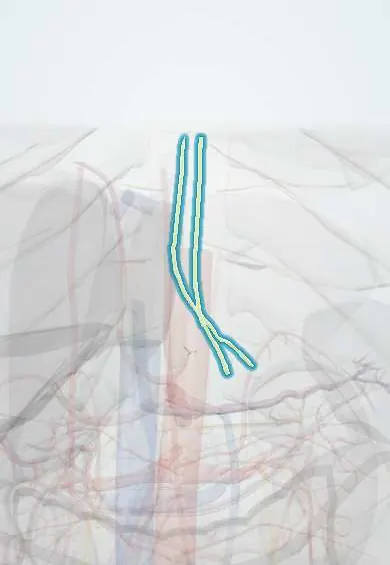
Vagal trunks !
The vagal trunks are the two continuations of the vagus nerves on the oesophagus and stomach; they control stomach acid and movement of the gut.
Official name: Anterior vagal trunk
Opens in the Durgical app, no sign-up needed.
What it is
The two vagus nerve trunks on the front and back of the esophagus as it enters the abdomen.
What it does
Stimulate stomach acid and gut movement ('rest and digest').
Key facts
- Roots
- Vagus nerves (CN X) via esophageal plexus: anterior trunk mainly left vagus, posterior mainly right; pass through esophageal hiatus (T10)
- Moves
- Parasympathetic to foregut and midgut up to near splenic flexure: gastric acid, motility, pyloric relaxation; anterior gives hepatic branch, posterior celiac branch
- Feeling from
- Visceral reflex afferents (fullness, nausea, satiety) from gut; not the main pain pathway
Relations
- Course
- Formed from the esophageal plexus above the diaphragm, they pass through the esophageal hiatus (T10) on the esophagus and spread over the stomach in the lesser omentum, alongside the left gastric vessels
- In front
- Anterior trunk on the front of the abdominal esophagus, under the peritoneum, with the left lobe of the liver in front
- Behind
- Posterior trunk in loose tissue behind the esophagus, often separate from its wall, toward the right crus and the aorta
How to find it
In hiatal and esophageal surgery the anterior trunk is seen as a white cord on the front of the esophagus just below the hiatus; the posterior trunk is found behind the esophagus, often away from its wall.
On imaging
Not seen on routine imaging. The anterior and posterior trunks lie on the esophagus as it passes the diaphragm, so the esophageal hiatus and the gastroesophageal junction are the landmarks. Their relevance is indirect: a barium swallow or CT shows a hiatal hernia, whose repair puts them at risk, and after vagotomy or such surgery a gastric emptying study may show delayed emptying.
Common problems
- Pain from pancreatic cancer can be eased by blocking it with an injection (celiac plexus block).
Clinical notes
- Truncal vagotomy reduced acid but slowed gastric emptying, so it needed a drainage operation (pyloroplasty); highly selective vagotomy cut only the branches to the acid-secreting body and kept the crow's foot
- A missed branch of the posterior trunk to the fundus (the criminal nerve of Grassi) was blamed for ulcer recurrence after vagotomy
- Injury in fundoplication, bariatric surgery or esophagectomy can cause delayed gastric emptying, diarrhoea or dumping
- Vagal afferents carry fullness, nausea and satiety, not the main visceral pain
Anatomical variants
- There may be two or more anterior or posterior trunks, one cause of incomplete vagotomy
Development
The stomach rotates about 90 degrees clockwise (seen from above) during development, carrying the left vagus to the front and the right vagus to the back.
Memory aid
LARP: Left vagus goes Anterior, Right goes Posterior.
Related conditions
Test yourself
Think of the answer, then tap the question to see it.
Which vagus nerve forms each vagal trunk, and why?
The anterior trunk is mainly the left vagus, the posterior mainly the right, because the stomach rotates about 90 degrees clockwise (seen from above) during development.
Through which opening do the vagal trunks enter the abdomen?
The esophageal hiatus of the diaphragm, at T10, on the esophagus.
Which named branches do the anterior and posterior vagal trunks give?
Anterior: the hepatic branch. Posterior: the celiac branch to the midgut. Each runs on as a nerve of Latarjet along the lesser curvature, ending in a crow's foot to the antrum and pylorus.
Why did truncal vagotomy need a drainage operation such as pyloroplasty?
It reduced acid but slowed gastric emptying; highly selective vagotomy kept the crow's foot and avoided this.
What is the criminal nerve of Grassi?
A branch of the posterior vagal trunk to the fundus; if missed at vagotomy, it was blamed for ulcer recurrence.
Educational information, not medical advice. For any symptom, see a health professional.
Its names
- Official Latin (TA2)
- truncus vagalis anterior; truncus vagalis posterior TA2 6674
- Official Spanish (DeCS)
- Troncos vagales anterior y posterior
- English (TA2)
- Anterior vagal trunk
Related
Sources: Terminologia Anatomica (TA2); Anatomy, Head and Neck: Anterior Vagus Nerve; Anatomy, Abdomen and Pelvis, Nerves.
Spotted a mistake?We are always improving for the community. Tell us what is wrong and our team will review it.Report a mistake
Representative model, for educational purposes only.