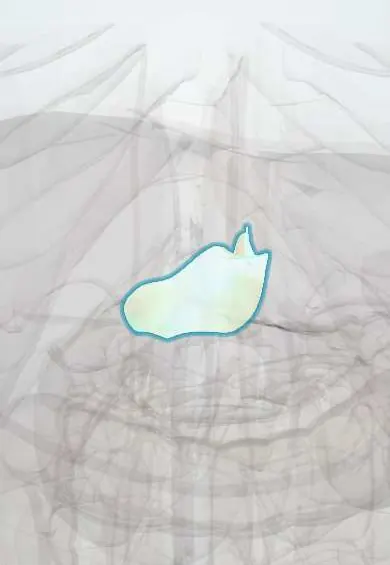
Lesser omentum !
The lesser omentum is a fold of peritoneum joining the liver to the stomach and duodenum; its free edge carries the bile duct, hepatic artery and portal vein.
Opens in the Durgical app, no sign-up needed.
What it is
A thin fold of peritoneum between the liver and the stomach and duodenum.
What it does
Its free edge carries the bile duct, hepatic artery and portal vein to the liver.
Key facts
- Where
- Double peritoneal fold between lesser curvature of stomach / first part of duodenum and the liver
- Attaches
- Hepatogastric ligament (to fissure for ligamentum venosum) and hepatoduodenal ligament (to porta hepatis)
- Function
- Free edge holds portal triad: bile duct right, hepatic artery left, portal vein behind; forms anterior border of omental foramen
Relations
- Contents
- Free edge (hepatoduodenal ligament): bile duct, hepatic artery proper and portal vein with lymph nodes and nerves; hepatogastric part: left and right gastric vessels
- Behind
- Lesser sac, and through it the pancreas, the celiac trunk and the caudate lobe; behind the free edge, the epiploic foramen with the inferior vena cava at its back
- Above
- Liver: the caudate process forms the roof of the epiploic foramen
- Below
- Lesser curvature of the stomach and the first part of the duodenum, which forms the floor of the epiploic foramen
How to find it
In surgery an index finger is slipped behind the free edge into the epiploic foramen to feel the portal triad between finger and thumb. The thin hepatogastric part (pars flaccida) can be opened to enter the lesser sac above the stomach, a common laparoscopic route.
On imaging
On CT the hepatoduodenal ligament shows the portal vein, bile duct and hepatic artery. Enlarged nodes in it or in the hepatogastric ligament suggest spread from gastric, biliary or pancreatic cancer; fluid in the lesser sac points to pancreatitis or a posterior gastric perforation.
Common problems
- Peritonitis: infection or inflammation, usually from a burst organ (appendix, ulcer); severe pain and a rigid abdomen. An emergency.
How it is diagnosed
Examination, blood tests, CT.
Treatment
- Treat the source (often surgery) and antibiotics.
Clinical notes
- Bile duct injury in cholecystectomy happens close to its free edge; the critical view of safety is used to identify the cystic duct and artery before dividing them
- Internal hernia of bowel through the epiploic foramen into the lesser sac is rare but recognized
Anatomical variants
- Hepatic artery variants are common: a replaced right hepatic artery from the superior mesenteric artery runs behind and to the right of the portal vein in the free edge; a replaced or accessory left hepatic artery from the left gastric runs in the hepatogastric ligament
Development
It comes from the ventral mesogastrium. The liver grows into this sheet and divides it in two: the lesser omentum, from the liver to the stomach and duodenum, and the falciform and coronary ligaments, from the liver to the front wall and the diaphragm.
Related conditions
Test yourself
Think of the answer, then tap the question to see it.
What runs in the free edge of the lesser omentum (hepatoduodenal ligament)?
The portal triad: bile duct on the right, hepatic artery proper on the left and portal vein behind, with lymph nodes and nerves.
What is the Pringle maneuver?
Compressing the hepatoduodenal ligament, with a finger in the epiploic foramen, to stop hepatic artery and portal inflow; continued bleeding suggests the hepatic veins or vena cava.
What lies behind the free edge of the lesser omentum?
The epiploic foramen (of Winslow), the only natural opening between greater and lesser sac, with the inferior vena cava at its back.
Which hepatic artery variant runs in the hepatogastric ligament?
A replaced or accessory left hepatic artery from the left gastric artery; it is at risk in gastric surgery.
Educational information, not medical advice. For any symptom, see a health professional.
Its names
- Official Latin (TA2)
- omentum minus; ligamentum hepatoduodenale TA2 3750
- Official Spanish (DeCS)
- Omento menor DeCS D009852
- English (TA2)
- Lesser omentum
Related
Sources: Terminologia Anatomica (TA2); DeCS; Anatomy, Abdomen and Pelvis, Peritoneum; Anatomy, Abdomen and Pelvis: Hepatoduodenal Ligament; Anatomy of the Human Body (20th ed.): The Digestive Apparatus (Lea & Febiger (Gray's Anatomy, 1918), 1918) · adapted, Public domain.
Spotted a mistake?We are always improving for the community. Tell us what is wrong and our team will review it.Report a mistake
Representative model, for educational purposes only.