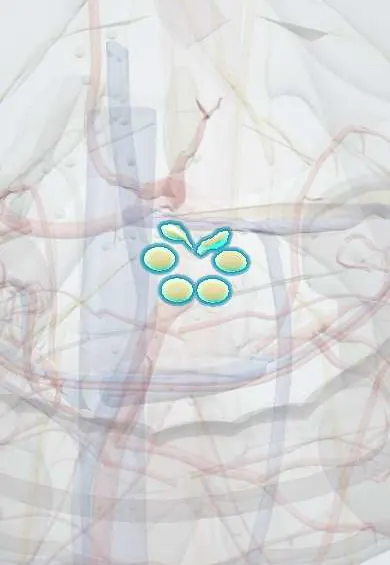
Celiac plexus !
The celiac plexus is a large network of nerves around the celiac trunk, behind the stomach and pancreas; it carries pain signals from the upper belly organs.
Official name: Coeliac plexus and ganglia
Opens in the Durgical app, no sign-up needed.
What it is
A network of autonomic nerves and ganglia around the celiac trunk (sometimes called the solar plexus).
What it does
Relays signals to and from the upper abdominal organs, including pain.
Key facts
- Roots
- Greater (T5–T9) and lesser (T10–T11) splanchnic nerves synapsing in celiac ganglia; vagal fibres (mainly posterior trunk)
- Moves
- Sympathetic: vasoconstriction, slows motility and secretion; vagal: increases motility and secretion of foregut organs
- Feeling from
- Visceral pain from foregut organs, referred to epigastrium (pancreatic pain to back); target of celiac plexus block
Relations
- In front
- Body of the pancreas, the lesser sac and the stomach; the celiac trunk passes forward through the plexus
- Behind
- Abdominal aorta and the crura of the diaphragm, at the level of T12–L1
- Lateral
- Right celiac ganglion behind the inferior vena cava; left celiac ganglion near the left adrenal gland; the adrenal glands on either side
- Above
- The greater and lesser splanchnic nerves pierce the crura to reach it; the celiac branch of the posterior vagal trunk joins it
- Below
- Continuous with the aorticorenal ganglia, renal plexuses and the superior mesenteric plexus
How to find it
Not palpable. It surrounds the origin of the celiac trunk. For a block it is reached from the back with the needle tip beside the body of L1 under CT or fluoroscopy, or through the back wall of the stomach with endoscopic ultrasound by following the aorta up to the celiac origin.
On imaging
On CT the celiac ganglia appear as small, flat or lobulated soft-tissue structures beside the celiac trunk and in front of the crura; they can be mistaken for enlarged lymph nodes or adrenal nodules. Endoscopic ultrasound finds the plexus from the stomach by following the aorta to the celiac trunk origin.
Common problems
- Pain from pancreatic cancer can be eased by blocking it with an injection (celiac plexus block).
Clinical notes
- Block routes: through the back under CT or fluoroscopy (in front of or behind the crura) or through the stomach wall with endoscopic ultrasound
- Rare serious complication: paraplegia from injury to the arteries supplying the spinal cord
- Foregut pain travels in its afferent fibres and is felt in the epigastrium; pancreatic pain typically also bores through to the back
- Median arcuate ligament syndrome: the ligament compresses the celiac trunk and the surrounding plexus, with pain after meals; how much the nerves contribute is debated
Anatomical variants
- The celiac ganglia vary in number (about one to five) and size (from about half a centimetre to over 4 cm)
Development
Like the other autonomic ganglia, the celiac ganglia come from neural crest cells that migrate to the front of the aorta during early development.
Related conditions
Test yourself
Think of the answer, then tap the question to see it.
Where is the celiac plexus?
Around the origin of the celiac trunk at about T12–L1, in front of the aorta and the crura of the diaphragm, behind the pancreas and the lesser sac.
Which nerves synapse in the celiac ganglia?
The greater (T5–T9) and lesser (T10–T11) splanchnic nerves; vagal fibres, mainly from the posterior trunk, also join the plexus.
What is a celiac plexus block used for, and what are its expected effects?
Easing the pain of pancreatic and other upper abdominal cancers; expected effects are low blood pressure on standing and diarrhoea.
What is a rare serious complication of celiac plexus block?
Paraplegia, from injury to the arteries supplying the spinal cord.
Educational information, not medical advice. For any symptom, see a health professional.
Its names
- Official Latin (TA2)
- plexus coeliacus TA2 6696
- Official Spanish (DeCS)
- Plexo celíaco DeCS D002447
- English (TA2)
- Coeliac plexus and ganglia
- Also called
- plexus celiacus
Related
Sources: Terminologia Anatomica (TA2); DeCS; Anatomy, Abdomen and Pelvis: Celiac Ganglia.
Spotted a mistake?We are always improving for the community. Tell us what is wrong and our team will review it.Report a mistake
Representative model, for educational purposes only.