Joints and ligaments · Lower limb
Anterolateral ligament (ALL) !
The anterolateral ligament (ALL) is a thin band on the outer side of the knee that helps control twisting.
Official name: Anterolateral ligament of knee
Opens in the Durgical app, no sign-up needed.
What it is
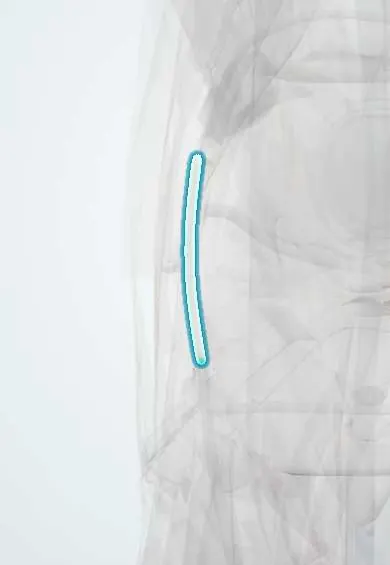
A thin band on the outer side of the knee, running from near the outer bump of the femur to the tibia, between Gerdy's tubercle and the head of the fibula.
What it does
Helps control the inward rotation of the shin bone, together with the ACL.
Key facts
- Attaches
- Near lateral femoral epicondyle to anterolateral tibia between Gerdy tubercle and fibular head; attaches to lateral meniscus
- Function
- Helps control internal rotation of tibia (varies: not found in all knees; status still debated)
- Tight in
- Knee flexion with internal rotation of tibia
Relations
- Course
- From near the lateral femoral epicondyle (texts differ on whether just in front of or behind the LCL origin), it runs forward and down to the anterolateral tibia
- Superficial
- IT band (iliotibial band)
- Deep
- Anterolateral joint capsule and the body of the lateral meniscus, to which it sends fibres
- Behind
- LCL
How to find it
It cannot be felt. In dissection it is shown by flexing the knee to about 30–60° and turning the tibia inward: a thin band tightens from just behind and above the lateral femoral epicondyle to the tibia midway between Gerdy's tubercle and the fibular head.
Examination
- Pivot shift: a high-grade, explosive shift suggests that the anterolateral structures are injured as well as the ACL
On imaging
Coronal MRI may show it as a thin band near the LCL, often only in part. On the AP knee X-ray, a Segond fracture is a small elliptical flake just below the lateral tibial plateau; a reverse Segond fracture on the medial side goes with PCL and medial meniscus injuries.
Common problems
- Can be injured together with the ACL in twisting injuries.
How it is diagnosed
Often seen on MRI in ACL injuries; its role is still being studied.
Treatment
- Some surgeons add a lateral reinforcement (anterolateral ligament reconstruction or a lateral tenodesis) to an ACL reconstruction in selected patients.
Clinical notes
- ALL reconstruction or lateral extra-articular tenodesis is considered with ACL reconstruction in young pivoting athletes, a high-grade pivot shift or a revision
- A Segond fracture on X-ray calls for MRI to look for ACL and meniscus tears
Anatomical variants
- It is not found as a distinct band in every knee; dissection studies report it in widely different proportions, and its femoral attachment is described in slightly different places
Test yourself
Think of the answer, then tap the question to see it.
What does a Segond fracture almost always indicate?
An ACL tear; it is a small avulsion of the lateral tibial rim at the attachment of the anterolateral structures.
What are the attachments and function of the anterolateral ligament (ALL)?
From near the lateral femoral epicondyle to the anterolateral tibia between Gerdy's tubercle and the fibular head; it helps control tibial internal rotation.
When is an ALL reconstruction or lateral extra-articular tenodesis added to ACL reconstruction?
In high-risk cases: young pivoting athletes, a high-grade pivot shift or a revision, to reduce re-tears.
Educational information, not medical advice. For any symptom, see a health professional.
Its names
- Official Spanish (DeCS)
- Ligamento anterolateral de la rodilla
- English (TA2)
- Anterolateral ligament of knee
- Also called
- ALL
Related
Sources: Anatomy, Bony Pelvis and Lower Limb, Knee.
Spotted a mistake?We are always improving for the community. Tell us what is wrong and our team will review it.Report a mistake
Representative model, for educational purposes only.