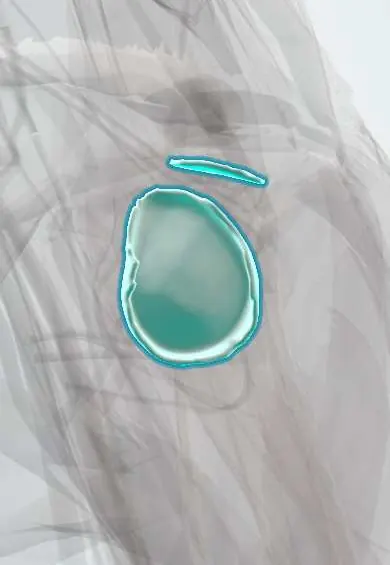
Glenoid cartilage !
The glenoid cartilage lines the shallow shoulder socket on the shoulder blade; it spreads load and lets the ball of the humerus glide.
Official name: Articular cartilage of the glenoid
Opens in the Durgical app, no sign-up needed.
What it is
The smooth cartilage lining the shoulder socket; it wears together with the humeral head in arthritis.
What it does
Spreads load and lets the humeral head glide.
Key facts
- Where
- Glenoid cavity of the scapula; thicker at the rim, thin in the centre
- Function
- Hyaline cartilage; smooth, low-friction joint surface; wears in osteoarthritis
Relations
- Lateral
- Humeral head cartilage, across the joint
- Deep
- Subchondral bone of the glenoid fossa and the neck of the scapula
- Above
- Supraglenoid tubercle with the long biceps tendon and the superior glenoid labrum; the base of the coracoid process above
- Below
- Infraglenoid tubercle, origin of the triceps long head
- In front
- Anterior rim with the labrum and the anterior band of the inferior glenohumeral ligament (IGHL); the subscapularis tendon outside the capsule
How to find it
Not palpable, since the shoulder joint lies deep. At arthroscopy through the usual posterior portal the glenoid face is the first landmark, with the humeral head opposite and the biceps anchor at its upper pole.
On imaging
A Grashey (true AP) view profiles the glenoid surface; an axillary view shows version and posterior subluxation of the head. CT with 3D reconstruction seen face-on measures anterior bone loss against a best-fit circle and classifies wear in osteoarthritis (Walch types) before surgery.
Common problems
- Shoulder osteoarthritis: the cartilage wears thin, causing pain, grinding and stiffness.
- Cuff tear arthropathy: a large old rotator cuff tear lets the ball ride up and wear out.
- Damage after repeated dislocations.
How it is diagnosed
X-rays show the narrowed joint space and bone spurs; CT plans surgery; MRI checks the rotator cuff.
Treatment
- Activity changes, pain medicines, physical therapy and sometimes injections.
- Total shoulder replacement when the cuff is healthy; reverse replacement when the cuff is torn.
Clinical notes
- Bony Bankart: a fragment of the anteroinferior rim broken off with the labrum in an anterior dislocation; larger defects call for a bone block (Latarjet coracoid transfer) rather than a soft-tissue repair
- GLAD lesion: a superficial anteroinferior labral tear together with a defect of the adjacent glenoid cartilage, usually without true instability; it causes pain and catching
- In osteoarthritis the glenoid often wears at the back (biconcave glenoid); a shoulder replacement has to correct this to avoid early loosening of the glenoid component
Anatomical variants
- Its outline is usually pear-like (narrower above), but oval and comma-like outlines are also described
Development
Extra ossification centres at the upper glenoid (with the base of the coracoid) and along the rim appear in adolescence; until they fuse they can mimic a rim fracture.
Related conditions
Test yourself
Think of the answer, then tap the question to see it.
How does the thickness of the glenoid cartilage vary?
Thick at the rim and thin in the centre; a thin central bare spot is normal, not a defect.
What does an inverted-pear glenoid at arthroscopy indicate?
Significant anteroinferior bone loss after repeated dislocations.
What is a GLAD lesion?
A superficial anteroinferior labral tear with a defect of the adjacent glenoid cartilage, usually without true instability.
Educational information, not medical advice. For any symptom, see a health professional.
Its names
- Official Latin (TA2)
- cartilago articularis cavitatis glenoidalis TA2 382
- Official Spanish (DeCS)
- Cartílago articular de la cavidad glenoidea
- English (TA2)
- Articular cartilage of the glenoid
Related
Sources: Terminologia Anatomica (TA2); Anatomy, Shoulder and Upper Limb, Glenohumeral Joint; Anatomy, Shoulder and Upper Limb, Shoulder.
Spotted a mistake?We are always improving for the community. Tell us what is wrong and our team will review it.Report a mistake
Representative model, for educational purposes only.