Joints and ligaments · Upper limb
Labrum !
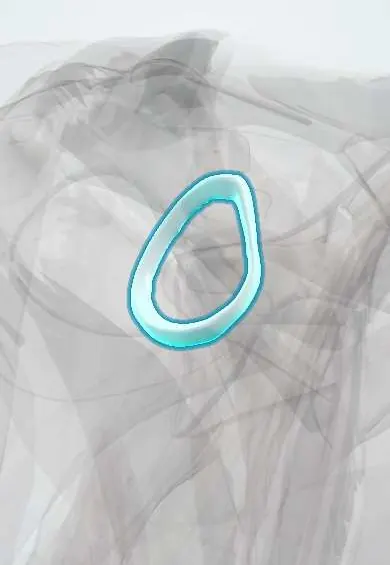
The glenoid labrum is a ring of tough tissue around the shoulder socket's rim; it deepens the socket and anchors the biceps tendon and ligaments.
Official name: Glenoid labrum
Opens in the Durgical app, no sign-up needed.
What it is
A firm ring of fibrocartilage around the rim of the shoulder socket.
What it does
Deepens the shallow socket, anchors the ligaments and the biceps tendon, and helps keep the ball in place.
Key facts
- Attaches
- Rim of the glenoid; long head of biceps blends in above (supraglenoid tubercle)
- Function
- Fibrocartilage ring; deepens the socket and seals the joint; SLAP (top) and Bankart (front-lower) tears
Relations
- Above
- Long biceps tendon, which blends with the labrum at the supraglenoid tubercle (biceps-labral complex); the superior glenohumeral ligament (SGHL) beside it
- In front
- Middle glenohumeral ligament (MGHL) and the anterior band of the inferior glenohumeral ligament (IGHL) attach to it; the subscapularis tendon lies in front of the capsule
- Below
- Axillary pouch of the IGHL hanging below; the axillary nerve runs just under the capsule
- Behind
- Posterior band of the IGHL and the posterior capsule; behind the posterosuperior labrum, the spinoglenoid notch with the suprascapular nerve
- Lateral
- Humeral head cartilage, which it cups
- Medial
- Glenoid rim and glenoid cartilage, to which its base is fixed by fibrous tissue
How to find it
Not palpable. At arthroscopy it is the white fibrocartilage rim around the glenoid, continuous above with the long head of biceps; the front half is probed from the posterior portal and the back half from an anterior portal.
Examination
- Apprehension test: supine, arm at 90° abduction, then external rotation; fear that the shoulder will slip out (not pain alone) suggests anterior instability, as with a Bankart lesion
- Relocation test: a backward push on the humeral head in the apprehension position relieves the fear, confirming anterior instability
- O'Brien active compression test: arm at 90° flexion, slightly adducted, thumb down, resisting a downward push; deep pain that eases with the palm up suggests a SLAP lesion (pain on top points to the AC joint)
- Load and shift test: the head is centred and then pushed forward and back; translation to the rim, over it, or locking out grades laxity
On imaging
MR arthrography is the reference study: contrast entering the labrum or lifting it off the glenoid marks a tear; the ABER view (abduction, external rotation) tightens the IGHL and shows anteroinferior tears. A normal sublabral recess is smooth and points medially; a SLAP tear is irregular or points laterally. A West Point view or CT shows a bony Bankart.
Common problems
- Bankart tear: the front-lower labrum is pulled off the rim when the shoulder dislocates forward.
- SLAP tear: the top of the labrum, where the biceps tendon anchors, tears in throwers or after a fall.
- After a tear the shoulder can feel loose, catch or dislocate again, especially in young athletes.
How it is diagnosed
Exam with apprehension and other special tests. MRI, often with contrast in the joint (MR arthrogram), shows the tear; CT checks for bone loss on the rim.
Treatment
- Physical therapy to strengthen the cuff and shoulder blade muscles.
- Arthroscopic labral repair with small anchors (Bankart or SLAP repair).
- Biceps tenodesis instead of a SLAP repair in some older patients.
Clinical notes
- Bankart variants: Perthes (labrum torn but the scapular periosteum still attached, so it can look normal), ALPSA (labroligamentous sleeve healed medially down the glenoid neck), GLAD (labral tear with a cartilage defect)
- SLAP lesions (Snyder): I fraying; II biceps anchor detached, the most common; III bucket-handle tear of the superior labrum; IV bucket-handle tear extending into the biceps tendon
- Reverse Bankart: a tear of the posterior labrum in posterior instability (seizures, electric shock, blocking in contact sports)
- Arthroscopic Bankart repair reattaches the labrum with anchors; a Latarjet coracoid transfer is chosen when glenoid bone loss is large; in older people biceps tenodesis is often preferred to a SLAP repair
Anatomical variants
- Sublabral foramen: the anterosuperior labrum is unattached to the rim, leaving an opening under it (reported in roughly 1 in 10 shoulders; series vary)
- Buford complex: the anterosuperior labrum is absent and the MGHL is a thick cord that attaches straight to the biceps anchor (uncommon, about 1–2% in most series)
- Sublabral recess: a smooth groove between the superior labrum and the glenoid at the biceps anchor, easily mistaken for a type II SLAP tear
Memory aid
SLAP = Superior Labrum, Anterior to Posterior: the tear runs from front to back across the biceps anchor.
Related conditions
Test yourself
Think of the answer, then tap the question to see it.
What are the three functions of the glenoid labrum?
It deepens the shallow glenoid, seals the joint like a suction cup and anchors the glenohumeral ligaments and the biceps.
Where on the glenoid clock face do Bankart and SLAP tears of the labrum sit?
Bankart tears at about 3 to 6 o'clock (front-lower); SLAP tears at the top, around the biceps anchor at 12 o'clock.
What is the Buford complex?
A normal variant: absent anterosuperior labrum with a thick cord-like MGHL attaching to the biceps anchor; it mimics a tear and must not be repaired.
Which is the most common SLAP lesion type?
Type II, in which the biceps anchor is detached from the superior labrum.
What is the reference imaging study for the glenoid labrum?
MR arthrography; contrast entering the labrum or lifting it off the glenoid marks a tear.
Educational information, not medical advice. For any symptom, see a health professional.
Its names
- Official Latin (TA2)
- labrum glenoideum TA2 1765
- Official Spanish (DeCS)
- Labrum glenoideo
- English (TA2)
- Glenoid labrum
- Also called
- glenoid lip
Related
Sources: Terminologia Anatomica (TA2); Anatomy, Shoulder and Upper Limb, Glenohumeral Joint; Anatomy, Shoulder and Upper Limb, Shoulder.
Spotted a mistake?We are always improving for the community. Tell us what is wrong and our team will review it.Report a mistake
Representative model, for educational purposes only.