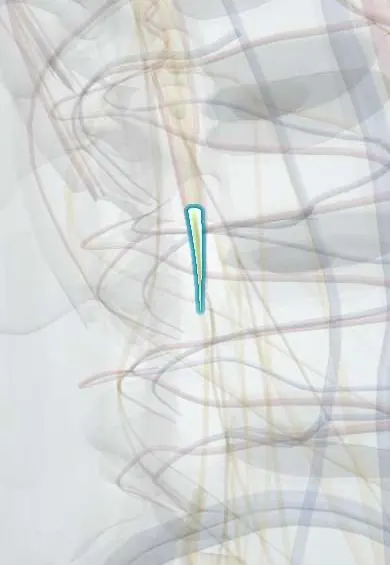
Conus medullaris !
The conus medullaris is the tapered lower end of the spinal cord, at about L1-L2 in adults; it holds the nerve centres for bladder and bowel.
Opens in the Durgical app, no sign-up needed.
What it is
The tapered lower end of the spinal cord, at about the L1-L2 level in adults.
What it does
Holds the nerve centres for the bladder, bowel and sexual function. Below it, only nerve roots fill the canal, which is why a lumbar puncture is done lower down.
Key facts
- Where
- Tapered lower end of the spinal cord at about L1–L2 in adults (about L3 at birth)
- Attaches
- Continues below as the filum terminale; surrounded by the cauda equina
- Function
- Sacral segments (S2–S4) for bladder, bowel and sexual function
Relations
- Above
- The lumbosacral enlargement of the spinal cord
- Below
- The filum terminale, continuing down to the coccyx
- Lateral
- The lumbar and sacral roots of the cauda equina, descending around it in the CSF
- In front
- Across the dural sac and epidural space, the bodies of T12 and L1 and the disc between them
- Behind
- The laminae and ligamenta flava at T12–L1
How to find it
It cannot be felt. The line across the tops of the iliac crests (about L4) is used to pick an interspace well below it for lumbar puncture or spinal anaesthesia.
On imaging
Sagittal T2 MRI shows it as the tapering tip of the cord with the roots streaming down from it; counting levels from the sacrum and checking for a transitional vertebra avoids miscounting. In young infants, ultrasound through the unossified posterior arches shows its level and movement.
Common problems
- Cervical myelopathy: slow squeezing by discs, spurs or a thick ligament, causing clumsy hands, numbness and unsteady walking.
- Spinal cord injury from fractures or dislocations, which can cause paralysis below the level.
- Inflammation (myelitis), tumours or problems with its blood supply.
How it is diagnosed
Neurological exam (strength, feeling, reflexes, balance) and MRI.
Treatment
- Cord compression with symptoms: surgery to take pressure off, such as ACDF in the neck.
- Acute injury: emergency care to stabilise the spine, then rehabilitation.
Clinical notes
- Conus vs cauda equina: conus lesions start suddenly and symmetrically, with early sphincter failure and less pain; cauda equina compression is more often asymmetric, with severe radicular pain, flaccid leg weakness and later sphincter loss
- Causes of conus damage include T12–L1 burst fractures, tumours (ependymoma of the conus and filum), L1–L2 disc herniation and a spinal needle placed too high
- Tethered cord: a low conus held by a thick or fatty filum; stretching with growth or bending gives back and leg pain, gait change, foot deformity and bladder problems
Anatomical variants
- The tip lies anywhere from the middle of T12 to the upper part of L3 in adults, most often at lower L1, with no clear difference by sex or age
- A small CSF-filled widening of the central canal in the conus (ventriculus terminalis, 'fifth ventricle') is normal in infants and may persist as a tiny cyst on adult MRI; it should not be mistaken for a syrinx or tumour
Development
The vertebral column grows faster than the cord: the conus rises from the end of the canal in the third fetal month to about L3 at birth and to the adult level during infancy.
Related conditions
Test yourself
Think of the answer, then tap the question to see it.
At what level does the conus medullaris usually lie in adults and at birth?
Most often at the lower third of L1 in adults (range mid-T12 to upper L3), and about L3 at birth.
Why is lumbar puncture done at L3–L4 or L4–L5?
These spaces lie safely below the conus medullaris, so the needle enters the lumbar cistern among the roots, not the cord.
How does conus syndrome differ from cauda equina syndrome?
Conus: sudden, symmetric, early sphincter failure, little pain, mixed upper and lower motor neuron signs. Cauda equina: asymmetric, painful, purely lower motor neuron.
What does a conus medullaris below the L2–L3 disc beyond infancy suggest?
A low-lying conus, which raises suspicion of a tethered cord.
Educational information, not medical advice. For any symptom, see a health professional.
Its names
- Official Latin (TA2)
- conus medullaris TA2 6052
- Official Spanish (DeCS)
- Cono medular
- English (TA2)
- Conus medullaris
- Also called
- medullary cone
Related
Sources: Terminologia Anatomica (TA2); Neuroanatomy, Conus Medullaris; Tratado de anatomía humana (9.ª ed.), tomo II, Libro V Sistema nervioso central, sección 1: Médula espinal.
Spotted a mistake?We are always improving for the community. Tell us what is wrong and our team will review it.Report a mistake
Representative model, for educational purposes only.