Skeletal system · Head and neck
Cricoid cartilage !
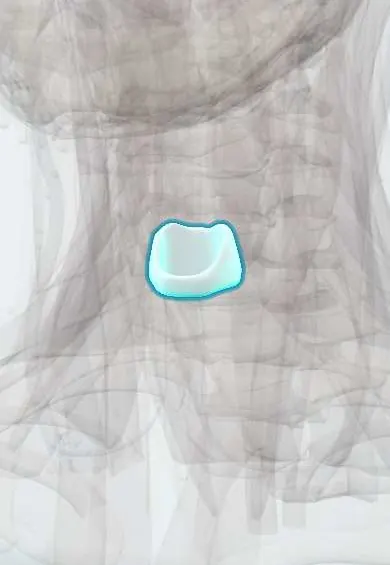
The cricoid cartilage is a ring-shaped cartilage just below the Adam's apple, the only complete ring in the airway; it forms the base of the larynx (voice box).
Opens in the Durgical app, no sign-up needed.
What it is
A signet-ring-shaped cartilage below the thyroid cartilage, the only complete ring in the airway.
What it does
Forms the base of the larynx; the arytenoids sit on top of it.
Key facts
- Where
- C6; only complete cartilage ring of the airway (signet-ring shape)
- Function
- Base for the arytenoids; landmark where the pharynx becomes the oesophagus and the larynx the trachea
Relations
- Above
- Thyroid cartilage, joined in front by the cricothyroid membrane and at the sides by the synovial cricothyroid joints with its inferior horns
- Below
- First tracheal ring, attached by the cricotracheal ligament
- Behind
- Posterior cricoarytenoid muscles on the lamina, then the start of the oesophagus with the cricopharyngeus
- In front
- Cricothyroid muscles on the arch; the isthmus of the thyroid gland lies just below, over the upper tracheal rings
- Lateral
- Lobes of the thyroid gland; the recurrent laryngeal nerve enters the larynx just behind the cricothyroid joint
How to find it
Running a finger down the midline from the thyroid notch, the soft dip of the cricothyroid membrane comes first, then the firm ring of the cricoid arch just below it; it rises on swallowing.
On imaging
Lateral neck radiograph and CT: marks the start of the trachea. In croup the frontal radiograph shows tapering of the subglottic airway (steeple sign); in subglottic stenosis CT or endoscopy shows narrowing at the cricoid ring.
Clinical notes
- Tracheostomy is made below it, usually through the second to fourth tracheal rings; cutting or eroding the cricoid risks subglottic stenosis
- Subglottic stenosis, congenital or after prolonged intubation, centres on this ring
- Fracture in blunt neck trauma (e.g. a clothesline injury) can collapse the airway and injure the recurrent laryngeal nerves
Development
Forms from the cartilage of the sixth pharyngeal arch, like the arytenoids; its hyaline cartilage calcifies and ossifies patchily from early adult life, which can be mistaken for a swallowed foreign body on a neck radiograph.
Related conditions
Test yourself
Think of the answer, then tap the question to see it.
Why is the cricoid cartilage important when intubating children?
Its ring is the narrowest rigid part of the paediatric airway, so a tight tube can cause subglottic swelling and later stenosis.
What is cricoid pressure (Sellick manoeuvre), and what are its drawbacks?
Pressing the cricoid back against the oesophagus to limit regurgitation at induction; its benefit is debated and it can worsen the laryngoscopic view.
What is unique about the cricoid cartilage among airway cartilages?
It is the only complete cartilage ring of the airway (signet-ring shape), at C6.
Why is a tracheostomy made below the cricoid cartilage?
Cutting or eroding the cricoid risks subglottic stenosis; it is usually made through the second to fourth tracheal rings.
Educational information, not medical advice. For any symptom, see a health professional.
Its names
- Official Latin (TA2)
- cartilago cricoidea TA2 978
- Official Spanish (DeCS)
- Cartílago Cricoides DeCS D003413
- English (TA2)
- Cricoid cartilage
- Also called
- cartilago cricoides
Related
Sources: Terminologia Anatomica (TA2); DeCS; Anatomy, Head and Neck, Cricoid Cartilage; Anatomy, Head and Neck: Larynx Cartilage; Anatomy of the Human Body (20th ed.): The Branchial Region (Lea & Febiger (Gray's Anatomy, 1918), 1918) · adapted, Public domain.
Spotted a mistake?We are always improving for the community. Tell us what is wrong and our team will review it.Report a mistake
Representative model, for educational purposes only.