Conditions · Pediatrics and neonatology
Cri-du-chat syndrome (5p deletion) !
A missing piece of chromosome 5. Babies have a high, cat-like cry, a small head, weak muscles and intellectual disability.
Updated 2026-11-01
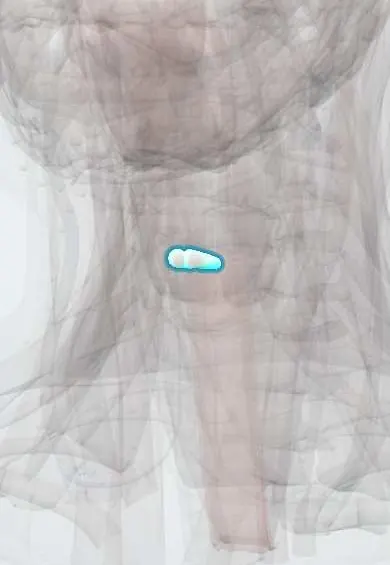
Structures involved
Tap one to see what it is and open it in 3D.
Why it happens
What it is
A chromosomal disorder caused by deletion of part of the short arm of chromosome 5 (5p-). It is named for the high-pitched, mewing cry of affected newborns and causes microcephaly, characteristic facial features, hypotonia and intellectual disability.
Who gets it
About 1 in 20,000 to 50,000 newborns, slightly more frequent in girls, in all populations. It is one of the most common deletion syndromes.
Causes
- Terminal or interstitial deletion of 5p (5p15 critical region), mostly de novo, usually on the paternal chromosome
- About 10 to 15% come from a balanced translocation in a parent
- Loss of genes such as CTNND2 is linked to more severe intellectual disability
Risk factors
- Parent carrying a balanced translocation involving 5p
- Most cases occur without risk factors
Pathophysiology
Loss of genes in the 5p15 region disrupts brain development and growth. The characteristic cry is attributed to abnormal laryngeal development (a small, narrow, diamond-shaped larynx with a floppy epiglottis) together with central nervous system factors. Larger deletions generally cause more severe disability.
Symptoms and signs
- High-pitched, monotonous cat-like cry in infancy, which usually fades with age
- Low birth weight, microcephaly and poor growth
- Round face in infancy, hypertelorism, epicanthal folds, low-set ears, micrognathia, broad nasal bridge
- Hypotonia in infancy, later hypertonia in some children
- Feeding and swallowing difficulties
- Severe intellectual disability and speech delay; hyperactivity and repetitive behaviors
- Congenital heart defects in some children; single palmar crease
Diagnosis
- Clinical
- Suspected in a newborn with the characteristic cry, microcephaly and facial features.
- Tests
- Karyotype may show larger deletions; chromosomal microarray or FISH detects smaller ones and defines size. Parental chromosome studies to look for a balanced translocation.
- Imaging
- Echocardiogram for heart defects; other imaging (renal ultrasound, brain imaging) according to findings. Laryngoscopy if airway problems.
Differential diagnosis
- Other chromosomal syndromes (Down syndrome, trisomy 18, 4p deletion or Wolf-Hirschhorn syndrome)
- Laryngomalacia or vocal cord anomalies with an abnormal cry
- Congenital microcephaly from infection or other causes
Goal of treatment
Support feeding, development and communication, treat associated malformations, and help the family plan care and future pregnancies.
Treatment
- Rehabilitation
- Early intervention with physical, occupational and speech therapy; alternative communication systems such as signs or pictures.
- Conservative
- Feeding support and positioning to reduce aspiration, tube feeding when needed; behavioral support for hyperactivity and self-injury.
- Surgical
- Surgical correction of congenital heart defects or other malformations when indicated.
- Follow-up
- Regular follow-up of growth, hearing, vision, teeth, scoliosis and development; genetic counseling for parents.
Complications
- Aspiration pneumonia and respiratory infections
- Failure to thrive
- Scoliosis
- Severe communication limitation and behavioral problems
- Complications of associated heart defects
Prognosis
Most deaths occur in the first year, mainly from heart defects, pneumonia or feeding problems; beyond infancy life expectancy is close to normal. Most adults need lifelong support, although many learn to walk and communicate.
Prevention
- Genetic counseling and prenatal diagnosis for families with a parental balanced translocation
Test yourself
Think of the answer, then tap the question to see it.
Which chromosome region is deleted in cri-du-chat syndrome?
The short arm of chromosome 5 (5p-).
What is the hallmark sign in the newborn?
A high-pitched, cat-like cry, together with microcephaly and hypotonia.
Which test should be offered to the parents after diagnosis?
Parental chromosome studies to look for a balanced translocation, which raises recurrence risk.
Which heart defects are seen in some affected children?
Ventricular septal defect, patent ductus arteriosus and other congenital heart defects.
Related conditions
- Down syndrome (trisomy 21)
- Trisomy 18 (Edwards) and trisomy 13 (Patau)
- Williams syndrome
- Autism spectrum disorder (ASD)
- Ventricular septal defect
- Patent ductus arteriosus
- Failure to thrive (faltering growth)
- Scoliosis
Educational information, not medical advice. For any symptom, see a health professional.
Sources: Cri-du-chat syndrome (MedlinePlus Genetics (U.S. National Library of Medicine), 2024).
Spotted a mistake?We are always improving for the community. Tell us what is wrong and our team will review it.Report a mistake
Representative model, for educational purposes only.