Nervous system · Head and neck
Fornix !
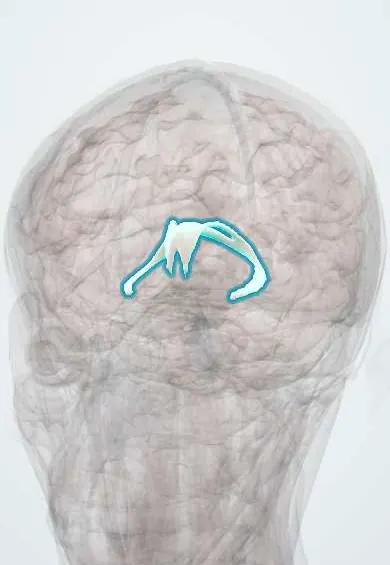
The fornix is an arched band of nerve fibres running from the hippocampus to the mammillary bodies; it carries signals of the memory circuit.
Opens in the Durgical app, no sign-up needed.
What it is
An arched band of fibres from the hippocampus to the mammillary bodies.
What it does
Carries memory circuit signals.
Key facts
- Where
- Arches from the hippocampus to the mammillary bodies under the corpus callosum
- Blood supply
- ACA, PCA branches
- Function
- Output of the hippocampus (Papez circuit)
Relations
- Course
- Fimbria along the hippocampus, crus arching up behind the thalamus under the splenium (the two crura are linked there by the hippocampal commissure), body under the corpus callosum, columns curving down in front of the interventricular foramen to the mammillary bodies
- Above
- Corpus callosum, joined to it in front by the septum pellucidum
- Below
- Roof of the third ventricle (tela choroidea with the internal cerebral veins) and the thalamus
- In front
- Its columns form the front border of the interventricular foramen (of Monro); the anterior commissure crosses just in front of them
- Lateral
- Bodies of the lateral ventricles, with the choroid plexus attached along its edge (choroid fissure)
How to find it
On midsagittal MRI it is the thin arched band under the corpus callosum, joined to it by the septum pellucidum, curving down in front of the thalamus to the mammillary body. On coronal images the paired bodies sit at the lower edge of the septum pellucidum.
On imaging
Wernicke encephalopathy: symmetric high T2/FLAIR signal in the medial thalami, mammillary bodies and periaqueductal grey; in chronic Korsakoff syndrome the mammillary bodies shrink.
Clinical notes
- Approaches to the third ventricle (transcallosal, through the interventricular foramen) put the fornix at risk
- Glucose given without thiamine to a malnourished person can precipitate Wernicke encephalopathy
Development
The C-shaped growth of the hemisphere, as the temporal lobe swings down and forward, explains why the fornix, the lateral ventricles, the tail of the caudate nucleus and the stria terminalis all arch from the frontal region into the temporal lobe.
Related conditions
Test yourself
Think of the answer, then tap the question to see it.
Where does the fornix carry the output of the hippocampus?
Mostly to the mammillary bodies, through the fimbria, crus, body and column, with some fibres to the septal nuclei.
What is the sequence of the Papez circuit?
Hippocampus, fornix, mammillary bodies, mammillothalamic tract, anterior thalamic nucleus, cingulate gyrus, and back to the hippocampus.
What does bilateral fornix injury cause, and in which surgery is it at risk?
Anterograde amnesia; it is at risk in surgery for a colloid cyst of the third ventricle, as its columns border the interventricular foramen.
Educational information, not medical advice. For any symptom, see a health professional.
Its names
- Official Latin (TA2)
- fornix TA2 5633
- Official Spanish (DeCS)
- Fórnix DeCS D020712
- English (TA2)
- Fornix
Related
Sources: Terminologia Anatomica (TA2); DeCS; Neuroanatomy, Limbic System; Neuroanatomy, Mammillary Bodies; Tratado de anatomía humana (9.ª ed.), tomo II, Libro V, cap. VI: Cerebro (configuración exterior e interior, ventrículos, formaciones coroideas, epífisis).
Spotted a mistake?We are always improving for the community. Tell us what is wrong and our team will review it.Report a mistake
Representative model, for educational purposes only.