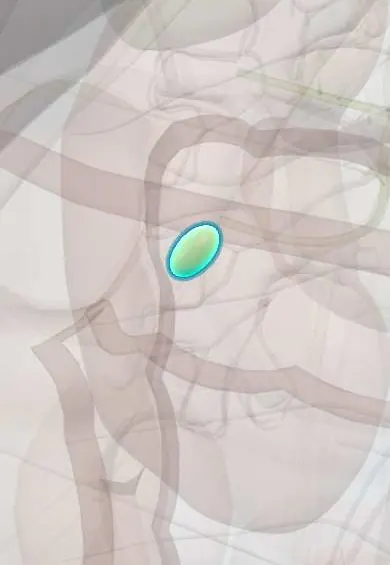
Ampulla of Vater !
The ampulla of Vater is where the bile duct and the main pancreatic duct meet and empty into the duodenum; a stone stuck here can cause pancreatitis.
Official name: Hepatopancreatic ampulla
Opens in the Durgical app, no sign-up needed.
What it is
The small chamber where the bile duct and pancreatic duct meet and open into the duodenum, controlled by the sphincter of Oddi.
What it does
Releases bile and pancreatic juice. A stone stuck here can cause pancreatitis.
Key facts
- Where
- Posteromedial wall of second part of duodenum, about 7–10 cm from pylorus, at major duodenal papilla
- Attaches
- Union of common bile duct and main pancreatic duct; ringed by sphincter of Oddi (hepatopancreatic sphincter)
- Function
- Sphincter of Oddi controls flow of bile and pancreatic juice; marks foregut–midgut junction
- Into
- Duodenum via major duodenal papilla
Relations
- Contents
- Ends of the common bile duct and the main pancreatic duct; the sphincter of Oddi is made of a bile duct sphincter, a pancreatic duct sphincter and an ampullary sphincter
- Above
- Minor duodenal papilla, higher up and a little more anterior, where the accessory pancreatic duct opens
- Medial
- Head of the pancreas, against the posteromedial wall of the second part of the duodenum
How to find it
At endoscopy the major duodenal papilla is found on the medial wall of the second part of the duodenum, at the lower end of a longitudinal mucosal fold, often under a transverse hooding fold. In open surgery it is felt through the duodenal wall after a Kocher maneuver.
On imaging
Not seen on radiographs, and ultrasound often loses it behind duodenal gas; it is found by following the common bile duct down. CT and MRCP show the ducts ending at the papilla in the second part of the duodenum. Classic finding: the double duct sign, with dilated bile and pancreatic ducts from a periampullary tumor. Endoscopic ultrasound and ERCP give close views and allow biopsy.
Common problems
- A gallstone stuck in it: jaundice, pain, and sometimes infection (cholangitis) or pancreatitis.
- Injury during cholecystectomy (rare but serious).
How it is diagnosed
Blood tests, ultrasound, MRI (MRCP).
Treatment
- Stones removed by ERCP (an endoscope through the mouth to the duodenum), then usually cholecystectomy.
Clinical notes
- Ampullary carcinoma tends to cause jaundice early, so it is often found sooner and has a better outlook than pancreatic head cancer; intermittent jaundice with hidden bleeding (silver-coloured stool) is the classic picture
- Pancreatitis is the most common complication of ERCP
- Sphincter of Oddi dysfunction is a debated cause of biliary-type pain after cholecystectomy
Anatomical variants
- The bile and pancreatic ducts may share a common channel of variable length, open separately on the same papilla, or open on different papillae
- The papilla may sit lower than usual or inside a periampullary diverticulum, which makes cannulation at ERCP harder
Development
The major papilla marks the junction of the embryonic foregut and midgut: the duodenum above it is supplied by celiac branches, the duodenum below it by superior mesenteric branches.
Related conditions
Test yourself
Think of the answer, then tap the question to see it.
Where is the ampulla of Vater?
At the major duodenal papilla on the posteromedial wall of the second part of the duodenum, where the common bile duct and main pancreatic duct unite.
How can a gallstone cause pancreatitis at the ampulla of Vater?
A stone passing through or stuck at the ampulla blocks pancreatic outflow (Opie common channel theory).
Why does ampullary carcinoma tend to have a better outlook than pancreatic head cancer?
It blocks bile early, causing jaundice sooner, so it is often found earlier.
Educational information, not medical advice. For any symptom, see a health professional.
Its names
- Official Latin (TA2)
- ampulla hepatopancreatica TA2 3111
- Official Spanish (DeCS)
- Ampolla hepatopancreática DeCS D014670
- English (TA2)
- Hepatopancreatic ampulla
- Also called
- biliaropancreatic ampulla
Related
Sources: Terminologia Anatomica (TA2); DeCS; Anatomy, Abdomen and Pelvis, Sphincter of Oddi (Hepatopancreatic Sphincter); Anatomy, Abdomen and Pelvis: Biliary Ducts.
Spotted a mistake?We are always improving for the community. Tell us what is wrong and our team will review it.Report a mistake
Representative model, for educational purposes only.