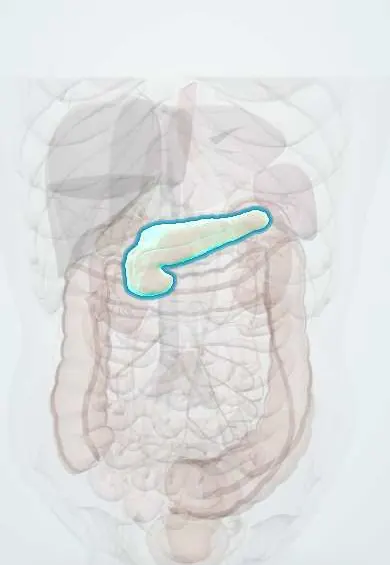
Acute pancreatitis !
Acute pancreatitis is sudden inflammation of the pancreas, most often from gallstones or alcohol; it causes severe upper belly pain and can become serious.
Updated 2026-10-29
Structures involved
Tap one to see what it is and open it in 3D.
- Pancreas
- Pancreatic duct
- Ampulla of Vater
- Common bile duct
- Duodenum
- Splenic vein
- Splenic artery
- Stomach
- Peritoneum
In biochemistry
- Lipoprotein lipase (LPL)
- Lipoprotein metabolism
- Chylomicron
- Amylase as a lab test
- Lipase as a lab test
- Fredrickson classification of hyperlipoproteinaemias
- Lactate dehydrogenase (LDH) as a lab marker
- Allosteric and covalent regulation of enzymes
- Isoenzymes
Microorganisms that cause it
In histology
In embryology
In the clinical exam
- Abdominal regions and quadrants: what lies under each
- Cullen and Grey Turner signs
- Acute abdomen and peritoneal irritation
In physiology
Why it happens
- Pathologic calcification: dystrophic vs metastatic
- Apoptosis vs necrosis: the comparison table
- Alcohol: how it injures the liver, brain, heart and fetus
- Other forms of cell death: necroptosis, pyroptosis, ferroptosis
- Patterns of necrosis: coagulative, liquefactive, caseous, fat, fibrinoid, gangrenous
What it is
Acute inflammation of the pancreas from premature activation of its digestive enzymes. Most cases are mild, but some cause necrosis, organ failure and death.
Who gets it
A frequent cause of hospital admission for abdominal pain. In Colombia and much of Latin America, gallstones are the leading cause; alcohol is the second.
Causes
- Gallstones (biliary pancreatitis), the most common cause
- Alcohol
- Very high triglycerides
- After ERCP
- Drugs (for example some diuretics, azathioprine, valproic acid), hypercalcaemia, trauma
- Infections, tumours, anatomical variants; some cases are idiopathic
Risk factors
- Gallstones
- Heavy alcohol use
- Smoking
- Severe hypertriglyceridaemia
- Obesity (also linked to more severe disease)
Pathophysiology
Duct obstruction or acinar injury activates trypsin inside the pancreas, which turns on other enzymes and digests the gland. Local inflammation spreads into a systemic inflammatory response that increases capillary leak and can cause shock, lung and kidney failure. Necrotic tissue may later become infected.
Classification
- Revised Atlanta classification: mild (no organ failure), moderately severe (transient organ failure under 48 hours or local complications), severe (persistent organ failure over 48 hours)
- Interstitial oedematous or necrotising pancreatitis
- Local complications: acute peripancreatic fluid collection, pseudocyst, acute necrotic collection, walled-off necrosis
Symptoms and signs
- Sudden, severe, constant epigastric pain, often radiating to the back
- Nausea and vomiting
- Epigastric tenderness, sometimes distension and reduced bowel sounds
- Fever and tachycardia
- Rarely, flank or periumbilical bruising (Grey Turner and Cullen signs) in haemorrhagic disease
Diagnosis
- Clinical
- Revised Atlanta: two of three criteria: typical abdominal pain, serum lipase (or amylase) at least three times the upper limit of normal, and imaging findings. Severity scores include BISAP and APACHE II.
- Tests
- Lipase is preferred over amylase. Liver tests (a rise in ALT suggests a biliary cause), triglycerides, calcium, blood count, urea, creatinine and blood gases or lactate.
- Imaging
- Ultrasound early to look for gallstones. Contrast CT is not needed when the diagnosis is clear; it is used if the diagnosis is uncertain or after about 72 hours when complications are suspected.
Differential diagnosis
- Perforated peptic ulcer
- Acute cholecystitis or cholangitis
- Acute mesenteric ischaemia
- Bowel obstruction
- Ruptured abdominal aortic aneurysm
- Inferior myocardial infarction
Goal of treatment
Support the patient through the inflammatory phase, prevent organ failure, treat the cause and manage local complications.
Treatment
- Acute
- Goal-directed intravenous fluids, usually balanced crystalloids such as lactated Ringer's, with close monitoring to avoid both under- and over-filling.
- Medical
- Pain control with analgesics, including opioids when needed.
- Medical
- Early oral or enteral feeding as tolerated, rather than prolonged fasting. Antibiotics are not given routinely; they are used for infected necrosis or another infection.
- Procedure
- ERCP urgently when there is associated cholangitis or persistent bile duct obstruction.
- Surgical
- Cholecystectomy during the same admission for mild gallstone pancreatitis; infected necrosis is managed by a step-up approach (drainage, then endoscopic or surgical necrosectomy).
- Lifestyle
- Stopping alcohol and smoking; treatment of high triglycerides.
Complications
- Organ failure: shock, respiratory failure (ARDS), acute kidney injury
- Pancreatic necrosis, which may become infected
- Pseudocyst or walled-off necrosis
- Splenic vein thrombosis and pseudoaneurysm
- Recurrent attacks and chronic pancreatitis
- Diabetes after severe necrosis
Prognosis
Mild pancreatitis usually resolves within a week. Persistent organ failure and infected necrosis carry substantial mortality.
Prevention
- Cholecystectomy after gallstone pancreatitis
- Stopping alcohol and smoking
- Controlling high triglycerides
Test yourself
Think of the answer, then tap the question to see it.
What are the two most common causes of acute pancreatitis?
Gallstones and alcohol.
How is acute pancreatitis diagnosed under the revised Atlanta classification?
Two of three: typical epigastric pain, lipase or amylase at least three times the upper limit of normal, and characteristic imaging.
What separates moderately severe from severe acute pancreatitis in the revised Atlanta classification?
Organ failure that resolves within 48 hours (moderately severe) versus organ failure lasting more than 48 hours (severe).
What is the cornerstone of early management?
Goal-directed intravenous fluids, analgesia and early feeding, with close monitoring for organ failure.
When is urgent ERCP indicated in gallstone pancreatitis?
When there is associated cholangitis or persistent common bile duct obstruction.
Related conditions
- Gallstones (cholelithiasis)
- Choledocholithiasis
- Acute cholangitis
- Acute cholecystitis
- Acute mesenteric ischaemia
- Peptic ulcer disease
- Small bowel obstruction
- Chronic pancreatitis
Educational information, not medical advice. For any symptom, see a health professional.
Sources: Acute Pancreatitis (StatPearls (NCBI Bookshelf), 2025).
Spotted a mistake?We are always improving for the community. Tell us what is wrong and our team will review it.Report a mistake
Representative model, for educational purposes only.