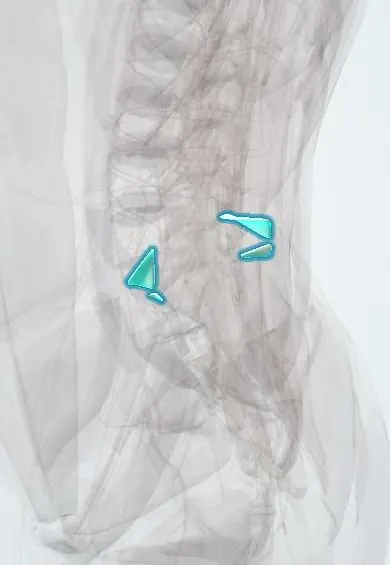
Iliolumbar ligament !
The iliolumbar ligament is a strong band from L5 to the back of the iliac crest; it ties the lowest vertebra to the pelvis.
Opens in the Durgical app, no sign-up needed.
What it is
A strong band from the transverse process of L5 (sometimes L4) to the back of the iliac crest.
What it does
Ties the lowest lumbar vertebra to the pelvis, stopping L5 from slipping forward or bending too far sideways.
Key facts
- Attaches
- Tip of L5 transverse process (± L4) to posterior inner lip of iliac crest; lower band (lumbosacral ligament) to sacral ala
- Function
- Anchors L5 to the pelvis; resists forward slip, rotation and side bending of L5 on S1
- Tight in
- Lateral flexion to the opposite side; flexion
Relations
- Above
- Quadratus lumborum, which arises partly from it and from the iliac crest
- In front
- Psoas major, with the iliolumbar vessels running nearby toward the iliac fossa
- Behind
- Erector spinae and multifidus
- Below
- Its lower band, the lumbosacral ligament, and the anterior sacroiliac ligament, with which it blends
How to find it
Not palpable; its iliac end lies deep at the back of the iliac crest, just in front of the sacroiliac joint. In dissection it is found by following the L5 transverse process outward: psoas major lies in front of it, quadratus lumborum above and the deep back muscles behind.
On imaging
Coronal and axial MRI show it as a dark band from the L5 transverse process to the iliac crest. CT of the pelvis shows L5 transverse process avulsions in pelvic trauma.
Common problems
- Strain can cause low back pain on one side, near the top of the pelvis.
How it is diagnosed
Exam (tenderness and pain with side bending); imaging mainly rules out other causes.
Treatment
- Physical therapy and pain medicine; sometimes an injection.
Clinical notes
- In vertical shear pelvic fractures it can pull off the tip of the L5 transverse process
- Iliolumbar syndrome: localised pain at the back of the iliac crest attributed to this ligament; the diagnosis is clinical and debated
- A thinner, weaker iliolumbar ligament has been reported with lumbosacral transitional vertebrae, changing how load passes to the level above
Development
In children it is largely muscle, part of quadratus lumborum, and becomes ligament by adulthood.
Related conditions
Test yourself
Think of the answer, then tap the question to see it.
Where does the iliolumbar ligament attach?
From the tip of the L5 transverse process (sometimes L4) to the posterior inner lip of the iliac crest; its lower band (lumbosacral ligament) reaches the sacral ala.
What does the iliolumbar ligament do?
Anchors L5 to the pelvis, resisting forward slip, rotation and side bending of L5 on S1.
In pelvic trauma, what can a fracture of the L5 transverse process signal?
An unstable pelvic ring injury, such as a vertical shear fracture, where the iliolumbar ligament pulls off the tip of the process.
How does the iliolumbar ligament help explain why L4–L5 degenerates and slips more than L5–S1?
It holds L5 firmly to the pelvis, so the L4–L5 level above is more mobile.
Educational information, not medical advice. For any symptom, see a health professional.
Its names
- Official Latin (TA2)
- ligamentum iliolumbale TA2 1853
- Official Spanish (DeCS)
- Ligamento iliolumbar
- English (TA2)
- Iliolumbar ligament
Related
Sources: Terminologia Anatomica (TA2); Anatomy, Back, Lumbar Spine; Anatomy of the Human Body (20th ed.): Articulation of the Vertebral Column with the Pelvis (Lea & Febiger (Gray's Anatomy, 1918), 1918) · adapted, Public domain.
Spotted a mistake?We are always improving for the community. Tell us what is wrong and our team will review it.Report a mistake
Representative model, for educational purposes only.