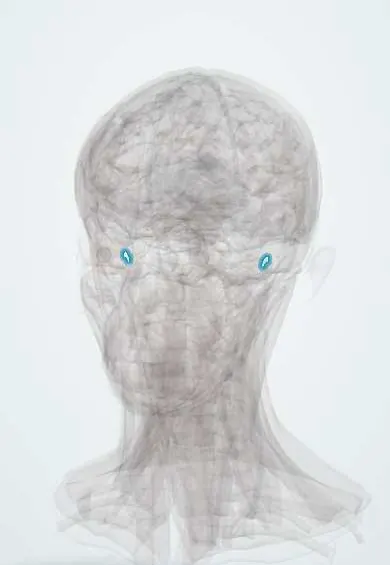
Incus !
The incus (anvil) is the middle of the three tiny ear bones; it passes vibrations from the malleus to the stapes on their way to the inner ear.
Opens in the Durgical app, no sign-up needed.
What it is
The middle ossicle.
What it does
Passes and amplifies the eardrum's vibrations to the inner ear.
Key facts
- Joints with
- Malleus, stapes
- Landmarks
- Body, short and long limbs, lenticular process
Relations
- In front
- Head of the malleus at the incudomalleolar joint
- Behind
- Short limb in the fossa incudis at the aditus to the mastoid antrum; the facial nerve lies just medial and below
- Below
- Long limb descending behind and parallel to the handle of the malleus, ending in the lenticular process that joins the head of the stapes
- Lateral
- Chorda tympani, crossing between its long limb and the handle of the malleus; the posterosuperior part of the eardrum
- Above
- Body in the epitympanic recess under the tegmen tympani
How to find it
The long limb can often be seen as a faint vertical shadow through the posterosuperior quadrant of a thin, translucent eardrum. At surgery the body and short limb are found in the attic; through a mastoidectomy the short limb is seen pointing into the aditus.
Examination
- Tympanometry: an unusually tall, very compliant peak (type Ad) with a conductive loss points to a break in the chain, most often at the incudostapedial joint
- Pure-tone audiometry: an air–bone gap that persists behind an intact drum after head injury suggests a dislocated incus
On imaging
On axial temporal bone CT its body and short process form the cone of the «ice cream cone», with the malleus head as the scoop. Oblique and coronal images follow the long process down to the stapes. Look for erosion of the long process in chronic otitis and cholesteatoma, and after head injury for a widened incudomalleolar joint or a separated incudostapedial joint.
Clinical notes
- Erosion of the long limb breaks the chain at the incudostapedial joint: conductive loss that can be repaired by ossiculoplasty
- Incus interposition: the patient's own incus is removed, reshaped and placed between the malleus handle and the stapes head
- In a mastoidectomy, the short limb and the lateral semicircular canal guide the surgeon to the second bend of the facial nerve
- Traumatic incudostapedial separation is suspected when conductive loss persists after the blood behind a perforated or intact drum has cleared
Development
Comes mainly from the first pharyngeal arch (Meckel cartilage), with the malleus (some texts: the long limb from the second arch).
Related conditions
Test yourself
Think of the answer, then tap the question to see it.
Which part of the ossicular chain is most often eroded in chronic otitis media, and why?
The long limb of the incus, because its blood supply is poor.
Which ossicle is most often dislocated by head injury or temporal bone fracture?
The incus, causing conductive hearing loss after trauma.
Why is the short limb of the incus important in mastoid surgery?
It points to the aditus and, with the lateral semicircular canal, guides the surgeon to the second bend of the facial nerve.
Educational information, not medical advice. For any symptom, see a health professional.
Its names
- Official Latin (TA2)
- incus TA2 888
- Official Spanish (DeCS)
- Yunque DeCS D007188
- English (TA2)
- Incus
- Also called
- anvil
Related
Sources: Terminologia Anatomica (TA2); DeCS; Ear, Hearing, and Facial Nerve Evaluation; Physiology, Ear.
Spotted a mistake?We are always improving for the community. Tell us what is wrong and our team will review it.Report a mistake
Representative model, for educational purposes only.