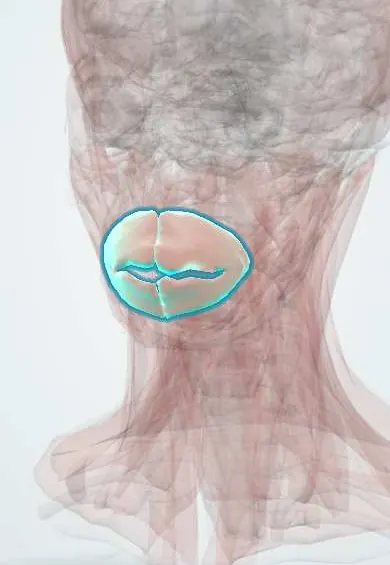
Cleft lip and palate !
Cleft lip and palate is a gap in the upper lip, the roof of the mouth or both, present from birth because the face did not fully join before birth.
Updated 2026-10-29
Structures involved
Tap one to see what it is and open it in 3D.
In embryology
- The pharyngeal apparatus: arches, pouches, clefts and membranes
- The face: five prominences
- Palate: primary and secondary palate
- Cleft lip and cleft palate
- First-arch syndromes: Treacher Collins and Pierre Robin sequence
- Holoprosencephaly
- Malformation, disruption, deformation, sequence, syndrome, association
- Valproate, carbamazepine and phenytoin
- Ionizing radiation, tobacco and cocaine
Why it happens
What it is
A congenital gap in the upper lip, the palate, or both, caused by incomplete fusion of facial processes in early pregnancy. It can occur alone or as part of a syndrome.
Who gets it
One of the most common birth defects of the face. Cleft lip with or without cleft palate is more frequent in males and in some Asian and Latin American groups; isolated cleft palate is more frequent in females.
Causes
- Multifactorial: genetic susceptibility plus environmental factors
- Part of a syndrome in some cases (for example 22q11.2 deletion, Van der Woude syndrome, Pierre Robin sequence)
Risk factors
- Family history of clefts
- Maternal smoking and alcohol use in pregnancy
- Some antiepileptic drugs and retinoids in pregnancy
- Maternal diabetes and obesity
- Low folate intake
Pathophysiology
Cleft lip results from failure of the medial nasal process to fuse with the maxillary process (weeks 4–7). Cleft palate results from failure of the palatal shelves to fuse in the midline (weeks 8–12). The open palate lets the mouth and nose communicate, which disturbs feeding, speech and the function of the auditory tube.
Classification
- Cleft lip alone, cleft lip and palate, isolated cleft palate
- Unilateral or bilateral; complete or incomplete
- Submucous cleft palate (bifid uvula, notched hard palate)
Symptoms and signs
- Visible gap in the lip, often extending into the nostril
- Gap in the roof of the mouth
- Feeding difficulty, nasal regurgitation and poor weight gain
- Nasal (hypernasal) speech
- Recurrent middle-ear effusion and hearing loss
- Dental anomalies
Diagnosis
- Clinical
- Examination at birth, including palpation and inspection of the whole palate to avoid missing an isolated or submucous cleft.
- Tests
- Genetic evaluation when other anomalies suggest a syndrome; newborn hearing screening.
- Imaging
- Often detected on prenatal ultrasound (cleft lip more readily than isolated cleft palate).
Differential diagnosis
- Submucous cleft palate
- Velopharyngeal insufficiency of other causes
- Pierre Robin sequence
- Facial clefts of other types
Goal of treatment
Restore the form and function of lip and palate, and support feeding, speech, hearing, dentition and growth through multidisciplinary care.
Treatment
- Conservative
- Feeding support with special bottles and nipples; nasoalveolar moulding before lip repair in some centres.
- Surgical
- Lip repair in the first months of life and palate repair around the first year; later alveolar bone grafting, and nose or jaw surgery when needed.
- Rehabilitation
- Speech therapy for resonance and articulation.
- Procedure
- Ventilation tubes for persistent middle-ear effusion.
- Follow-up
- Long-term follow-up by a cleft team: hearing, dental and orthodontic care, growth and psychosocial support.
Complications
- Feeding problems and poor growth
- Otitis media with effusion and conductive hearing loss
- Speech disorders and velopharyngeal insufficiency
- Dental and orthodontic problems
- Oronasal fistula after repair
Prognosis
With timely surgery and team care, most children achieve good appearance, speech and function, though several procedures over childhood are common.
Prevention
- Adequate folic acid before and during early pregnancy
- Avoiding tobacco and alcohol in pregnancy
Test yourself
Think of the answer, then tap the question to see it.
Failure of which processes to fuse causes cleft lip?
The medial nasal process and the maxillary process.
Why do children with cleft palate get frequent middle-ear effusions?
The tensor veli palatini is poorly anchored, so the auditory tube does not open properly.
Which triad defines Pierre Robin sequence?
Micrognathia, glossoptosis and airway obstruction, often with a U-shaped cleft palate.
What signs suggest a submucous cleft palate?
A bifid uvula, a notch in the back of the hard palate and a translucent midline zone of the soft palate.
Related conditions
Educational information, not medical advice. For any symptom, see a health professional.
Sources: Cleft Lip (StatPearls (NCBI Bookshelf), 2023).
Spotted a mistake?We are always improving for the community. Tell us what is wrong and our team will review it.Report a mistake
Representative model, for educational purposes only.