Cardiovascular system · Upper limb
Superficial palmar arch !
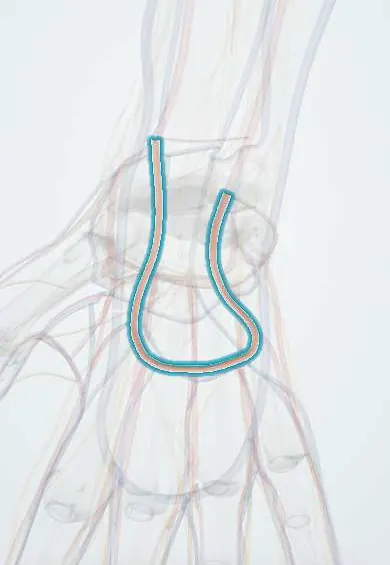
The superficial palmar arch is a loop of artery under the palm's tough sheet, mainly from the ulnar artery; it sends blood to the fingers.
Opens in the Durgical app, no sign-up needed.
What it is
An arch of artery across the palm just beyond the carpal tunnel; surgeons keep it safe during carpal tunnel release.
What it does
Sends blood to the fingers; it lies just beyond the carpal tunnel.
Key facts
- Origin
- Mainly the ulnar artery (+ superficial palmar branch of the radial artery)
- Branches
- Common palmar digital arteries
- Supplies
- Fingers; level with the distal border of the abducted thumb (Kaplan's line)
Relations
- Course
- The ulnar artery leaves the Guyon canal, gives off its deep palmar branch and curves laterally across the palm toward the thenar eminence, where it meets a radial branch (superficial palmar, princeps pollicis or radialis indicis)
- Superficial
- Palmar aponeurosis, palmaris brevis on the ulnar side, and skin
- Deep
- Long flexor tendons, lumbricals and the digital nerves (branches of the median and ulnar nerves)
How to find it
Not felt as a pulse. Lines drawn on the palm are used to estimate where it lies when planning incisions; Doppler ultrasound shows the arch and its flow directly.
Examination
- Allen test: after the palm blanches, each wrist artery is released in turn; slow refilling from one side suggests the arch does not link the two sources
On imaging
Doppler ultrasound shows it just deep to the palmar aponeurosis, roughly level with the distal border of the fully extended thumb. CT, MR or catheter angiography show whether the arch is complete, which matters before radial artery harvest, and reveal emboli or aneurysm in hypothenar hammer syndrome. Radiographs only show calcified arteries, as in diabetes or chronic kidney disease.
Clinical notes
- Because the arch fills from both sides, a cut through it bleeds from both ends, and both ends are controlled
- When the arch is incomplete, losing one forearm artery (after access, harvest or a dialysis fistula) is more likely to leave fingers short of blood
- Hypothenar hammer syndrome damages the ulnar artery where it begins the arch over the hook of the hamate, sending clots to the fingers
- Surgery for Dupuytren disease works just above the arch and the common digital vessels
Anatomical variants
- Complete in most hands but incomplete in a sizeable minority, more often than the deep arch; reported rates vary widely with the definition used
- Patterns include the classic radio-ulnar arch, an arch formed by the ulnar artery alone and arches joined by a persistent median artery
Development
Early in development the median artery, running with the median nerve, is the main supply of the forearm and palm; it normally regresses once the radial and ulnar arteries grow. If it persists, it can pass through the carpal tunnel and join this arch.
Related conditions
Test yourself
Think of the answer, then tap the question to see it.
Which artery mainly forms the superficial palmar arch?
The ulnar artery, completed in many hands by the superficial palmar branch of the radial artery.
How do the arteries and digital nerves relate in the palm and in the fingers?
In the palm the arteries (superficial palmar arch) lie superficial to the digital nerves; in the fingers the nerves move palmar to the arteries.
Why does a cut through the superficial palmar arch need control of both ends?
The arch fills from both sides, so it bleeds from both ends.
Educational information, not medical advice. For any symptom, see a health professional.
Its names
- Official Latin (TA2)
- arcus palmaris superficialis TA2 4671
- Official Spanish (DeCS)
- Arco palmar superficial
- English (TA2)
- Superficial palmar arch
Related
Sources: Terminologia Anatomica (TA2); Anatomy, Shoulder and Upper Limb, Hand Volar Arch Arteries; Anatomy of the Human Body (20th ed.): Development of the Vascular System (Lea & Febiger (Gray's Anatomy, 1918), 1918) · adapted, Public domain; Tratado de anatomía humana (9.ª ed.), tomo II, Libro IV Angiología, arterias subclavia, axilar, humeral, radial y cubital, arcos palmares y vías anastomóticas del miembro superior.
Spotted a mistake?We are always improving for the community. Tell us what is wrong and our team will review it.Report a mistake
Representative model, for educational purposes only.