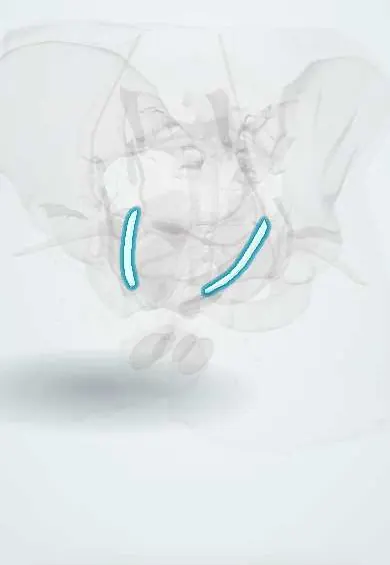
Tendinous arch of levator ani !
The tendinous arch of levator ani is a band of thick fascia on the pelvic side wall; the levator ani muscle hangs from it.
Opens in the Durgical app, no sign-up needed.
What it is
A thickened line of fascia on the obturator internus, from the pubis to the ischial spine.
What it does
The levator ani hangs from it; when the vagina's side support tears from it, the bladder can sag (paravaginal defect).
Key facts
- Where
- Thickened band of obturator fascia from the back of the pubis to the ischial spine
- Attaches
- Origin of pubococcygeus and iliococcygeus; the tendinous arch of pelvic fascia (white line) runs just below it to the vaginal side wall
- Function
- Lateral anchor of the pelvic floor; detachment of the vaginal support from the white line = paravaginal defect
Relations
- In front
- Back of the body of the pubis, near the pubic symphysis
- Behind
- Ischial spine, where it ends together with the tendinous arch of pelvic fascia
- Above
- Pelvic part of the obturator internus; further up and in front, the obturator canal with the obturator nerve and vessels
- Below
- Perineal part of the obturator internus, whose fascia contains the pudendal canal
- Medial
- Origins of the pubococcygeus (front) and iliococcygeus (back); slightly lower, the tendinous arch of pelvic fascia
How to find it
It cannot be felt. In the retropubic space (space of Retzius), opened through the abdomen or by laparoscopy, it appears as a white line on the obturator fascia from the back of the pubis to the ischial spine. The ischial spine is its posterior landmark on vaginal examination.
On imaging
Not seen on radiographs. High-resolution MRI can show it as a thin dark line on the obturator internus fascia, running from the back of the pubis to the ischial spine, where the levator ani arises. It is assessed together with the muscle: after levator injury, MRI shows the muscle detached or thinned below this line. Its course is found from the pubic and ischial spine landmarks.
Common problems
- Stretching or tearing in vaginal birth.
- Pelvic organ prolapse.
- Urinary or faecal incontinence.
- Overactive, painful pelvic floor (pain with sex, pelvic pain).
How it is diagnosed
Pelvic examination, sometimes ultrasound or MRI of the pelvic floor.
Treatment
- Pelvic floor muscle training (Kegel exercises) with a physiotherapist.
- A pessary (a removable support placed in the vagina).
- Surgery for prolapse that bothers the person.
Clinical notes
- Paravaginal repair reattaches the lateral vaginal wall to the tendinous arch of pelvic fascia when it has torn away, a cause of anterior wall prolapse
- The ischial spine, where both arches end, is the key landmark for sacrospinous and iliococcygeus fixations and for pudendal block
- Transobturator slings and retropubic sutures pass close to the obturator neurovascular bundle above the arch
Anatomical variants
- The levator ani can be joined to the arch only loosely, leaving gaps between muscle and arch (hiatus of Schwalbe) through which a rare pelvic floor hernia may pass
Memory aid
Two white lines on the side wall: the upper one hangs the muscle (levator ani), the lower one hangs the vagina (pelvic fascia).
Test yourself
Think of the answer, then tap the question to see it.
What does the tendinous arch of levator ani divide the obturator internus into?
A pelvic part above (lateral pelvic wall) and a perineal part below (lateral wall of the ischioanal fossa).
Between which two points does the tendinous arch of levator ani run?
From the back of the body of the pubis to the ischial spine, along the obturator internus fascia.
How does the tendinous arch of levator ani differ from the tendinous arch of pelvic fascia?
The levator arch hangs the levator ani; the pelvic fascia arch (white line) lies just below and medial and anchors the anterior vaginal wall.
Educational information, not medical advice. For any symptom, see a health professional.
Its names
- Official Latin (TA2)
- arcus tendineus levatoris ani TA2 2434
- Official Spanish (DeCS)
- Arco tendinoso del músculo elevador del ano
- English (TA2)
- Tendinous arch of levator ani
- Also called
- tendinous arch of levator ani muscle · arcus tendineus musculi levatoris ani · arcus tendineus fasciae obturatoriae
Related
Sources: Terminologia Anatomica (TA2); Anatomy, Abdomen and Pelvis: Levator Ani Muscle; Anatomy, Abdomen and Pelvis: Pelvic Floor.
Spotted a mistake?We are always improving for the community. Tell us what is wrong and our team will review it.Report a mistake
Representative model, for educational purposes only.