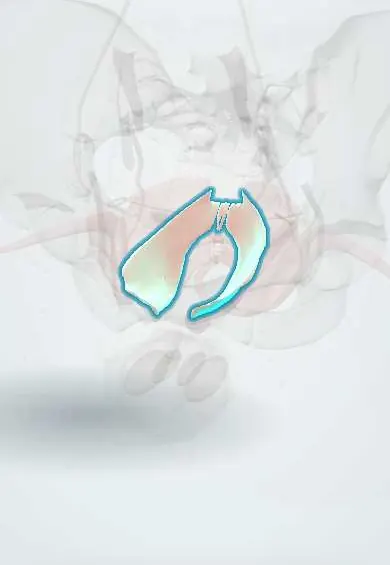
Pubococcygeus !
The pubococcygeus is a pelvic floor muscle running from the pubic bone to the tailbone; it supports the organs and is the muscle trained in Kegel exercises.
Official name: Pubococcygeus muscle
Opens in the Durgical app, no sign-up needed.
What it is
The main front part of the levator ani, from the back of the pubic bone to the coccyx; its inner fibres hug the vagina.
What it does
Supports the organs and tightens around the urethra, vagina and rectum; it is the muscle trained in Kegel exercises.
Key facts
- Origin
- Back of the body of the pubis and anterior tendinous arch of levator ani
- Insertion
- Anococcygeal body and coccyx; medial fibres into the vaginal wall and perineal body (pubovaginalis)
- Action
- Supports pelvic organs; constricts the vagina and helps close the urethra and anorectum
- Nerve
- Nerve to levator ani (S3–S4) and pudendal nerve (S2–S4) branches
- Blood supply
- Inferior gluteal, internal pudendal and inferior vesical/vaginal arteries
Relations
- In front
- Back of the body of the pubis beside the pubic symphysis; the retropubic space and the urinary bladder lie above it
- Medial
- The levator hiatus with the urethra, the vagina (women) or the prostate (men), and the anorectum
- Lateral
- Obturator internus and its fascia, joined at the tendinous arch of levator ani
- Behind
- Iliococcygeus, continuing the floor back towards the coccyx
- Below
- Perineal membrane and the anterior recesses of the ischioanal fossa
How to find it
On vaginal examination it is felt on the side walls a few centimetres inside the opening; when the person squeezes as if holding back urine, the muscle tightens around the examining finger and lifts it up and forward. In men it is assessed through the rectum.
Examination
- Digital assessment of pelvic floor contraction graded on the Modified Oxford scale, from 0 (no contraction) to 5 (strong contraction against resistance); a low grade means a weak voluntary contraction
- Perineometry: a vaginal pressure probe records the squeeze; a low reading means a weak contraction
On imaging
Seen on pelvic floor MRI (axial and coronal T2) and on 3D transperineal ultrasound as part of the levator ani bordering the hiatus. The classic finding after vaginal birth is avulsion of the pubovisceral muscle from the inner surface of the pubic bone, seen as loss of its attachment on one or both sides. Ultrasound also shows how far the hiatus widens on straining (ballooning).
Common problems
- Stretching or tearing in vaginal birth.
- Pelvic organ prolapse.
- Urinary or faecal incontinence.
- Overactive, painful pelvic floor (pain with sex, pelvic pain).
How it is diagnosed
Pelvic examination, sometimes ultrasound or MRI of the pelvic floor.
Treatment
- Pelvic floor muscle training (Kegel exercises) with a physiotherapist.
- A pessary (a removable support placed in the vagina).
- Surgery for prolapse that bothers the person.
Clinical notes
- Pelvic floor muscle training aims to strengthen voluntary contraction of the pubococcygeus and puborectalis; it is one of the most studied first-line approaches for stress incontinence and mild prolapse
- Avulsion of its pubic attachment after vaginal birth, more often with forceps and in a first birth, is associated with later prolapse, especially of the anterior vaginal wall
- In men, the levator prostatae fibres beside the prostate are part of the support preserved in radical prostatectomy to help early urinary continence
Related conditions
Test yourself
Think of the answer, then tap the question to see it.
What do the medial edges of the pubococcygeus bound, and what passes through it?
The levator (urogenital) hiatus: the urethra, the vagina in women and the anorectum pass through it.
Which part of the levator ani is most often torn from the pubic bone in vaginal birth?
The pubovisceral muscle (pubococcygeus with puborectalis): levator avulsion, more often with forceps and in a first birth.
How does contraction of the pubococcygeus contribute to urinary continence?
It lifts the bladder neck and urethra up and forward against the pubis; losing this support contributes to stress urinary incontinence.
What scale grades a digital assessment of pubococcygeus contraction?
The Modified Oxford scale, from 0 (no contraction) to 5 (strong contraction against resistance).
Educational information, not medical advice. For any symptom, see a health professional.
Its names
- Official Latin (TA2)
- musculus pubococcygeus TA2 2405
- Official Spanish (DeCS)
- Músculo pubococcígeo DeCS D017773
- English (TA2)
- Pubococcygeus muscle
Related
Sources: Terminologia Anatomica (TA2); DeCS; Anatomy, Abdomen and Pelvis: Levator Ani Muscle; Anatomy, Abdomen and Pelvis: Pelvic Floor.
Spotted a mistake?We are always improving for the community. Tell us what is wrong and our team will review it.Report a mistake
Representative model, for educational purposes only.