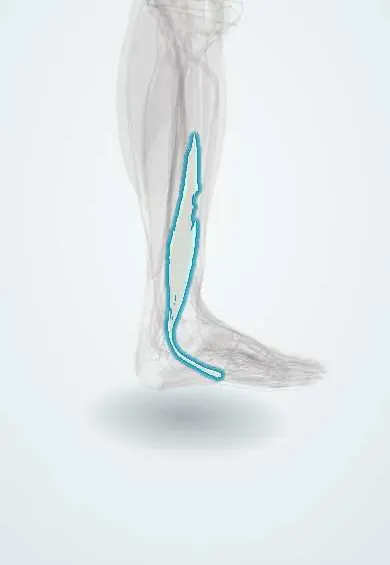
Fibularis brevis tendon !
The fibularis brevis tendon runs behind the outer ankle bone to the base of the fifth metatarsal; it turns the foot outward.
Official name: Tendon of fibularis brevis
Opens in the Durgical app, no sign-up needed.
What it is
The tendon of the fibularis brevis. It runs behind the outer ankle bone to the base of the fifth metatarsal.
What it does
Turns the foot outward and helps protect the ankle from rolling inward.
Key facts
- Attaches
- Behind the lateral malleolus in the retromalleolar groove (deep to the longus), under the superior fibular retinaculum and above the fibular trochlea, to the tuberosity of the fifth metatarsal
- Function
- Main evertor; dynamic restraint against inversion sprains; a longitudinal split tear can occur where it presses on the fibula
- Tight in
- Inversion with dorsiflexion
Relations
- Course
- Down the lateral leg, in the groove behind the lateral malleolus, then forward above the fibular trochlea along the outer calcaneus and cuboid to the fifth metatarsal tuberosity
- Superficial
- Fibularis longus tendon and the superior fibular retinaculum
- Deep
- Groove on the back of the fibula; below the malleolus, the CFL
- Below
- Fibularis longus tendon, which runs below the fibular trochlea
How to find it
With the foot turned out against resistance, the brevis tendon is felt running forward along the outer foot to the bony bump at the base of the fifth metatarsal.
Examination
- Resisted eversion with the foot pointed down: pain behind the malleolus suggests a split tear or tendinopathy
On imaging
Radiographs show fifth metatarsal base fractures; on MRI or ultrasound a C-shaped or boomerang-shaped brevis wrapping round the longus, or two separate slips, is the sign of a split tear.
Common problems
- Split tears and tendinitis behind the outer ankle, often with chronic ankle instability.
- It can pull off a piece of the fifth metatarsal (avulsion fracture).
Clinical notes
- Older non-anatomic lateral ankle reconstructions rerouted all or part of the brevis; anatomic ligament repair is now more common
- The sural nerve runs close behind the fibular tendons and is at risk in lateral approaches
- Screws for fractures at the base of the fifth metatarsal enter at the tip of the tuberosity, beside this insertion, where a branch of the sural nerve is at risk
Anatomical variants
- Fibularis quartus, an extra muscle beside the brevis, in a minority (about 5–20% in reported series)
- The fibular groove is concave in most people; a flat or convex groove favours tendon dislocation
Test yourself
Think of the answer, then tap the question to see it.
Where does the fibularis brevis tendon insert?
On the tuberosity of the fifth metatarsal.
Why do split tears of the fibularis brevis occur behind the lateral malleolus?
The brevis is pinched between the fibularis longus and the fibula; a low-lying belly or a fibularis quartus adds to the risk.
How does a fifth metatarsal tuberosity avulsion differ from a Jones fracture in healing?
A tuberosity avulsion heals well; a Jones fracture at the metaphysis–shaft junction heals less reliably.
Educational information, not medical advice. For any symptom, see a health professional.
Its names
- Official Latin (TA2)
- musculus fibularis brevis TA2 2653
- Official Spanish (DeCS)
- Tendón del peroneo corto DeCS D013710
- English (TA2)
- Tendon of fibularis brevis
- Also called
- musculus peroneus brevis · peroneus brevis muscle
Related
Sources: Terminologia Anatomica (TA2); DeCS; Anatomy, Bony Pelvis and Lower Limb, Foot Peroneus Brevis Muscle.
Spotted a mistake?We are always improving for the community. Tell us what is wrong and our team will review it.Report a mistake
Representative model, for educational purposes only.