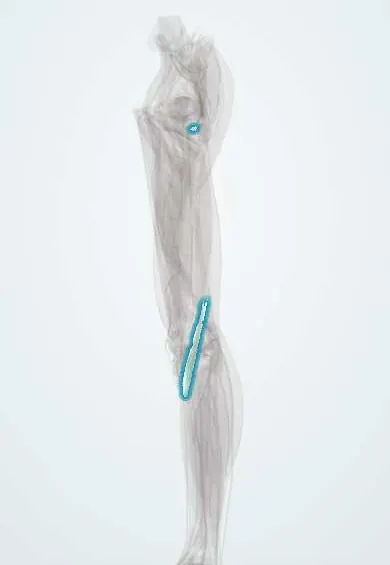
Semitendinosus tendon !
The semitendinosus tendon is a long, round hamstring tendon on the inner back of the knee; it is a common graft to rebuild the ACL.
Official name: Tendon of semitendinosus
Opens in the Durgical app, no sign-up needed.
What it is
A long, thin hamstring tendon on the inner back of the knee, ending on the inner tibia.
What it does
Helps bend the knee and turn the shin inward; supports the knee from the inner side.
Key facts
- Attaches
- Long round tendon (lower half of the muscle) to the pes anserinus on the upper medial tibia, the lowest and most posterior of the three
- Function
- Knee flexion and medial rotation; hip extension; the most used hamstring graft for ACL reconstruction
- Tight in
- Hip flexion with the knee extended (straight-leg raise)
Relations
- Course
- Lies on the semimembranosus down the back of the thigh, becomes tendinous in the lower thigh, passes behind the medial femoral condyle and curves forward to the pes anserinus
- Deep
- Semimembranosus, on which it lies for most of its length
- Above
- Gracilis tendon, just above it at the pes anserinus
- Lateral
- Popliteal fossa, with the tibial nerve, popliteal artery and popliteal vein
- Superficial
- Sartorius aponeurosis at the insertion; fascia and skin higher up
How to find it
Prone, with the knee bent against resistance, it is the sharp cord at the back of the inner knee; the semimembranosus is felt as a broader, softer mass on either side of it and deeper.
On imaging
On MRI or ultrasound after harvest, a new tendon-like structure often regrows along the old path over months; it is not the same as normal tendon.
Common problems
- Strains or tendinitis, mostly in sports with sprinting or kicking.
- It is one of the most common graft sources for ACL reconstruction; the leg usually adapts well.
How it is diagnosed
Physical exam; ultrasound or MRI if needed.
Treatment
- Rest, ice and progressive physical therapy.
- Used as a tendon graft in ACL reconstruction.
Clinical notes
- Harvest can injure the saphenous nerve or its infrapatellar branch, so the incision and the stripper path are planned with them in mind
- Distal ruptures are uncommon, mostly in sprinters; most hamstring injuries are higher, at the muscle–tendon junction or the proximal tendon shared with the biceps femoris
- It can snap over the back of the inner knee (snapping pes), a rare cause of medial knee snapping
Anatomical variants
- Accessory slips can join it to the gracilis (a 'double' pes anserinus) or end in the crural fascia
Related conditions
Test yourself
Think of the answer, then tap the question to see it.
Why is the semitendinosus the first-choice hamstring autograft for ACL reconstruction?
Its tendon is long and round, and it is often folded into four strands.
What must be cut before stripping the semitendinosus tendon, and why?
Accessory bands to the fascia of the medial head of gastrocnemius; otherwise the stripper cuts the graft short.
Which border of the popliteal fossa does the semitendinosus form?
The upper medial border, with the semimembranosus.
Educational information, not medical advice. For any symptom, see a health professional.
Its names
- Official Latin (TA2)
- musculus semitendinosus TA2 2641
- Official Spanish (DeCS)
- Tendón del semitendinoso DeCS D013710
- English (TA2)
- Tendon of semitendinosus
- Also called
- musculus semitendineus
Related
Sources: Terminologia Anatomica (TA2); DeCS; Anatomy, Bony Pelvis and Lower Limb: Thigh Semitendinosus Muscle; Anatomy, Bony Pelvis and Lower Limb, Hamstring Muscle.
Spotted a mistake?We are always improving for the community. Tell us what is wrong and our team will review it.Report a mistake
Representative model, for educational purposes only.