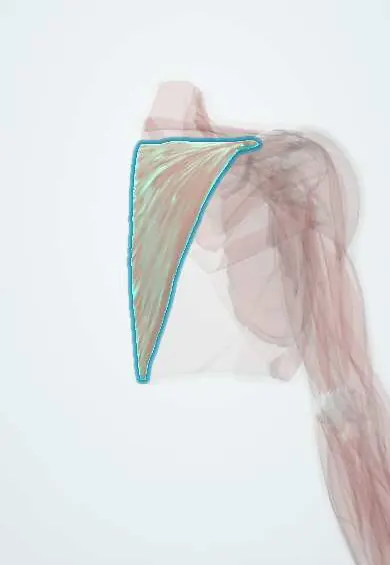
Lower trapezius !
The lower trapezius rises from the mid back to the shoulder blade; it pulls it down and helps rotate it upward for overhead reach.
Official name: Trapezius, lower (ascending) part
Opens in the Durgical app, no sign-up needed.
What it is
The lower part of the trapezius, from the mid-back to the spine of the shoulder blade.
What it does
Pulls the shoulder blade down and helps rotate it upward for overhead reach.
Key facts
- Origin
- Spinous processes T4–T12
- Insertion
- Medial end of the spine of the scapula
- Action
- Depresses and upwardly rotates the scapula
- Nerve
- Accessory nerve (CN XI)
- Blood supply
- Transverse cervical artery, posterior intercostal arteries
Relations
- Superficial
- Skin of the mid-back
- Deep
- Rhomboid major, the upper part of the latissimus dorsi and the erector spinae
- Below
- Latissimus dorsi, which forms the lower border of the triangle of auscultation
- Lateral
- The medial end of the spine of the scapula, where its tendon glides over a smooth triangular area with a small bursa
How to find it
Lying prone with the arm raised diagonally overhead in line with the fibres (a 'Y' position), lifting the arm off the table tightens the oblique band from the lower thoracic spines to the root of the spine of the scapula.
Examination
- Manual muscle test in the 'Y' position: weakness, with the scapula riding up and tipping forward, points to CN XI injury or poor scapular control
- Scapular assistance test: the examiner helps the scapula rotate upward and tilt back as the arm is raised; less pain suggests scapular dyskinesis contributes to the shoulder pain
On imaging
On axial CT or MRI of the mid-thorax it is a thin superficial layer over the paraspinal muscles and the upper edge of the latissimus dorsi. It is assessed with the rest of the trapezius: atrophy and fatty change after accessory nerve injury. Before a lower trapezius transfer, MRI or ultrasound checks that the muscle is healthy.
Clinical notes
- The triangle of auscultation widens when the scapula is pulled forward (arms folded, trunk bent forward); it is a thin spot of the back wall used for listening and for some muscle-sparing approaches to the chest
- Lower trapezius transfer, lengthened with a graft to the greater tubercle, is used to restore external rotation when the infraspinatus cannot be repaired
- As a pedicled flap it rotates on branches of the transverse cervical artery (some texts: the dorsal scapular artery) to cover defects of the posterior neck and skull
Related conditions
Test yourself
Think of the answer, then tap the question to see it.
What are the borders of the triangle of auscultation?
The lateral edge of the lower trapezius, the latissimus dorsi below and the medial border of the scapula laterally.
Which muscles form the force couple that rotates the scapula upward?
The lower trapezius, the upper trapezius and the serratus anterior.
What is the lower trapezius transferred for?
For irreparable posterosuperior rotator cuff tears: lengthened with a graft to the greater tubercle, it restores external rotation.
Educational information, not medical advice. For any symptom, see a health professional.
Its names
- Official Latin (TA2)
- pars ascendens musculi trapezii TA2 2229
- Official Spanish (DeCS)
- Porción ascendente del músculo trapecio
- English (TA2)
- Trapezius, lower (ascending) part
Related
Sources: Terminologia Anatomica (TA2); Anatomy, Back, Trapezius.
Spotted a mistake?We are always improving for the community. Tell us what is wrong and our team will review it.Report a mistake
Representative model, for educational purposes only.