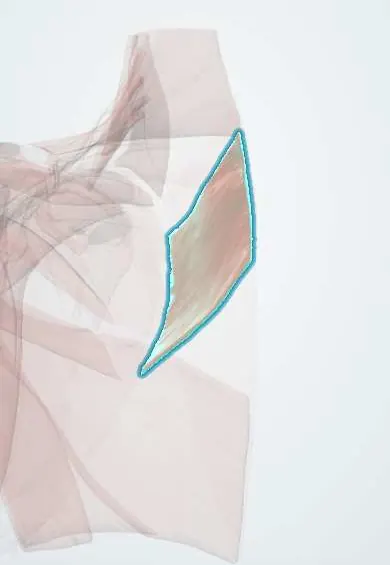
Rhomboid major !
The rhomboid major is a flat muscle between the upper spine and the inner edge of the shoulder blade; it pulls the shoulder blade toward the spine.
Opens in the Durgical app, no sign-up needed.
What it is
A flat muscle from the upper back spine to the inner edge of the shoulder blade.
What it does
Pulls the shoulder blade toward the spine.
Key facts
- Origin
- Spinous processes T2–T5
- Insertion
- Medial border of the scapula below the spine
- Action
- Retracts the scapula, rotates the glenoid down
- Nerve
- Dorsal scapular nerve (C4–C5)
- Blood supply
- Dorsal scapular artery
Relations
- Superficial
- Middle trapezius and lower trapezius
- Deep
- Serratus posterior superior, the erector spinae and the posterior ribs; the dorsal scapular nerve and artery near the scapula
- Above
- Rhomboid minor, often separated only by a thin fascial cleft
- Below
- Latissimus dorsi; the triangle of auscultation opens at its lower lateral corner
How to find it
With the back of the hand resting on the lower back, pushing the hand away from the back against resistance makes the rhomboids contract under the trapezius, felt as an oblique band along the medial border of the scapula.
Examination
- Rhomboid test (hand on the lower back, pushing backward against resistance): weakness, with the medial border of the scapula drifting away from the spine, points to the dorsal scapular nerve or the C5 root
On imaging
Axial CT or MRI shows it deep to the trapezius, between the spinous processes and the medial border of the scapula. Imaging is seldom needed: MRI shows a strain as oedema, and atrophy points to dorsal scapular nerve injury. Ultrasound shows it as the layer between the trapezius and the ribs along the medial border of the scapula.
Clinical notes
- The dorsal scapular nerve pierces the middle scalene; compression there causes aching between the shoulder blades and mild winging
- In brachial plexus injury, normal rhomboids and serratus anterior suggest the roots are intact close to the spinal cord, which matters when nerve repair or transfer is planned
- Isolated rhomboid palsy is rare and gives subtle winging, easy to miss beside the more obvious serratus anterior and trapezius patterns
Anatomical variants
- The two rhomboids are sometimes fused into one sheet; rarely an extra rhomboid muscle is found
Development
Like the levator scapulae and serratus anterior, the rhomboids arise from premuscle tissue at lower cervical levels and migrate onto the back, keeping their cervical nerve, the dorsal scapular nerve (C5).
Related conditions
Test yourself
Think of the answer, then tap the question to see it.
What nerve supplies the rhomboid major, and where does it run?
The dorsal scapular nerve (C5), with its artery, on the deep surface of the muscle along the medial border of the scapula.
In a brachial plexus injury, what does rhomboid major weakness mean?
A lesion close to the spinal cord, because the dorsal scapular nerve comes straight off the C5 root.
Where can the dorsal scapular nerve be compressed, and with what symptoms?
Where it pierces the middle scalene; aching between the shoulder blades and mild winging.
Educational information, not medical advice. For any symptom, see a health professional.
Its names
- Official Latin (TA2)
- musculus rhomboideus major TA2 2232
- Official Spanish (DeCS)
- Músculo romboides mayor
- English (TA2)
- Rhomboid major
Related
Sources: Terminologia Anatomica (TA2); Anatomy, Back, Rhomboid Muscles; Anatomy of the Human Body (20th ed.): Development of the Muscles (Lea & Febiger (Gray's Anatomy, 1918), 1918) · adapted, Public domain.
Spotted a mistake?We are always improving for the community. Tell us what is wrong and our team will review it.Report a mistake
Representative model, for educational purposes only.