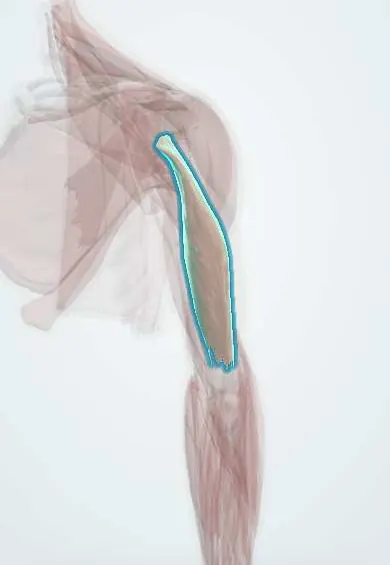
Triceps (long head) !
The long head of the triceps starts on the shoulder blade below the socket; it straightens the elbow and helps pull the arm back.
Official name: Triceps brachii, long head
Opens in the Durgical app, no sign-up needed.
What it is
The head of the triceps that starts below the shoulder socket.
What it does
Straightens the elbow and helps pull the arm back.
Key facts
- Origin
- Infraglenoid tubercle of the scapula
- Insertion
- Olecranon
- Action
- Extends the elbow; extends and adducts the arm
- Nerve
- Radial nerve (C6–C8)
- Blood supply
- Deep brachial artery
Relations
- Course
- From the infraglenoid tubercle it descends in front of the teres minor and behind the teres major, then down the medial part of the back of the arm to the triceps tendon
- Superficial
- Rear deltoid above, then skin and the brachial fascia of the back of the arm
- Deep
- Triceps (medial head) and the radial nerve with the deep brachial artery entering the radial groove
- Lateral
- Triceps (lateral head); higher up, the quadrangular space with the axillary nerve and posterior circumflex humeral vessels
How to find it
With the arm pulled backward and the elbow straightened against resistance, the long head forms the medial bulge on the back of the arm, running up into the armpit below the rear deltoid.
Examination
- Triceps reflex (arm supported, tendon tapped just above the olecranon): a reduced reflex points mainly to the C7 root (some texts C6–C8) or the radial nerve; a brisk one suggests an upper motor neuron lesion
- Resisted elbow extension with the arm overhead: weakness points to C7 or a high radial nerve lesion
On imaging
On axial and sagittal oblique MRI its origin at the infraglenoid tubercle sits just below the glenoid and blends with the inferior capsule; it separates the quadrangular space (lateral) from the triangular space (medial), a landmark when these spaces are assessed. Injuries at its origin are uncommon and show on MRI as oedema or a gap. Radiographs are usually normal.
Clinical notes
- Crutch palsy and other compressions in the axilla weaken the triceps as well as the wrist extensors; midshaft humerus lesions usually spare it
- The spaces it divides guide posterior shoulder surgery and the diagnosis of quadrangular space syndrome
Anatomical variants
- A fourth head is rare; when present it has been linked to compression of the radial or ulnar nerve
Development
All three heads come from the dorsal (extensor) muscle mass of the arm and so share the radial nerve, a branch of the posterior cord; the long head is the only one that crosses the shoulder.
Memory aid
Reflex roots: 'five, six, pick up sticks' (biceps, C5–C6); 'seven, eight, lay them straight' (triceps, mainly C7).
Related conditions
Test yourself
Think of the answer, then tap the question to see it.
Which spaces does the long head of triceps divide?
Between teres minor and teres major: the quadrangular space lies lateral to it and the triangular space medial.
Why does a radial groove fracture spare the long head of triceps, while a high axillary lesion weakens it?
Its nerve leaves the radial nerve high in the axilla, above the radial groove.
Which root does the triceps reflex mainly test?
C7 (some texts C6–C8), through the radial nerve.
Educational information, not medical advice. For any symptom, see a health professional.
Its names
- Official Latin (TA2)
- caput longum musculi tricipitis brachii TA2 2472
- Official Spanish (DeCS)
- Cabeza larga del músculo tríceps braquial
- English (TA2)
- Triceps brachii, long head
Related
Sources: Terminologia Anatomica (TA2); Anatomy, Shoulder and Upper Limb, Triceps Muscle.
Spotted a mistake?We are always improving for the community. Tell us what is wrong and our team will review it.Report a mistake
Representative model, for educational purposes only.