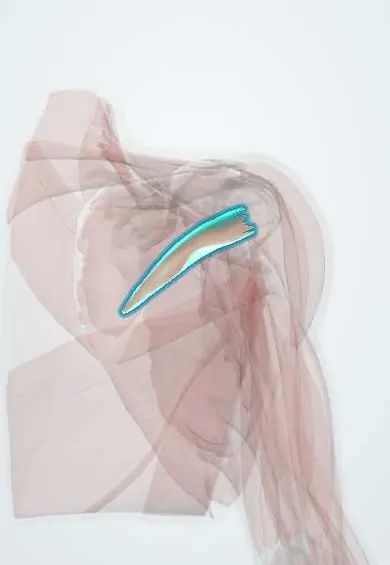
Teres minor !
The teres minor is a small rotator cuff muscle along the outer edge of the shoulder blade; it helps turn the arm outward.
Opens in the Durgical app, no sign-up needed.
What it is
A small rotator cuff muscle at the back of the shoulder; it turns the arm outward.
What it does
Turns the arm outward.
Key facts
- Origin
- Upper two thirds of the lateral border of the scapula
- Insertion
- Inferior facet of the greater tubercle
- Action
- Laterally rotates the arm
- Nerve
- Axillary nerve (C5–C6)
- Blood supply
- Circumflex scapular artery, posterior circumflex humeral artery
Relations
- Above
- Infraspinatus, from which it may be hard to separate
- Below
- Teres major, with the triceps (long head) passing between the two to divide the quadrangular space from the triangular space
- Superficial
- Rear deltoid
- Deep
- Posterior shoulder capsule; the circumflex scapular artery winds round the lateral border of the scapula close to its origin
How to find it
Along the upper part of the lateral border of the scapula, below the infraspinatus and above the teres major, it is felt under the lower edge of the rear deltoid as a small rounded band when the arm is turned outward against resistance.
Examination
- Hornblower's sign: arm at 90° in the plane of the scapula and elbow at 90°, external rotation is resisted; inability to hold the position (or bringing the hand to the mouth only by lifting the elbow) points to teres minor loss in a large cuff tear
On imaging
Best seen on sagittal oblique MRI, the lowest of the posterior cuff muscles, below the infraspinatus. Isolated atrophy and fatty change of the teres minor is the classic MRI sign of quadrilateral space syndrome or axillary nerve injury. Its fatty change predicts a poorer result after cuff repair. Ultrasound shows its tendon behind the greater tuberosity.
Common problems
- Rotator cuff tear, partial or full, from wear with age or from a fall; the most common cause of shoulder weakness.
- Tendinopathy and impingement: pain lifting the arm and at night.
- Calcific tendinitis: calcium deposits that cause sudden severe pain.
How it is diagnosed
Weakness and pain on cuff tests (for example the empty-can test). Ultrasound or MRI shows the tear size and muscle quality.
Treatment
- Physical therapy, pain medicines and sometimes injections, especially for partial and age-related tears.
- Arthroscopic rotator cuff repair with suture anchors for many full-thickness tears, especially recent ones in active people.
- Reverse shoulder replacement for large, irreparable tears with arthritis.
Clinical notes
- Isolated teres minor atrophy on MRI suggests compression of the axillary nerve branch in the quadrangular space
- After axillary nerve injury its weakness is masked by the intact infraspinatus
- Fatty change of the teres minor predicts poorer external rotation after reverse shoulder replacement
Anatomical variants
- May be fused with the infraspinatus
Development
Belongs to the dorsal (extensor) muscle mass of the limb bud, which is why its nerve, the axillary, comes from the posterior cord like the nerves of the deltoid and triceps.
Memory aid
The minor is in the cuff, the major is not: teres minor is part of SITS, teres major is not a cuff muscle.
Related conditions
Test yourself
Think of the answer, then tap the question to see it.
Which rotator cuff muscle is supplied by the axillary nerve?
The teres minor (posterior branch of the axillary nerve), not the suprascapular nerve like the infraspinatus.
What is the hornblower's sign, and what does it indicate?
Arm at 90° in the scapular plane and elbow at 90°, external rotation is resisted; failure to hold it points to teres minor loss in a large cuff tear.
Which two spaces does the teres minor border from above?
The quadrangular space (axillary nerve, posterior circumflex humeral vessels) and the triangular space (circumflex scapular artery).
Educational information, not medical advice. For any symptom, see a health professional.
Its names
- Official Latin (TA2)
- musculus teres minor TA2 2459
- Official Spanish (DeCS)
- Músculo redondo menor
- English (TA2)
- Teres minor
Related
Sources: Terminologia Anatomica (TA2); Anatomy, Shoulder and Upper Limb, Teres Minor Muscle; Anatomy, Rotator Cuff.
Spotted a mistake?We are always improving for the community. Tell us what is wrong and our team will review it.Report a mistake
Representative model, for educational purposes only.