Joints and ligaments · Upper limb
Volar plates (fingers) !
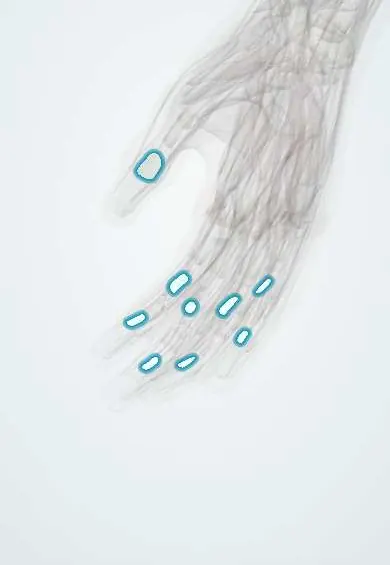
The volar plates of the fingers are thick pads on the palm side of the finger joints; they stop the joints bending backward.
Official name: Volar (palmar) plates of the interphalangeal joints
Opens in the Durgical app, no sign-up needed.
What it is
Thick pads on the palm side of the finger joints.
What it does
Stop the finger joints bending backward.
Key facts
- Attaches
- Base of the middle/distal phalanx, anchored proximally by check-rein ligaments
- Function
- Prevent hyperextension of the finger joints
- Tight in
- Extension: splint PIP joints straight
Relations
- In front
- Flexor tendon sheath: the A3 pulley over the PIP plate and A5 over the DIP plate, with the FDS tendons and FDP tendons
- Behind
- Joint space and the head of the proximal or middle phalanx
- Lateral
- Accessory collateral ligaments inserting along its edges; the digital nerves and digital arteries further out
How to find it
Not felt directly; it lies under the palmar PIP crease, deep to the flexor tendons. After a hyperextension injury, tenderness is greatest over the front of the joint and at the base of the middle phalanx rather than on its sides.
Examination
- Hyperextension stress of the PIP joint: pain and more hyperextension than in the other fingers suggest a volar plate tear
- Active range after a digital block: smooth, congruent movement means a stable injury; redisplacement as the finger extends means instability
On imaging
A true lateral of the single finger shows a small fragment at the palmar base of the middle phalanx and the V sign: a V-shaped gap at the back of the joint instead of parallel surfaces, which signals dorsal subluxation.
Common problems
- Jammed finger: the middle (PIP) joint is bent backward and the volar plate tears, sometimes with a small bone chip.
- Swan-neck deformity can follow a loose volar plate; a stiff, swollen joint is common for months.
How it is diagnosed
Exam of tenderness and stability; X-rays look for a fragment and for joint alignment.
Treatment
- Buddy taping or a splint that blocks straightening, then early motion.
- Surgery for large fractures or an unstable joint.
Clinical notes
- PIP dorsal dislocation, the commonest finger dislocation, tears the volar plate
- Unstable dorsal fracture-dislocations may be managed with extension-block splinting, fixation, volar plate arthroplasty or hemi-hamate grafting
Related conditions
Test yourself
Think of the answer, then tap the question to see it.
How is the PIP volar plate attached?
Thick and firmly fixed distally to the base of the middle phalanx; thin proximally, where check-rein ligaments tether it.
Which common finger dislocation tears the PIP volar plate?
The PIP dorsal dislocation, the commonest finger dislocation, usually from hyperextension.
What deformity can a lax PIP volar plate produce?
Swan-neck: the PIP hyperextends, the lateral bands slip dorsally and the DIP falls into flexion.
What is a pseudo-boutonnière deformity?
A fixed PIP flexion contracture from scarred check-rein ligaments of the volar plate, with a normal DIP joint.
Educational information, not medical advice. For any symptom, see a health professional.
Its names
- Official Latin (TA2)
- ligamenta interphalangea palmaria TA2 1844
- Official Spanish (DeCS)
- Ligamentos palmares interfalángicos
- English (TA2)
- Volar (palmar) plates of the interphalangeal joints
- Also called
- volar plate · palmar plate · Palmar interphalangeal ligaments
Related
- Finger collateral ligaments
- Distal phalanx, thumb
- Distal phalanx, index finger
- Distal phalanx, middle finger
- Distal phalanx, ring finger
- Distal phalanx, little finger
- Middle phalanx, index finger
- Middle phalanx, middle finger
Sources: Terminologia Anatomica (TA2); Anatomy, Shoulder and Upper Limb, Metacarpophalangeal Joints.
Spotted a mistake?We are always improving for the community. Tell us what is wrong and our team will review it.Report a mistake
Representative model, for educational purposes only.