Nervous system · Head and neck
Pons !
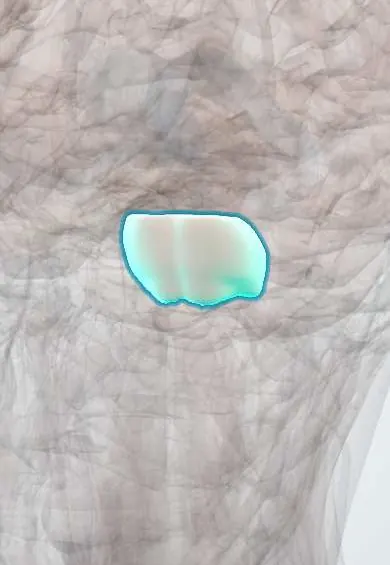
The pons is the bulging middle part of the brainstem, in front of the cerebellum; it relays signals to the cerebellum and holds breathing centres.
Opens in the Durgical app, no sign-up needed.
What it is
The bulging middle part of the brainstem, in front of the cerebellum.
What it does
Relays signals to the cerebellum; holds the nuclei of nerves V to VIII and breathing centres.
Key facts
- Where
- Middle brainstem, in front of the cerebellum
- Blood supply
- Basilar paramedian and short circumferential branches; AICA (lower lateral pons); superior cerebellar artery (upper lateral and dorsal pons)
- Function
- Nuclei of V-VIII; relay to the cerebellum; breathing control
Relations
- In front
- Basilar artery in or beside the basilar groove (the groove is shaped by the corticospinal ridges, and the artery often curves off the midline), the prepontine cistern and the clivus
- Behind
- Upper half of the floor of the fourth ventricle, then the cerebellum
- Lateral
- Middle cerebellar peduncles; the trigeminal nerve emerges on the side, and the facial and vestibulocochlear nerves at the cerebellopontine angle below
- Above
- Midbrain
- Below
- Medulla oblongata at the pontomedullary junction, where the abducens, facial and vestibulocochlear nerves emerge
How to find it
The bulging front of the brainstem between midbrain and medulla, resting on the clivus, with the basilar artery in the shallow groove down its middle. The trigeminal nerve leaves its side; the abducens, facial and vestibulocochlear nerves leave the groove at its lower border. Its back forms the upper half of the floor of the fourth ventricle.
Examination
- Corneal reflex: sensory limb in the trigeminal nerve, motor limb in the facial nerve, both relayed in the pons; loss on both sides is one of the brainstem reflexes tested for brain death
- Oculocephalic (doll's eyes) and cold caloric tests in a comatose patient: preserved reflex eye movements show that the vestibular nuclei, medial longitudinal fasciculus and eye-movement nuclei still work
On imaging
MRI is far better than CT in the posterior fossa. Osmotic demyelination shows as a T2-bright trident or bat-wing area in the central pons, sparing the edges; a cross-shaped line ('hot cross bun') suggests multiple system atrophy.
Clinical notes
- Millard–Gubler syndrome: a ventral caudal pontine lesion gives abducens and facial palsy on the same side with weakness of the opposite arm and leg
- Internuclear ophthalmoplegia: a lesion of the medial longitudinal fasciculus (multiple sclerosis in the young, stroke in the old) stops the eye on that side from adducting on lateral gaze
- Paramedian basilar branches supply the base of the pons (corticospinal fibres, pontine nuclei, medial lemniscus) but not the floor of the fourth ventricle, which is why a ventral infarct can leave the person awake with vertical gaze and blinking (locked-in)
Development
Comes from the metencephalon, the upper part of the hindbrain vesicle, which also forms the cerebellum; this shared origin fits the large pontine fibre bundles that run into the cerebellum.
Related conditions
- Respiratory alkalosis
- Leigh syndrome
- Intracerebral haemorrhage
- Coma and brain death
- Brainstem stroke syndromes (Wallenberg and others)
- Osmotic demyelination syndrome (central pontine myelinolysis)
- Multiple system atrophy (MSA)
- Spinocerebellar ataxias (autosomal dominant ataxias)
- REM sleep behaviour disorder (RBD)
- Opioid use disorder, overdose and withdrawal
- Serotonin syndrome
Test yourself
Think of the answer, then tap the question to see it.
What is locked-in syndrome?
Basilar artery occlusion infarcts the ventral pons; the person is awake but cannot move or speak, keeping only blinking and vertical eye movements.
What causes central pontine myelinolysis?
Too-rapid correction of long-standing low sodium, which strips myelin in the centre of the pons: quadriparesis and trouble speaking and swallowing.
What is the facial colliculus, and what does a lesion there cause?
Facial nerve fibres looping around the abducens nucleus in the floor of the fourth ventricle; a lesion gives a facial palsy and a gaze palsy on the same side.
What are the signs of a pontine haemorrhage?
Sudden coma, pinpoint pupils and paralysis of all four limbs.
Educational information, not medical advice. For any symptom, see a health professional.
Its names
- Official Latin (TA2)
- pons TA2 5921
- Official Spanish (DeCS)
- Puente DeCS D011149
- English (TA2)
- Pons
- Also called
- Protuberancia
Related
Sources: Terminologia Anatomica (TA2); DeCS; Neuroanatomy, Pons; 13.1 The Embryologic Perspective (OpenStax (Rice University), 2022) · adapted, CC BY 4.0; 13.2 The Central Nervous System (OpenStax (Rice University), 2022) · adapted, CC BY 4.0; Tratado de anatomía humana (9.ª ed.), tomo II, Libro V, sección 2 (Encéfalo), capítulos I-V: bulbo, protuberancia, cerebelo, cuarto ventrículo, mesencéfalo.
Spotted a mistake?We are always improving for the community. Tell us what is wrong and our team will review it.Report a mistake
Representative model, for educational purposes only.