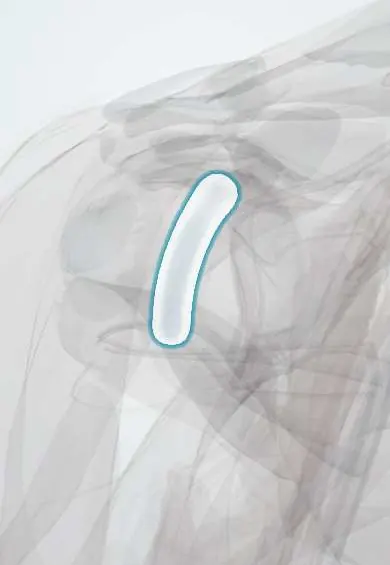
Biceps tendon rupture !
A biceps tendon rupture is a tear of the biceps tendon at the shoulder or at the elbow; a tear at the elbow weakens turning the palm up.
Updated 2026-10-29
Structures involved
Tap one to see what it is and open it in 3D.
- Biceps (long head)
- Biceps (short head)
- Biceps tendon sheath
- Radius
- Bicipitoradial bursa
- Transverse humeral ligament
- Brachialis
- Supinator
- Lateral forearm skin nerve
Why it happens
What it is
Tear of a tendon of the biceps brachii, either proximally at the shoulder (almost always the long head) or distally at the elbow, where the tendon inserts on the radial tuberosity. Proximal ruptures are far more common; distal ruptures cause more weakness, mainly of supination.
Who gets it
Proximal long-head ruptures occur mostly in people over about 50 with degenerative shoulder disease. Distal ruptures typically affect men in middle age, usually in the dominant arm, during heavy lifting.
Causes
- Proximal: degeneration of the long-head tendon with rotator cuff disease or impingement, often after minor effort
- Distal: sudden eccentric load on a flexed elbow, as when catching or lowering a heavy weight
Risk factors
- Age and tendon degeneration
- Rotator cuff tear or subacromial impingement (proximal)
- Male sex, smoking and anabolic steroid use (distal)
- Heavy lifting, weight training and manual labour
- Previous corticosteroid injections near the tendon
Pathophysiology
The long-head tendon runs in the bicipital groove and wears with rotator cuff disease until it fails; the intact short head preserves some function. The distal tendon has a poorly perfused zone near the radial tuberosity and ruptures under a forceful eccentric contraction; the muscle then retracts unless the bicipital aponeurosis holds it.
Classification
- Proximal (long head; short head rarely)
- Distal: partial or complete; with or without an intact bicipital aponeurosis
Symptoms and signs
- Sudden pain and sometimes a pop at the shoulder or elbow
- Bruising in the arm or antecubital fossa
- Proximal: bulge of the retracted muscle in the lower arm (Popeye sign), often with mild weakness
- Distal: proximal retraction of the muscle (reverse Popeye), weakness of supination and, to a lesser degree, of elbow flexion
Diagnosis
- Clinical
- Proximal: Popeye deformity and tenderness in the bicipital groove. Distal: the hook test is positive when the examiner cannot hook a finger under the tendon from the lateral side; supination weakness is common.
- Tests
- Not usually needed.
- Imaging
- Ultrasound or MRI confirm the tear, whether it is partial or complete, and how far the tendon has retracted; X-rays exclude a bony avulsion or fracture.
Differential diagnosis
- Rotator cuff tear
- Partial distal biceps tear or bicipitoradial bursitis
- Brachialis strain
- SLAP (superior labral) lesion
- Soft-tissue mass of the arm
Goal of treatment
Relieve pain and restore strength and function suited to the patient's needs; for distal ruptures in active people, re-attach the tendon early to recover supination strength.
Treatment
- Conservative
- Proximal long-head rupture: most are treated without surgery, with rest, cold, analgesics and nonsteroidal anti-inflammatory drugs.
- Rehabilitation
- Physiotherapy for range of motion and strengthening; loss of strength after a proximal rupture is usually small.
- Surgical
- Proximal rupture: tenodesis is considered for young, active or manual workers, cosmetic concerns or persistent cramping, often with treatment of rotator cuff disease.
- Surgical
- Distal rupture: anatomic re-attachment to the radial tuberosity, ideally within the first few weeks; late cases may need tendon grafting.
- Conservative
- Distal rupture in low-demand patients: non-operative care is an option, accepting lasting weakness of supination and flexion.
Complications
- Loss of supination and flexion strength and endurance (distal, untreated)
- Cramping or fatigue of the arm
- Cosmetic deformity
- After distal repair: lateral antebrachial cutaneous or posterior interosseous nerve injury, heterotopic ossification, re-rupture
Prognosis
Proximal ruptures generally leave good function with a visible bulge. After early distal repair most patients regain near-normal strength; untreated distal ruptures leave a lasting loss of supination strength.
Prevention
- Gradual progression in weight training
- Treating rotator cuff and impingement disease
- Avoiding anabolic steroids and smoking
Test yourself
Think of the answer, then tap the question to see it.
Which head of the biceps is involved in most proximal biceps tendon ruptures?
The long head, usually with degenerative rotator cuff or impingement disease.
What is the hook test used for?
To detect a complete distal biceps tendon rupture: the examiner cannot hook a finger under the tendon from the lateral side of the elbow.
Which motion is weakest after a distal biceps tendon rupture?
Supination of the forearm; elbow flexion is also weakened, though less, because the brachialis helps.
What is the Popeye sign?
A bulge in the lower arm from distal retraction of the biceps muscle after a long-head rupture.
Why is early repair favoured for a distal biceps rupture in an active patient?
The tendon retracts and scars over time, making anatomic re-attachment harder and sometimes requiring a graft.
Related conditions
Educational information, not medical advice. For any symptom, see a health professional.
Sources: Biceps Tendon Rupture (StatPearls (NCBI Bookshelf), 2023).
Spotted a mistake?We are always improving for the community. Tell us what is wrong and our team will review it.Report a mistake
Representative model, for educational purposes only.