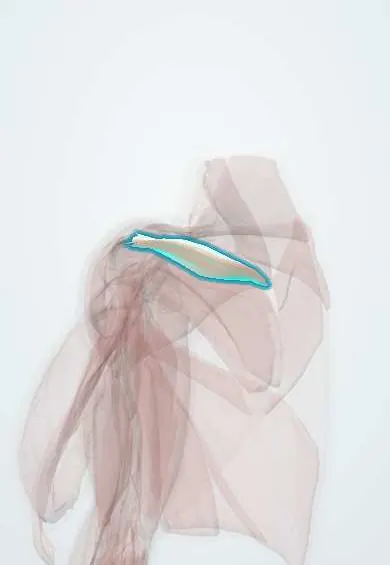
Rotator cuff tear !
A rotator cuff tear is a partial or full tear of a shoulder tendon, most often the supraspinatus; it causes pain and weakness when raising the arm.
Updated 2026-10-29
Structures involved
Tap one to see what it is and open it in 3D.
- Supraspinatus
- Infraspinatus
- Subscapularis
- Teres minor
- Subacromial bursa
- Coracoacromial ligament
- Humerus
- Scapula
- Biceps (long head)
- Suprascapular nerve
In histology
In the clinical exam
Why it happens
- Connective tissue proper: cells and fibres
- Extracellular matrix: collagen types, elastin, ground substance
What it is
A partial or full-thickness tear of one or more rotator cuff tendons, most often the supraspinatus. It causes shoulder pain and weakness, especially when raising the arm.
Who gets it
Becomes more common with age; many tears in older adults are degenerative and some cause no symptoms. Acute tears occur in younger people after trauma or sport.
Causes
- Degenerative tendon wear with age
- Acute trauma: fall on the arm or shoulder dislocation
- Repetitive overhead activity
- Subacromial impingement contributing to tendon damage
Risk factors
- Age over about 40 to 50
- Overhead work or sports
- Smoking
- Diabetes and hypercholesterolaemia
- Previous corticosteroid injections
- Family history
Pathophysiology
The cuff tendons stabilise the humeral head in the glenoid while the deltoid lifts the arm. With age, blood supply near the supraspinatus insertion falls and the tendon degenerates, so it can fail under ordinary loads or minor trauma. A large tear lets the humeral head ride up, and long-standing tears lead to muscle atrophy, fatty infiltration and retraction.
Classification
- Partial-thickness (bursal side, articular side or intratendinous) or full-thickness
- Acute traumatic or chronic degenerative
- By size and number of tendons involved (small to massive; systems vary)
Symptoms and signs
- Lateral shoulder pain, often spreading to the deltoid area
- Night pain, especially lying on the affected side
- Painful arc on abduction
- Weakness raising or rotating the arm
- Loss of active movement with relatively preserved passive movement
Diagnosis
- Clinical
- Painful arc. Supraspinatus: empty-can (Jobe) test and drop-arm sign. Infraspinatus/teres minor: weak external rotation, external rotation lag sign. Subscapularis: lift-off and belly-press tests.
- Tests
- Laboratory tests are not needed unless infection or inflammatory arthritis is suspected.
- Imaging
- X-ray to look for a high-riding humeral head, arthritis or a fracture. Ultrasound or MRI shows the tear, its size and muscle quality; MR arthrography for some partial tears.
Differential diagnosis
- Subacromial impingement or bursitis
- Frozen shoulder (adhesive capsulitis)
- Glenohumeral or acromioclavicular osteoarthritis
- Calcific tendinitis
- Cervical radiculopathy (C5)
- Suprascapular nerve entrapment
Goal of treatment
Relieve pain, restore strength and function, and in suitable patients repair the tendon before the muscle degenerates.
Treatment
- Conservative
- Activity modification and a short period of relative rest; many degenerative tears are managed without surgery.
- Medical
- Analgesics and NSAIDs; a subacromial corticosteroid injection may help pain in selected patients.
- Rehabilitation
- Physiotherapy to strengthen the remaining cuff and scapular muscles and restore range of motion.
- Surgical
- Arthroscopic or open tendon repair for acute traumatic tears and for symptomatic tears in active patients; options for massive irreparable tears include tendon transfer or reverse shoulder arthroplasty.
Complications
- Tear progression and muscle atrophy
- Retear after repair
- Shoulder stiffness
- Cuff tear arthropathy
Prognosis
Many patients improve with physiotherapy. Repair gives good results in most cases, but healing is less reliable in older patients, large tears and tears with muscle fatty infiltration.
Prevention
- Scapular and rotator cuff strengthening for overhead athletes and workers
- Avoiding smoking
Test yourself
Think of the answer, then tap the question to see it.
Which rotator cuff tendon is torn most often?
The supraspinatus, usually near its insertion on the greater tubercle of the humerus.
What are the four rotator cuff muscles?
Supraspinatus, infraspinatus, teres minor and subscapularis (SITS).
What does the drop-arm test show in a rotator cuff tear?
The patient cannot slowly lower the arm from about 90° of abduction; it drops, suggesting a large supraspinatus tear.
Which test assesses the supraspinatus with the arm in the scapular plane and the thumb pointing down?
The empty-can (Jobe) test: pain or weakness against downward pressure suggests supraspinatus involvement.
Which imaging studies show a rotator cuff tear?
Ultrasound or MRI; plain X-ray only shows indirect signs such as a high-riding humeral head.
Related conditions
- Subacromial impingement syndrome
- Frozen shoulder (adhesive capsulitis)
- Shoulder dislocation
- Cervical radiculopathy
- Proximal humerus fracture
- Brachial plexus injury
- Acromioclavicular joint separation
- Biceps tendon rupture
Educational information, not medical advice. For any symptom, see a health professional.
Sources: Rotator Cuff Injury (StatPearls (NCBI Bookshelf), 2023).
Spotted a mistake?We are always improving for the community. Tell us what is wrong and our team will review it.Report a mistake
Representative model, for educational purposes only.